
True urban safety in Montreal is not achieved by adding security hardware, but by architecting human behaviour through intelligent environmental design.
- Subtle cues like paving textures and strategic lighting are more effective at defining territory and deterring crime than overt barriers like fences and excessive cameras.
- Proactive maintenance and year-round programming of public spaces send a powerful “signal of care,” which naturally crowds out illicit activity.
Recommendation: Shift focus from reactive security gadgets to a structural design methodology where safety is the default, integrated outcome of a well-planned environment.
For decades, the conventional response to urban crime in Montreal has been reactive: install more cameras, erect higher fences, and flood areas with harsh lighting. This approach treats security as an overlay, a technological fix for a human problem. But as planners and developers shaping the city’s future, we must recognize the inherent limitations of this model. What if the most powerful tool for crime prevention wasn’t a piece of hardware, but the very fabric of the environment itself?
This is the core premise of Crime Prevention Through Environmental Design (CPTED). It’s a proactive methodology that uses urban planning and architectural features to influence human behaviour, making criminal acts more difficult and less likely to occur. It moves beyond the simplistic platitudes of “more surveillance” to explore the nuanced world of psychological thresholds, natural sightlines, and community ownership. This is not about building fortresses; it’s about fostering environments where safety feels inherent and effortless.
The true opportunity for Montreal lies in shifting our perspective from adding security to architecting safety. It’s about understanding that the choice between a 3000K and a 5000K light fixture isn’t just technical, it’s behavioural. It’s recognizing that the way we prune a shrub or program a public square in January is as crucial to security as a police patrol. This guide provides a structural blueprint for applying these principles, moving from micro-details to macro-systems to build a safer, more resilient Montreal by design.
This article delves into the practical application of CPTED principles within the unique context of Montreal. It provides a strategic framework for planners, developers, and civic leaders to create urban spaces that are not just secured, but inherently safe. The following sections break down key strategies, from landscaping and lighting to programming public spaces and managing large-scale events.
Summary: A CPTED Blueprint for Montreal’s Urban Fabric
- How to Prune Landscaping to Eliminate Hiding Spots Without Removing Greenery?
- Fences vs Changes in Paving: How to Define Private Space Subtly?
- 3000K vs 5000K Lighting: Which Makes Streets Feel Safer at Night?
- The “Broken Window” Theory: Why Cleaning Graffiti Within 24 Hours Matters?
- How to Program Public Squares to Crowd Out Criminal Activity?
- How to Space Bollards to Stop Cars but Allow Strollers and Wheelchairs?
- Why High Camera Density Doesn’t Always Equal Better Security in Downtown Montreal?
- Meeting Municipal Safety Standards for Large Outdoor Events in Montreal
How to Prune Landscaping to Eliminate Hiding Spots Without Removing Greenery?
Landscaping is a fundamental element of urban design, yet it’s often a double-edged sword in security. Overgrown greenery provides ideal hiding spots, compromising natural surveillance. The traditional response is often to remove it, creating sterile, uninviting landscapes. The CPTED approach, however, is one of strategic maintenance, not removal. It’s about shaping the green space to enhance visibility while preserving its aesthetic and environmental benefits. This is a core tenet of behavioural architecture: designing the environment to guide desired outcomes.
The principle is simple: “see and be seen.” Shrubs should be maintained at a height no greater than one meter, and tree canopies should be pruned up to a height of two meters from the ground. This creates a clear sightline for pedestrians and observers, eliminating potential concealment areas for criminal activity. In Montreal, it’s also crucial to remember that any pruning affecting more than 50% of a tree’s crown requires a municipal permit, ensuring that these CPTED goals are balanced with urban canopy preservation.
This strategic pruning does more than just remove hiding spots. It sends a clear “signal of care,” indicating that the property is actively managed and monitored. A well-tended landscape is less likely to be targeted for vandalism or other crimes. Winter conditions in Montreal add another layer of complexity; pruning must account for snow accumulation, which can lower branches and create new temporary hiding spots if not planned for in advance. The goal is to maintain sightlines year-round, turning greenery from a potential liability into a security asset.
Fences vs Changes in Paving: How to Define Private Space Subtly?
Defining the boundary between public and private space is a cornerstone of CPTED, known as territorial reinforcement. The most obvious tool is a fence, but physical barriers can create a fortress-like mentality, hinder community interaction, and may not even be effective. A more sophisticated approach uses subtle environmental cues to create “psychological thresholds” that people intuitively respect without feeling excluded.
Montreal’s architecture, particularly the iconic triplexes with their exterior staircases, provides a perfect canvas for this strategy. Instead of erecting fences, property lines can be demarcated through changes in ground texture. A shift from the smooth public concrete of the sidewalk to a patterned cobblestone or coloured paver at the base of a staircase clearly signals a transition to a semi-private zone. This is reinforced with low planters, decorative rocks, or a slight elevation change. These elements act as symbolic barriers that are highly effective at guiding behaviour while maintaining an open, welcoming aesthetic.
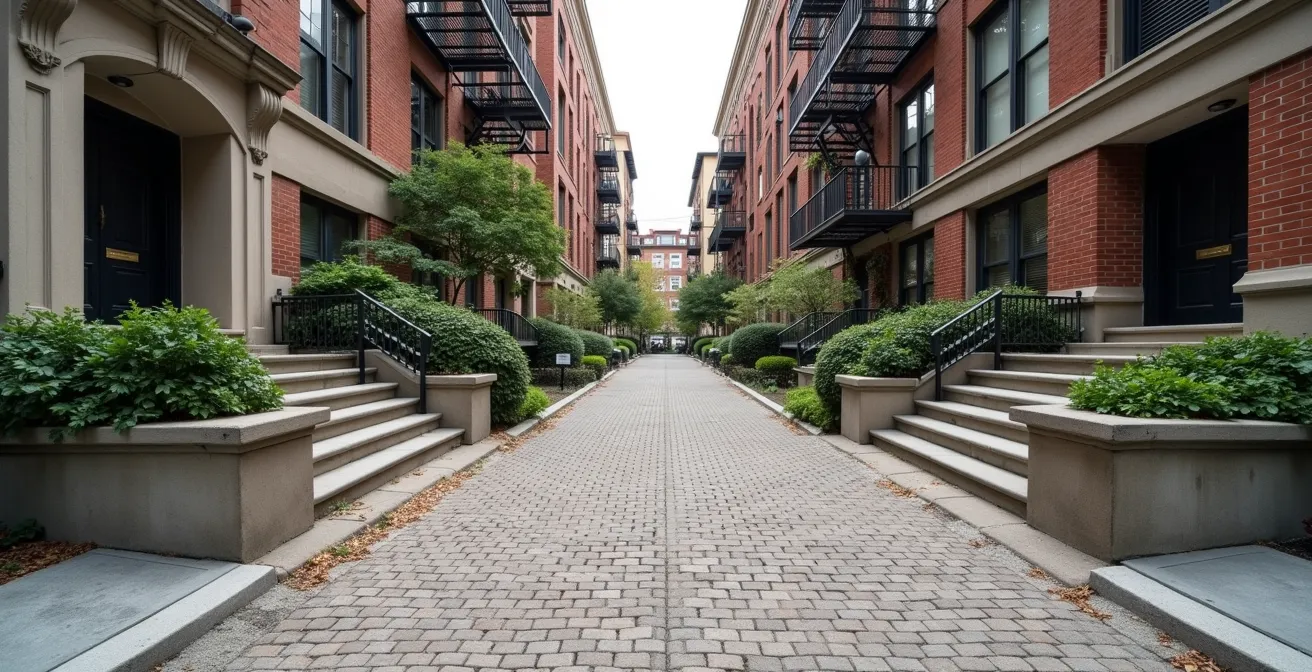
The city’s “Ruelles Vertes” (Green Alleys) program is a large-scale example of this principle in action. As noted in analyses of the program, these initiatives transform ambiguous, crime-prone back alleys into vibrant, semi-private community spaces. By using community gardens, distinctive paving stones, and murals, residents establish a sense of ownership. This increases natural surveillance and community cohesion far more effectively than installing gates or fences, demonstrating how psychological thresholds can successfully redefine and secure a space through collaborative design.
3000K vs 5000K Lighting: Which Makes Streets Feel Safer at Night?
The platitude “more light equals more safety” is dangerously simplistic. While adequate lighting is crucial for natural surveillance, the *quality* of that light is just as important as its quantity. The colour temperature of a light source, measured in Kelvin (K), has a profound psychological impact on how a space is perceived. This is the concept of ambient cohesion—creating an atmosphere that feels safe, not just one that is brightly lit. As a planner, choosing between a warm 3000K light and a cool 5000K light is a significant design decision.
A 5000K light is a stark, bluish-white light similar to daylight. It provides high contrast and clarity, making it excellent for task-oriented areas like industrial zones or transit entrances where alertness is key. However, its clinical feel can be perceived as harsh and unwelcoming in residential or recreational areas. Conversely, a 3000K light is a warmer, yellowish-white light. It creates a more calming, inviting atmosphere, often associated with residential streets and historic districts like Old Montreal. It produces softer shadows, which can be less intimidating than the sharp, dark shadows cast by high-Kelvin lights.
The following table, based on CPTED best practices, breaks down these differences, with special consideration for Montreal’s unique winter environment. A recent analysis of CPTED factors highlights how these environmental details are critical for effective crime prevention.
| Aspect | 3000K (Warm) | 5000K (Cool) | Montreal Winter Impact |
|---|---|---|---|
| Visibility | Softer shadows | Sharper contrast | Snow reflection amplifies brightness |
| Psychological Effect | Welcoming, calming | Alert, clinical | Critical for 4-5 months/year |
| Best Application | Residential, Old Port tourism areas | Metro entrances, transit zones | Consider seasonal adjustment |
| Glare on Snow | Minimal, comfortable | High, potentially harsh | Major safety consideration |
For Montreal, the high reflectivity of snow is a major factor. A 5000K light can create excessive, uncomfortable glare off a blanket of snow, effectively reducing visibility despite its high brightness. A 3000K light is often a better choice for pedestrian areas in winter, providing sufficient visibility without the harsh glare. The ideal strategy often involves a hybrid approach: using cooler temperatures for high-traffic thoroughfares and warmer temperatures for residential streets and public squares to create an environment that is both functionally lit and psychologically secure.
The “Broken Window” Theory: Why Cleaning Graffiti Within 24 Hours Matters?
The “Broken Window” theory is a foundational concept in criminology, but its application is often misunderstood. As articulated by experts at Blackbird Security, the theory states that visible signs of disorder and neglect—such as graffiti, litter, or broken fences—create an environment that encourages more serious crime. It signals that a space is unmonitored and that misconduct has no consequences. In CPTED, we reframe this as maintaining a positive “signal of care.” The goal is not just to erase neglect, but to actively broadcast that a space is valued and defended by its community.
Rapid response is the key. Removing graffiti within 24-48 hours sends a powerful message: this behaviour is not tolerated here, and this space is being watched. This swift action disrupts the feedback loop of disorder and deters future vandalism. It’s an investment in prevention that is far more cost-effective than dealing with the escalation of crime that follows. The effectiveness of this proactive maintenance is reflected in municipal data; for example, SPVM data shows a significant 22-23% annual decrease in mischief cases in recent years, a trend supported by such proactive strategies.

This principle extends beyond graffiti. It includes repairing broken benches, replacing burnt-out light bulbs, and clearing litter promptly. Each act of maintenance, no matter how small, contributes to an overall atmosphere of order and control. For planners and developers, this means integrating a robust and responsive maintenance plan into the design and budget of any project from day one. A beautifully designed park or plaza can quickly become a hub for crime if its maintenance is neglected. A strong “signal of care” is the ongoing, operational side of CPTED that ensures a well-designed space remains a safe space.
How to Program Public Squares to Crowd Out Criminal Activity?
An empty public space is a vulnerable one. The most effective way to secure a public square is to fill it with legitimate users. This CPTED principle, often called “Activity Support,” leverages positive human presence to create constant, natural surveillance. The key is strategic programming that attracts a diverse range of people at different times of the day and, crucially for Montreal, throughout all four seasons. This strategy of four-season activation is essential for transforming potentially dangerous voids into vibrant community hubs.
Montreal excels in this area, offering powerful case studies. The year-round programming at Place des Festivals, for instance, ensures a steady flow of “eyes on the street.” In winter, when many public spaces in northern cities fall dormant, Montreal activates them with events like Luminothérapie, winter markets, and outdoor ice rinks. This approach demonstrates a structural understanding that security during the city’s long winter is contingent on providing compelling reasons for people to be outside. As seen in the successful transformation of Cabot Square, integrating social and cultural programming can dramatically reduce vagrancy and illicit behaviour by replacing negative uses with positive ones.
For developers, this means thinking of a public square not as a static architectural object, but as a stage for community life. The design must be flexible, with infrastructure that supports a variety of activities: electrical hookups for market stalls, level ground for stages or rinks, and seating that can be reconfigured. Partnering with local merchants’ associations (Sociétés de développement commercial – SDC), community groups, and artists is vital to creating a sustainable and diverse calendar of events. By programming a space for continuous, positive use, we architect an environment where criminal activity is naturally crowded out.
Your Action Plan: Auditing a Public Space for CPTED Programming
- Identify Stakeholders: List all potential user groups (families, students, seniors, office workers) and key organizational partners (local SDCs, community groups) who could activate the space.
- Inventory Assets & Deficits: Collect data on existing features (lighting, seating, power access) and identify problem areas like blind spots, unused corners, and periods of inactivity (e.g., weekday afternoons).
- Assess for Coherence: Confront the current design with CPTED principles. Do pathways encourage flow? Does the seating promote social interaction or isolation? Is the space’s intended use aligned with its actual use?
- Evaluate the Space’s Identity: Does the space feel welcoming, unique, and owned by the community? Or is it anonymous and neglected? Identify elements that build a positive “signal of care” versus those that suggest disorder.
- Create an Integration Plan: Based on the audit, create a prioritized plan for interventions. This could include introducing winter-specific activities, partnering with a local group for a weekly market, or improving lighting to extend active hours.
How to Space Bollards to Stop Cars but Allow Strollers and Wheelchairs?
Bollards are a critical tool for access control, protecting pedestrian zones from vehicle intrusion. However, poorly planned bollard placement can create new problems, obstructing access for people with strollers, wheelchairs, or mobility aids, and even hindering essential services like snow removal. This challenge is especially acute in a dense urban environment like Montreal, and it underscores a core CPTED tenet: security measures must not compromise legitimate use and accessibility. With projections indicating that a majority of the global population will reside in cities, getting these micro-details of urban flow right is paramount.
The key is to find the precise balance between security and permeability. The standard for wheelchair access is a minimum clearance of 90 cm, but best practice suggests a wider gap of 120 cm to comfortably accommodate various models and user needs. Strollers often require a similar clearance. Therefore, a common CPTED recommendation for bollard spacing is between 1.2 and 1.5 meters (4 to 5 feet). This is wide enough for wheelchairs and strollers to pass through easily but narrow enough to effectively block a standard passenger vehicle.
The following table outlines key spacing considerations, adapted from municipal guidelines and best practices. As detailed in Montreal’s own standards on private property maintenance and access, these dimensions must account for real-world conditions.
| User Type | Minimum Clearance | Montreal Winter Consideration |
|---|---|---|
| Wheelchair | 90-120 cm | Add 15cm for winter clothing/equipment |
| Stroller | 95-110 cm | Account for snow buildup on wheels |
| Snow removal vehicle | 150-200 cm | Critical for 4-5 month winter season |
In Montreal, winter adds a critical dimension. Snow buildup can narrow the effective gap between bollards, and bulky winter clothing can increase the space needed for a person in a wheelchair. Furthermore, access for small-scale snow removal vehicles is essential for maintaining pedestrian pathways. This may require incorporating removable or retractable bollards at strategic points to allow service access while maintaining perimeter security at other times. Ultimately, effective bollard strategy is not a one-size-fits-all formula; it requires a site-specific analysis that prioritizes universal accessibility and four-season functionality.
Why High Camera Density Doesn’t Always Equal Better Security in Downtown Montreal?
The proliferation of CCTV cameras in downtown cores is often seen as a panacea for urban crime. The logic seems simple: more eyes, more deterrence. However, this tech-solutionist approach suffers from diminishing returns and can create a false sense of security. The reality is that high camera density does not automatically translate to better security. In fact, despite widespread surveillance, SPVM 2022 data indicates a 14% increase in criminal offences in Montreal compared to the five-year average, suggesting that the current strategy is incomplete.
The problem is twofold. First, passive surveillance is not a deterrent if criminals believe no one is actively monitoring the feed or if the consequences are not immediate. A camera only records a crime; it does not stop it. Second, a blanket of cameras can fail to address the root causes of crime, which are often embedded in the poor design of the environment itself. A dark, isolated alley remains dangerous even with a camera pointed at it. The CPTED approach argues that it is more effective to eliminate the dark, isolated alley altogether through better design.
A more effective strategy, as highlighted in modern urban safety studies, focuses on strategic placement combined with other CPTED principles. Instead of covering entire streets, cameras are most effective when placed at key “chokepoints” where movement is naturally funneled, such as building entrances, metro station exits, and parking garage ramps. This targeted approach is far more efficient for monitoring. More importantly, it must be integrated with other design elements. For example, ensuring the area under surveillance is well-lit, free of hiding spots, and has high pedestrian traffic makes the camera a useful tool within a larger, inherently safe system. The goal is to use cameras to support natural surveillance, not to replace it.
Key Takeaways
- Design over Devices: True safety is architected into the environment through principles of surveillance, access control, and territoriality, not bolted on with cameras and fences.
- Subtlety is Strength: Psychological thresholds created by changes in paving, lighting, and landscaping are often more effective at guiding behaviour than overt physical barriers.
- Activation is Security: A constantly programmed and well-maintained public space filled with legitimate users is the single most powerful deterrent to crime.
Meeting Municipal Safety Standards for Large Outdoor Events in Montreal
Large outdoor events, from festivals to public markets, are the lifeblood of Montreal’s vibrant culture. They are also complex security challenges. The temporary nature of these events means that permanent CPTED infrastructure is absent, requiring planners to build a safe environment from the ground up for a limited duration. Meeting municipal safety standards is not just a matter of compliance; it is about applying CPTED principles in a dynamic, high-density context. The focus must be on managing flow, ensuring clear sightlines, and creating an environment that feels organized and secure for thousands of attendees.
The core principles of CPTED are adapted for this temporary setting. Natural access control is achieved using temporary barriers (like concrete blocks or water-filled barricades) to create a clear perimeter and channel attendees through designated entry and exit points. These points must be staffed and well-lit. Natural surveillance is enhanced by strategically placing security personnel at elevated positions and ensuring that all areas, especially food stalls, washrooms, and first-aid tents, are brightly and uniformly lit, eliminating dark corners. Wayfinding is critical; clear, intuitive signage and logical pathway design prevent confusing crowds and potential panic points.
Ultimately, the attendees themselves are the greatest security asset. An event that feels safe, well-organized, and cared for encourages pro-social behaviour. This reinforces the value of community-based approaches; for example, studies show that community-led initiatives like Neighborhood Watch programs can achieve a 16% to 26% reduction in crime by fostering a collective sense of ownership and vigilance. For an event, this means creating an atmosphere where attendees feel like part of a safe community, making them more likely to report suspicious activity. It’s about architecting a temporary community, not just controlling a crowd.
As a planner or developer in Montreal, adopting a CPTED-first mindset is the next logical step in creating urban spaces that are not only functional and beautiful, but structurally safe. Begin today by integrating these principles into your next project’s earliest design phase.