
A standard mantrap design is insufficient for Montreal; true security requires precise calibration against local environmental and human factors.
- Winter conditions, including heavy coats and salt residue, directly impact the accuracy of common sensor technologies, demanding careful selection.
- Compliance with the Quebec Construction Code for emergency egress and accessibility standards is non-negotiable and must be integrated from the initial design phase.
- High-traffic buildings must have vestibules designed to handle morning rush-hour throughput without creating security-compromising bottlenecks.
Recommendation: Prioritize sensor technology testing under simulated winter conditions and conduct a pre-inspection audit against the Quebec Construction Code for all heritage building retrofits.
For an architect designing a high-security zone in a Montreal office, a mantrap vestibule appears to be a straightforward solution. The principle of two interlocking doors creating a controlled space is a foundational concept in physical security. While many security integrators can install a basic system, this approach often overlooks the unique operational pressures and regulatory landscape of Montreal. A system that works perfectly in a temperate climate can fail catastrophically during a Quebec winter or in a heritage greystone building.
The common advice focuses on hardware—card readers, locks, and ballistic panels. However, a truly effective secure vestibule is not merely an assembly of parts; it’s a calibrated system. Its resilience is determined by its ability to function under duress, whether from environmental friction like heavy snow, human factors like rush-hour impatience, or the stringent requirements of local building codes. A generic design might stop a casual intruder, but it often fails to prevent determined tailgating or can create dangerous situations during an emergency evacuation.
This guide moves beyond the basics to address the critical nuances of designing mantraps specifically for the Montreal context. We will not focus on what a mantrap is, but on how to make it functionally robust and compliant. The true measure of your design isn’t its theoretical impenetrability, but its flawless performance on a freezing February morning. This requires a shift in perspective: from simply installing security to architecting a system calibrated for its specific environment.
This article provides a technical blueprint for architects, focusing on the practical challenges and solutions inherent to designing high-security vestibules in Montreal. Each section addresses a specific failure point or design consideration, offering precise, actionable guidance for creating systems that are both secure and operationally sound.
Table of Contents: A Technical Blueprint for Secure Montreal Vestibules
- Why Your Secure Vestibule Fails if Sensors Don’t Detect Multiple People?
- How to Position Intercoms in Vestibules for Clear Audio Despite Traffic Noise?
- Level 1 vs Level 3 Ballistic Protection: What Does a Corporate Lobby Really Need?
- The Safety Override You Must Install in Every Mantrap System
- How to Calculate Vestibule Throughput During Morning Rush Hour?
- The Code-Sharing Risk That Lets Unauthorized Strangers Roam Your Hallways
- The Emergency Exit Layout That Fails Inspection in 50% of Old Buildings
- How to Upgrade Access Control in Older Montreal Buildings Without Rewiring?
Why Your Secure Vestibule Fails if Sensors Don’t Detect Multiple People?
The primary function of a mantrap is to enforce a “single person, single entry” rule. This entire principle collapses if the system’s sensors cannot reliably detect tailgating or piggybacking. This is not a trivial issue; a staggering 70% of organizations admit vulnerability to security breaches from tailgating, according to a Boon Edam survey. The sensor package is the technological heart of the vestibule, and its failure is the system’s failure.
For a Montreal architect, the choice of sensor is complicated by environmental factors. Traditional weight-based sensors, for instance, can be thrown off by salt and water residue tracked in during winter. Heavy winter coats can also fool less sophisticated infrared or microwave sensors. This is why advanced technologies like 3D stereo vision are becoming the standard for high-security applications. These systems, such as the T-DAR stereo vision technology, scan the mantrap area to ensure only one person is present, interlocking doors to block unauthorized passage. They can control spaces from a compact five-by-five-foot area to large corridors, offering high precision.
The selection process requires a rigorous analysis of technology against local conditions. Simply specifying a “presence sensor” is insufficient. The design documentation must detail the required performance under specific scenarios, such as detecting two individuals in close proximity, one of whom is wearing bulky winter clothing.
This table compares common sensor technologies, with a specific focus on their performance in a Montreal winter context, providing a clear basis for architectural specification.
| Sensor Type | Detection Accuracy | Montreal Winter Impact | Cost Range |
|---|---|---|---|
| 3D Stereo Vision | 99%+ accuracy | Unaffected by coats/layers | $15,000-25,000 |
| Weight Sensors | 85-90% accuracy | Salt residue affects calibration | $5,000-10,000 |
| LiDAR Detection | 95%+ accuracy | Minimal weather impact | $10,000-20,000 |
How to Position Intercoms in Vestibules for Clear Audio Despite Traffic Noise?
While sensors and locks form the automated core of a mantrap, the intercom system is the critical human interface for visitor management and assistance. In a Montreal office lobby, this system must contend with significant ambient noise from street traffic, echoing hard surfaces like marble or granite, and conversations. Poor intercom placement can render the system useless, creating frustration for legitimate visitors and a potential security gap if instructions are misunderstood.
Optimal placement is a matter of precise architectural integration, not an afterthought. The primary unit must be installed at a height compliant with accessibility standards, ensuring it is usable by all individuals. Per the Quebec building code, this means positioning the unit at a maximum of 48 inches from the finished floor to accommodate wheelchair users. Furthermore, it should be located at least 18 inches from the door’s swing arc to prevent physical interference and allow clear access.
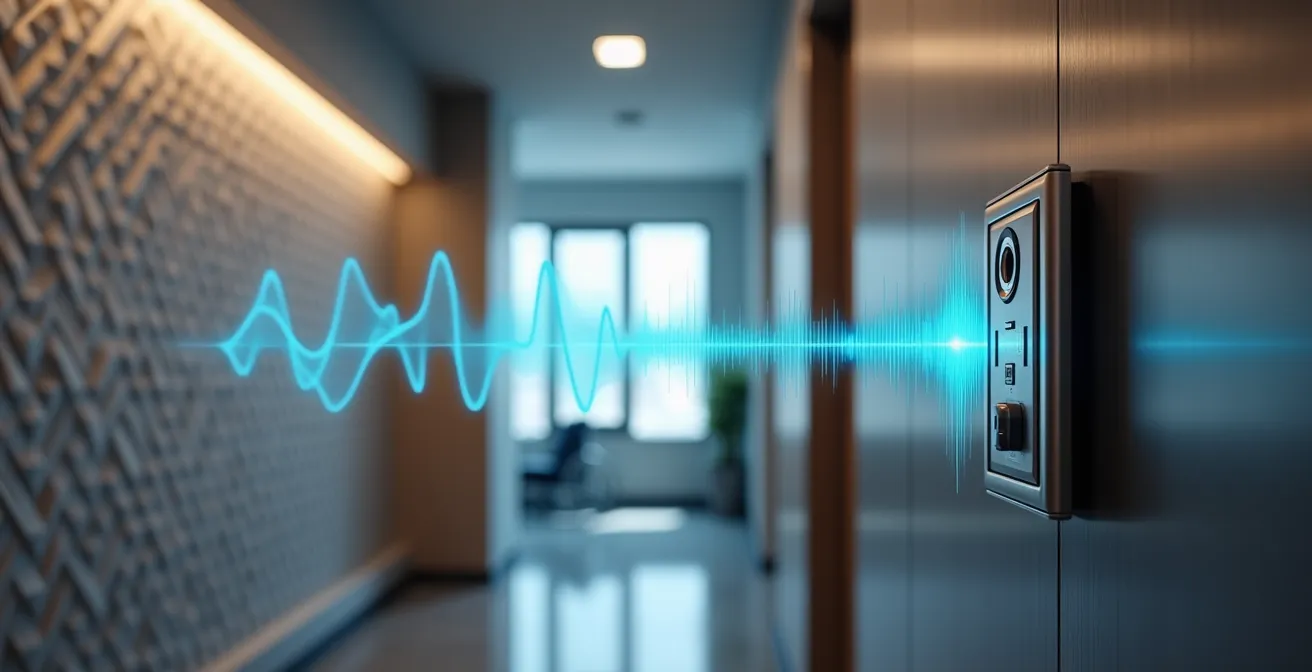
As the image illustrates, hardware placement is only part of the solution. The acoustic environment is equally important. To combat the reverberation common in modern lobbies, acoustic dampening panels should be specified for the wall opposite the intercom. This simple addition can dramatically reduce echo and improve audio clarity. For enhanced accessibility, an induction loop system should also be integrated to assist users with hearing impairments, as per AQLPH (Association québécoise pour le loisir des personnes handicapées) recommendations. Finally, compliance with Quebec’s Charter of the French Language requires programming bilingual voice prompts, with French as the default language.
Level 1 vs Level 3 Ballistic Protection: What Does a Corporate Lobby Really Need?
Specifying ballistic protection for a mantrap vestibule moves the design from access control to active threat mitigation. However, choosing the appropriate level of protection requires a careful threat modeling process, not just selecting the highest rating available. For most corporate lobbies in Montreal, the primary threats are not military-grade assaults but forced entry, smash-and-grab crime, or hand-gun-related violence. Over-specifying can lead to unnecessary costs and an intimidating, fortress-like environment, while under-specifying creates a dangerous illusion of security.
Ballistic protection levels are rated by organizations like Underwriters Laboratories (UL). A UL Level 1 rating is designed to stop three shots from a 9mm handgun, a common threat. A UL Level 3 rating, in contrast, must withstand three shots from a .44 Magnum. The structural and material requirements for Level 3 are significantly higher, impacting frame design, glazing thickness, and overall cost. A custom secure vestibule installation can range from $25,000 to $45,000 based on 2021 data, with higher ballistic ratings driving the cost toward the upper end of that spectrum.
The architect’s role is to guide the client through a risk assessment. For a jewelry wholesaler or a high-profile financial institution, Level 3 might be a justifiable necessity. For a standard corporate headquarters, a well-implemented Level 1 system is often sufficient to deter opportunistic crime and provide a meaningful barrier. As Jim Richards, CEO of Total Security Solutions, notes, the lobby itself functions as the first line of defense.
We do a lot of lobby work for corporations that functionally approximate the mantrap. This, then, is the first line of defense: by limiting access to who is allowed in and how they enter.
– Jim Richards, CEO of Total Security Solutions
The decision must be documented, linking the chosen ballistic level to a specific, identified threat profile. This protects the architect and ensures the client has made an informed decision based on risk rather than fear.
The Safety Override You Must Install in Every Mantrap System
A mantrap is designed as a `fail-secure` system: in case of power failure, the doors lock to protect the secure area. However, this creates a significant life-safety risk. In an emergency, such as a fire, an individual could become trapped in the intermediate space. For this reason, all mantrap designs must incorporate a robust and code-compliant emergency override system that is fundamentally `fail-safe`.
Fire codes, including the Quebec Construction Code which is based on the National Building Code of Canada, mandate that any access control system must not impede egress in an emergency. For a mantrap, this means the system must be integrated with the building’s fire alarm. When the fire alarm is triggered, the mantrap logic must immediately change: the lock on the secure-side door remains engaged, but the door leading to the non-secure side (the exit path) must automatically unlock, allowing anyone inside the vestibule to evacuate freely.
This is typically achieved with an electromagnetic lock connected to a fire alarm relay. The design must also include clearly marked emergency release buttons or bars inside the vestibule. These manual overrides must function independently of the access control system. This ensures that even if the control panel malfunctions, a person can physically force the exit door open. The integration isn’t just a suggestion; it’s a legal requirement for obtaining an occupancy permit. A system that traps an individual during a fire drill will unequivocally fail inspection.
While a primary goal is preventing forced entry, modern security glazing compliant with standards like ASTM F3561 can provide significant resistance. Even without a locked door, this glazing offers a substantial barrier, providing up to 30 minutes of forced-entry resistance, which is ample time for a security response while still ensuring a safe exit path.
How to Calculate Vestibule Throughput During Morning Rush Hour?
A high-security vestibule that creates a significant bottleneck during peak hours is a failed design. Employee frustration leads to pressure on security staff and an increase in tailgating attempts as people hold doors for colleagues. An architect must therefore calculate the required throughput capacity of the vestibule system to ensure it can handle the building’s peak traffic flow without compromising security protocols.
The calculation involves three key variables:
- Peak Arrival Window: The period of highest traffic, typically 8:30-9:00 AM in a downtown Montreal office tower.
- Total Population: The number of employees expected to enter during that window.
- Door Cycle Time: The total time required for one person to pass through the mantrap. This includes approach, authentication, door opening/closing, transit, and the second door’s cycle.
A typical door cycle time can range from 6 to 10 seconds. A 10-second cycle time means the system can process 6 people per minute, or 360 people per hour. If a building with 1000 employees has 50% of them arriving in a 30-minute window (500 people), a single vestibule with a 360/hour capacity is grossly inadequate. This would necessitate either multiple vestibules or a different access control strategy for the main entrance.
The context within Montreal heavily influences these numbers. A downtown office connected to the Metro will experience a very condensed surge right before 9:00 AM, while a Technoparc office with parking may see a more distributed arrival pattern. Winter conditions can also increase cycle time as people fumble with gloves and access cards.
This comparative data illustrates how location impacts throughput calculations, providing a baseline for architects to adapt to their specific project’s context.
| Location Type | Peak Arrival Window | Door Cycle Time | Throughput/Hour |
|---|---|---|---|
| Downtown Tower (3000 employees) | 8:30-9:00 AM | 8 seconds (winter) | 450 people |
| Technoparc Office (250 employees) | 8:00-9:30 AM | 6 seconds (parking lot) | 600 people |
| Metro-connected Building | 8:45-9:00 AM surge | 10 seconds (multi-auth) | 360 people |
The Code-Sharing Risk That Lets Unauthorized Strangers Roam Your Hallways
Even the most technologically advanced mantrap can be defeated by the simplest of human behaviors: misplaced trust and the social convention of politeness. The risk of an authorized employee sharing their access code or holding a door open for an unauthorized person is a significant vulnerability. This is not a hypothetical attack vector; it’s a common social engineering tactic.
As one security analysis points out, this behavior is deeply ingrained. Attackers rely on it.
Many of us are accustomed to hold the door open for other people, as a matter of common courtesy. Tailgating attackers exploit this simple kindness to evade security systems.
– FirewallTimes Security Analysis, Mantraps: What You Need to Know
An architect cannot eliminate this human factor, but they can design a system that mitigates its impact. This involves a combination of technology and policy reinforcement. One of the most effective technologies is anti-passback. This feature prevents a single access card from being used twice to enter without first being used to exit, making it impossible for an employee to pass their card back to someone else. Tying credentials to a unique personal device, such as through mobile access control on a smartphone, also significantly reduces the risk of casual sharing.
In the Quebec context, where politeness is a strong cultural trait, mitigation must also include awareness. The security design should be paired with a recommendation for user training that specifically addresses and explains these risks. Furthermore, with the introduction of Quebec’s Law 25 on data privacy, a physical breach that could lead to a data breach has serious compliance implications. Linking physical access control policies to data privacy requirements can create a stronger organizational incentive to enforce them, turning a security recommendation into a legal and financial imperative.
The Emergency Exit Layout That Fails Inspection in 50% of Old Buildings
Retrofitting a mantrap system into an older or heritage building in Montreal presents a unique set of challenges, particularly concerning emergency egress. These buildings were not designed with modern access control in mind, and their existing layouts often conflict with the strict requirements of the Quebec Construction Code. It is common for proposed security upgrades to fail inspection because they inadvertently obstruct a required exit path or violate minimum clearance dimensions.
An architect must conduct a thorough pre-design audit of the existing conditions against the code. Key items to verify include the “largeur de dégagement” (minimum egress width) and the travel distance to the nearest designated emergency exit. Placing a vestibule in a corridor cannot reduce the width below the legal minimum, which is a frequent point of failure. The system’s integration with the fire alarm, ensuring a fail-safe release, is another critical inspection point that must be documented.
Because modifications to heritage buildings often require special approval, the design process must include early consultation with the City of Montreal’s planning department (Service de l’urbanisme et de la mobilité). Attempting to install a system without this pre-approval can result in costly work-stoppage orders and mandated redesigns. The following checklist provides a framework for a pre-inspection audit tailored to Montreal heritage properties.
Pre-inspection Checklist for Montreal Heritage Buildings
- Verify ‘largeur de dégagement’ meets Quebec Construction Code minimum width requirements for the entire exit path.
- Confirm that the travel distance from any point to the nearest exit remains under the maximum allowed by code after the vestibule installation.
- Specify electromagnetic locks with integrated emergency release buttons on all protected doors within the path of egress.
- Document the complete fire alarm integration plan, detailing how the system triggers a fail-safe release of the vestibule’s exit door.
- Schedule a pre-approval meeting with the City of Montreal’s planning department to review the proposed modifications before finalizing construction documents.
Successfully navigating the regulatory maze is as critical as the technical design. Ignoring these steps is a primary reason why security projects in older buildings face significant delays and budget overruns.
Key Takeaways
- Sensor technology is the most critical choice for a Montreal mantrap; 3D stereo vision or LiDAR are superior to weight-based systems due to their resilience to winter conditions.
- All mantraps must be integrated with the building’s fire alarm system to provide a fail-safe emergency override, as required by the Quebec Construction Code. This is a non-negotiable life-safety feature.
- For heritage buildings, wireless access control technology is the most effective way to upgrade security without the destructive and costly process of extensive rewiring.
How to Upgrade Access Control in Older Montreal Buildings Without Rewiring?
One of the most significant barriers to retrofitting high-security access control in Montreal’s many heritage buildings is the prohibition against destructive alterations. The prospect of drilling through 19th-century greystone or plaster walls for new wiring is often a non-starter, both financially and from a preservation perspective. The solution lies in leveraging modern wireless access control technologies.
Wireless locks and card readers can be installed on existing door frames with minimal physical impact, preserving the historic fabric of the building. These battery-powered devices communicate with a central hub, which can then be integrated with the building’s main security platform. This allows for a phased and minimally invasive upgrade. For instance, an architect can specify a strategy that begins with securing the most critical access points, like server rooms and executive offices, before expanding to common areas.
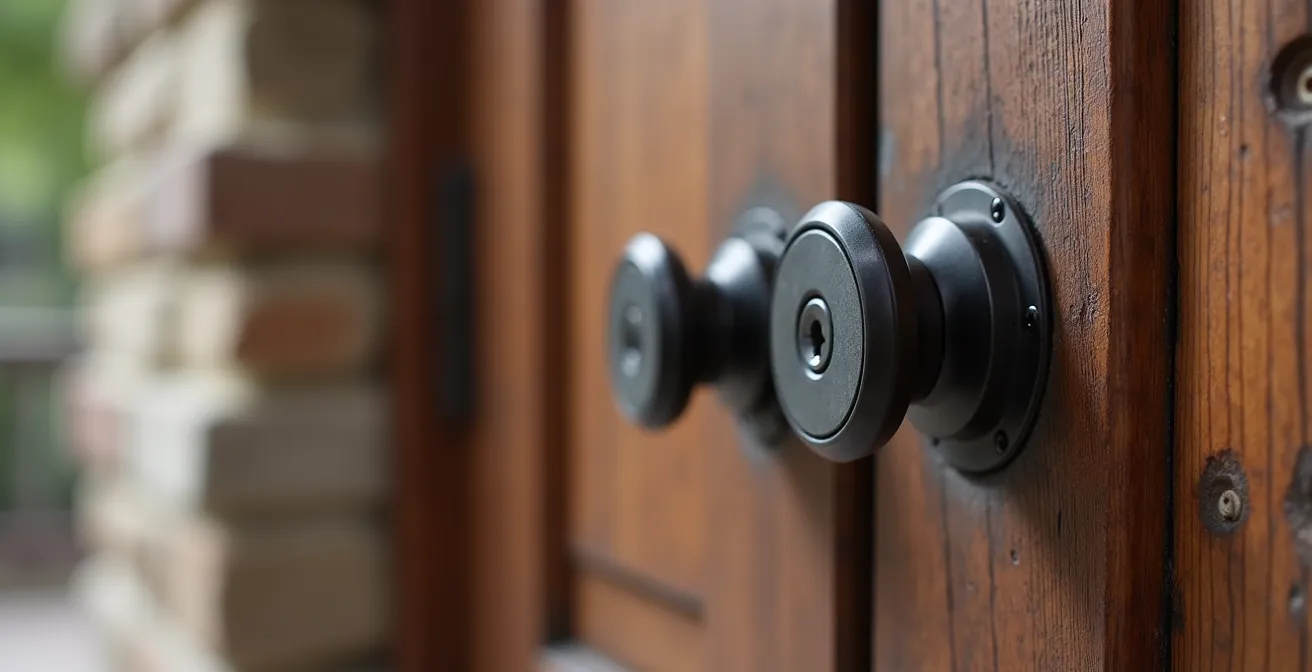
This approach offers flexibility and scalability. Wireless intercoms can be added to vestibules, and the entire system can be managed via a cloud-based platform for remote administration. Beyond preserving the building’s character, this strategy also offers significant efficiency gains. The use of prefabricated, modular vestibules combined with wireless technology can reduce project timelines substantially; indeed, modular vestibules can install in up to 40% less time than traditional construction, minimizing disruption to building occupants.
For an architect working on a heritage property, specifying a wireless strategy is not just a technical choice; it’s an enabling one. It makes a high-security upgrade feasible where it might otherwise be deemed impossible, balancing the need for modern security with the duty of architectural preservation.
To ensure your design is both secure and compliant, the next logical step is to initiate a formal review against the specific requirements of the Quebec Construction Code and Montreal’s municipal bylaws for your project’s typology.