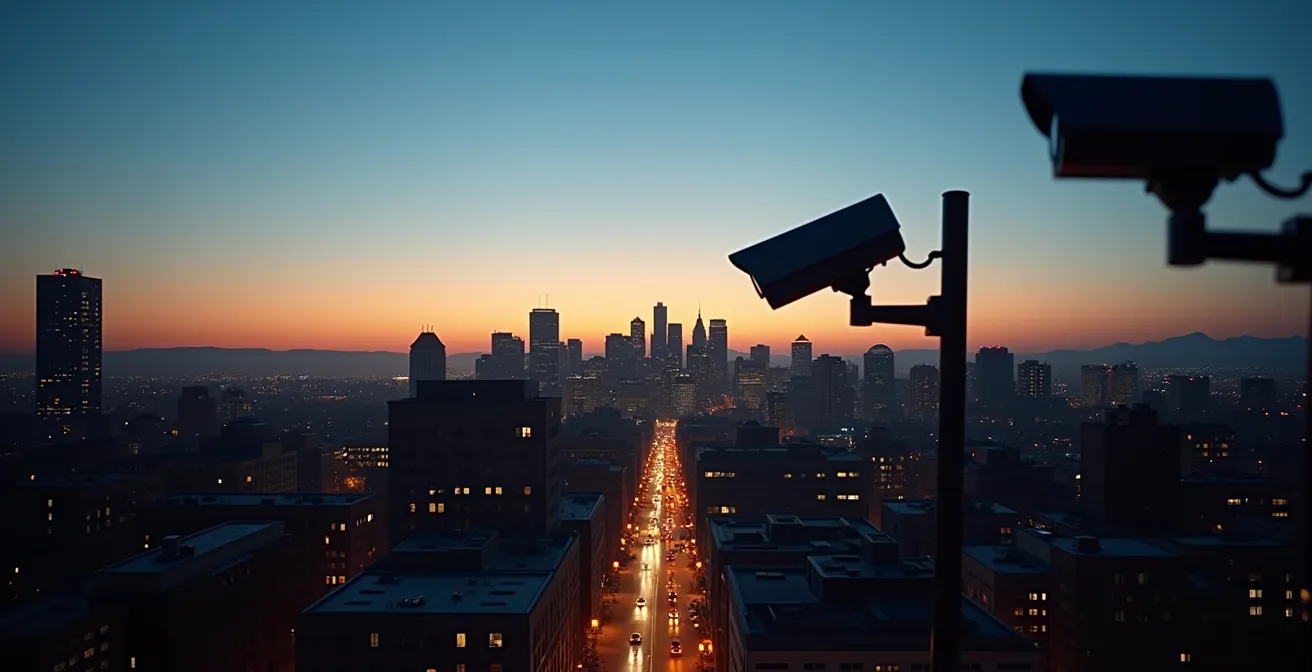
Effective security in Montreal isn’t about camera quantity; it’s about the quality of the intelligence your system generates and its compliance with local realities.
- Tailoring surveillance AI for Quebec’s harsh winters is non-negotiable for year-round reliability and preventing false alarms.
- A hybrid storage model is the optimal strategy for balancing high-performance access with the stringent data residency requirements of Quebec’s Law 25.
Recommendation: Prioritize systems that offer actionable, real-time intelligence and “compliance-by-design” to maximize both public safety and your return on investment.
For any municipal administrator or HOA manager in Montreal, the challenge of ensuring public safety in dense, historic, and diverse urban zones is a constant priority. The default reaction to a rise in incidents is often a call for more cameras on street corners. The logic seems simple: more eyes lead to less crime. However, this approach of simply increasing camera density often leads to an ocean of raw, unmanageable footage, high costs, and diminishing returns on security investment. It creates data noise, not actionable intelligence.
The conversation around urban security is evolving beyond simple hardware deployment. While related technologies like acoustic sensors or drone patrols have their place, the core of a modern system lies in its video surveillance architecture. The critical shift is from passive recording to active analysis. But what if the key to unlocking real security improvements wasn’t in the number of cameras, but in the intelligence of the ecosystem connecting them? What if the system was designed from the ground up to not only see, but to understand, predict, and comply with Montreal’s unique environmental and legal landscape?
This data-driven guide is designed for Montreal’s decision-makers. We will move past the platitudes and architect a blueprint for an effective smart surveillance system. We will explore how to select AI that thrives in Quebec’s winters, navigate the critical storage decisions mandated by Bill 25, identify the signs of technological obsolescence, and ultimately leverage your network for benefits that extend far beyond simple crime deterrence. It’s time to build a system that delivers not just footage, but true urban intelligence.
To provide a clear roadmap for this architectural approach, this article is structured to address the key decisions you will face. The following sections break down each component, from initial strategy to long-term network leverage.
Summary: Architecting a Smarter, Safer Montreal with Intelligent Surveillance
- Why High Camera Density Doesn’t Always Equal Better Security in Downtown Montreal?
- How to Choose Surveillance AI That Works During Quebec’s Harsh Winters?
- Cloud vs On-Premise Storage: Which Is Best for Montreal Business Surveillance?
- The Privacy Mistake That Can Cost Your Organization $50,000 in Fines
- When to Upgrade Your Smart Cameras: 3 Signs of Obsolescence
- When to Add Edge Computing to Your Camera Network?
- Why Automated Phishing Bots Can Bypass Your Legacy Spam Filters?
- Leveraging Connected Camera Networks for Traffic and Emergency Response
Why high camera density doesn’t always equal better security in downtown montreal?
The traditional security playbook suggests that a higher number of cameras directly correlates with increased safety. However, in complex urban environments like downtown Montreal, this “more is better” approach quickly meets a point of diminishing returns. An overabundance of cameras without an intelligent backend simply creates a data deluge, overwhelming monitoring staff and storage systems. The goal is not to collect more footage, but to generate actionable intelligence from the right footage at the right time. A dozen smart cameras analyzing pedestrian flow, detecting anomalies, and alerting operators to specific events are infinitely more valuable than a hundred passive cameras recording empty streets.
The true measure of a surveillance system’s effectiveness is its return on investment (ROI), both in financial terms and in public safety outcomes. It’s about strategic placement and intelligent integration, not brute-force coverage. This shift from a hardware-centric to a data-centric model is where real value is created. A well-architected system provides tangible benefits that go far beyond simple deterrence.
Case study: The financial impact of integrated surveillance
A landmark analysis of Chicago’s integrated video surveillance network revealed the powerful financial argument for smart systems. The study found that the city’s system, which connects thousands of public and private cameras, delivered an exceptional ROI. It demonstrated that a well-designed network could save an estimated $4.30 for every dollar spent on video surveillance. These savings were not theoretical; they came from concrete reductions in criminal justice system costs and the financial impact on victims, amounting to approximately $815,000 in monthly savings. This proves that the value lies in the system’s intelligence and integration, not just the camera count.
For Montreal, this means focusing investments on AI-powered analytics, robust network infrastructure, and proper operator training. By doing so, you transform your surveillance network from a passive cost center into an active asset that proactively enhances urban safety and delivers a measurable return. The question isn’t “how many cameras can we afford?” but “how much intelligence can our system generate?”.
How to choose surveillance AI that works during quebec’s harsh winters?
Deploying a smart surveillance system in Montreal introduces a challenge many other cities don’t face: extreme winter. Standard AI-powered cameras, calibrated for temperate climates, can fail spectacularly when faced with heavy snowfall, freezing rain, and temperatures plunging to -40°C. Snowflakes can trigger endless false motion alerts, ice can obscure a lens completely, and internal components can seize up. Choosing a system without explicit environmental resilience is a recipe for a network that is unreliable for a significant portion of the year, undermining the entire security investment.
To ensure year-round operational integrity, your selection criteria must prioritize hardware and software designed specifically for these conditions. This includes cameras with built-in heating elements to prevent ice accretion on the lens, military-grade lubricants that don’t freeze, and AI algorithms trained to differentiate between falling snow and genuine movement. This is a non-negotiable aspect of system architecture in our climate.
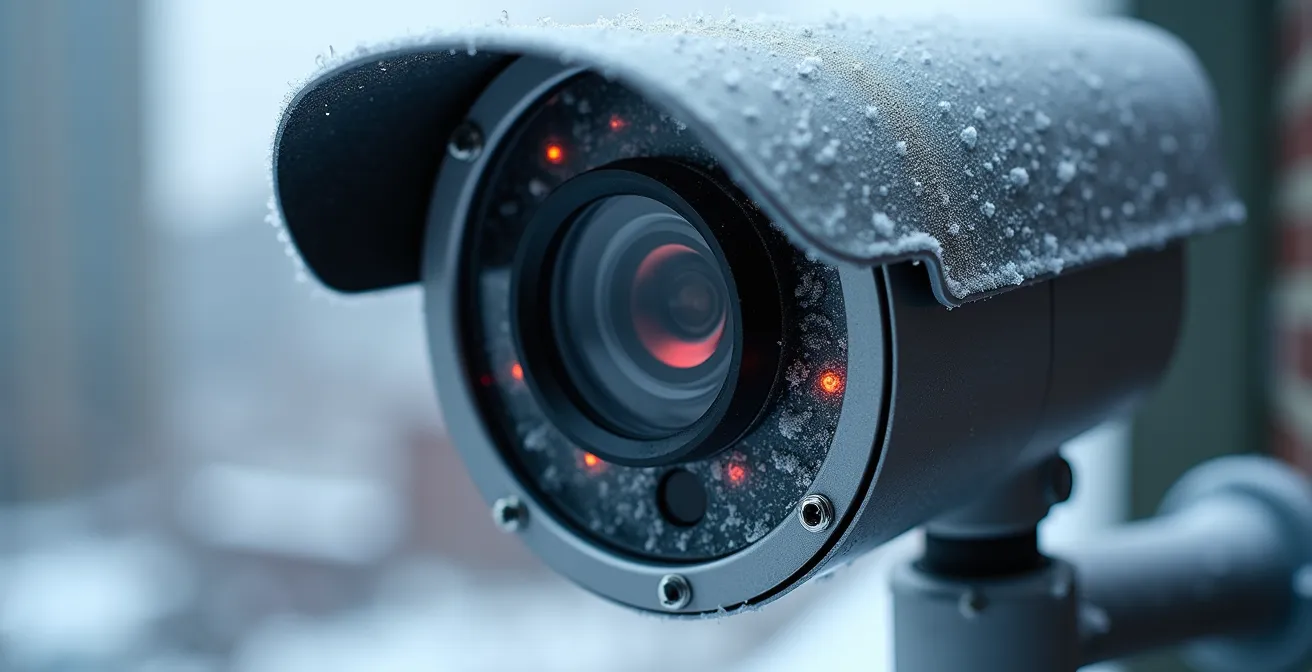
Furthermore, consider advanced imaging technologies. As ECAM Security Technologies notes, “Thermal cameras detect heat signatures to make it easier to identify people or objects in complete darkness, severe weather, fog, and smoke.” This technology is particularly effective during a Montreal whiteout, as it sees heat, not visible light, cutting through the visual noise of a blizzard to detect a person or vehicle where a standard camera would see only white.
The following table illustrates the critical differences between a standard system and one optimized for Quebec’s climate. Making the right choice here is fundamental to achieving reliable, year-round security.
| Feature | Standard Cameras | Winter-Optimized AI Cameras |
|---|---|---|
| Operating Temperature | -10°C to +40°C | -40°C to +50°C |
| Lens Heating | Not Available | Built-in De-icing System |
| Snow Detection | Triggers False Alarms | AI Distinguishes Snow from Motion |
| Ice Accretion Alert | No Monitoring | Automatic Obstruction Detection |
| Arctic Lubricants | Standard | Military-Grade Arctic Formula |
Cloud vs on-premise storage: which is best for montreal business surveillance?
The decision between cloud and on-premise storage for surveillance footage is no longer just a technical or budgetary choice in Quebec—it’s a critical legal one. With the enforcement of Quebec’s Law 25 (formerly Bill 64), how you store, manage, and protect personal information, including video footage of identifiable individuals, has significant financial implications. Non-compliance is not an option, with penalties reaching up to $25 million or 4% of worldwide revenue, whichever is greater. This legislation fundamentally shifts the risk calculation for storage architecture.
Cloud storage offers scalability and accessibility, but raises immediate questions about data sovereignty. To be compliant with Law 25, personal information must be protected with the same rigor, regardless of where it is stored. If a cloud provider’s servers are outside Quebec or Canada, you must conduct a Privacy Impact Assessment (PIA) to ensure the data receives equivalent protection, adding a layer of legal complexity. On-premise storage provides complete control over data location, satisfying residency requirements, but comes with higher upfront capital costs, maintenance overhead, and physical security risks. For Montreal, a third option often provides the ideal balance: the hybrid model.
Case study: A hybrid storage model for Bill 25 compliance
A Montreal-based retail chain facing the challenge of modernizing its surveillance while adhering to Law 25 implemented a strategic hybrid storage solution. Critical, high-resolution footage of specific incidents (e.g., theft, altercations) is stored locally on-premise servers for immediate, high-speed access by security staff and to ensure a clear chain of custody. This satisfies the most stringent compliance and operational needs. Simultaneously, routine, lower-resolution footage used for general monitoring and pattern analysis is archived in secure, Canadian-based cloud servers. According to an analysis by Osler, this approach not only ensured full regulatory compliance but also reduced overall storage costs by 40%. It also provided crucial redundancy, a lesson learned from the widespread infrastructure failures during the 1998 ice storm.
This “compliance-by-design” approach leverages the strengths of both models. It keeps the most sensitive data under direct physical control while using the cloud for cost-effective, scalable archiving of less critical data. For any Montreal organization, this nuanced strategy is the most robust way to manage both risk and performance.
The privacy mistake that can cost your organization $50,000 in fines
Beyond data storage, Quebec’s Law 25 imposes strict rules on the day-to-day operation of surveillance systems. A single misstep in how you inform the public or handle data requests can lead to significant penalties. For corporations, the minimum fine for a violation is $15,000, with fines doubling for subsequent offenses. These are not just theoretical risks; they are tangible financial liabilities that can arise from simple operational oversights. The most common and costly mistake is inadequate public notification and a failure to have a documented process for handling footage access requests.
Law 25 mandates “transparent, quality information” be provided to individuals. This goes far beyond a simple “Smile, you’re on camera” sign. Signage must clearly state the purpose of the surveillance (e.g., “for theft prevention and public safety”), provide the contact information of your organization’s designated Privacy Officer, and explicitly state that video recording is in progress. Failure to provide this complete information is a direct violation.
Equally critical is your organization’s ability to respond to a Subject Access Request. Any individual captured on your cameras has the right to request a copy of their personal information. You must be able to locate, isolate, and redact the footage (to protect the privacy of other individuals in the frame) and provide it within 30 days. Without the right technology and a documented protocol, this is nearly impossible and opens your organization to both fines and reputational damage. Adopting a “compliance-by-design” mindset is essential to avoid these costly errors.
Your checklist for Law 25 surveillance compliance
- Assess signage: Verify that all camera locations have compliant signage clearly stating the surveillance purpose and Privacy Officer contact details.
- Inventory your tech: Ensure you have the software tools for AI-powered search and redaction to efficiently handle footage access requests.
- Document proportionality: Create a formal document that justifies the scope and placement of each camera, demonstrating it is proportional to the security need.
- Establish protocols: Implement and drill a 30-day response protocol for all staff involved in handling data access requests.
- Conduct a PIA: Perform and document a Privacy Impact Assessment for any new camera installation or significant change to your system.
When to upgrade your smart cameras: 3 signs of obsolescence
In the rapidly evolving field of smart surveillance, technological obsolescence is a constant threat to your security posture. A camera system that was state-of-the-art five years ago may now be a significant liability. Holding onto outdated hardware not only reduces your system’s effectiveness but also leaves you vulnerable to new and emerging threats. As the city of Montreal itself invests in modernizing its infrastructure, private and municipal entities must also keep pace. The SPVM, for example, expanded its network to 42 cameras across the city by 2022 as part of a continuous upgrade cycle. Recognizing the signs of obsolescence is key to maintaining a robust and effective security ecosystem.
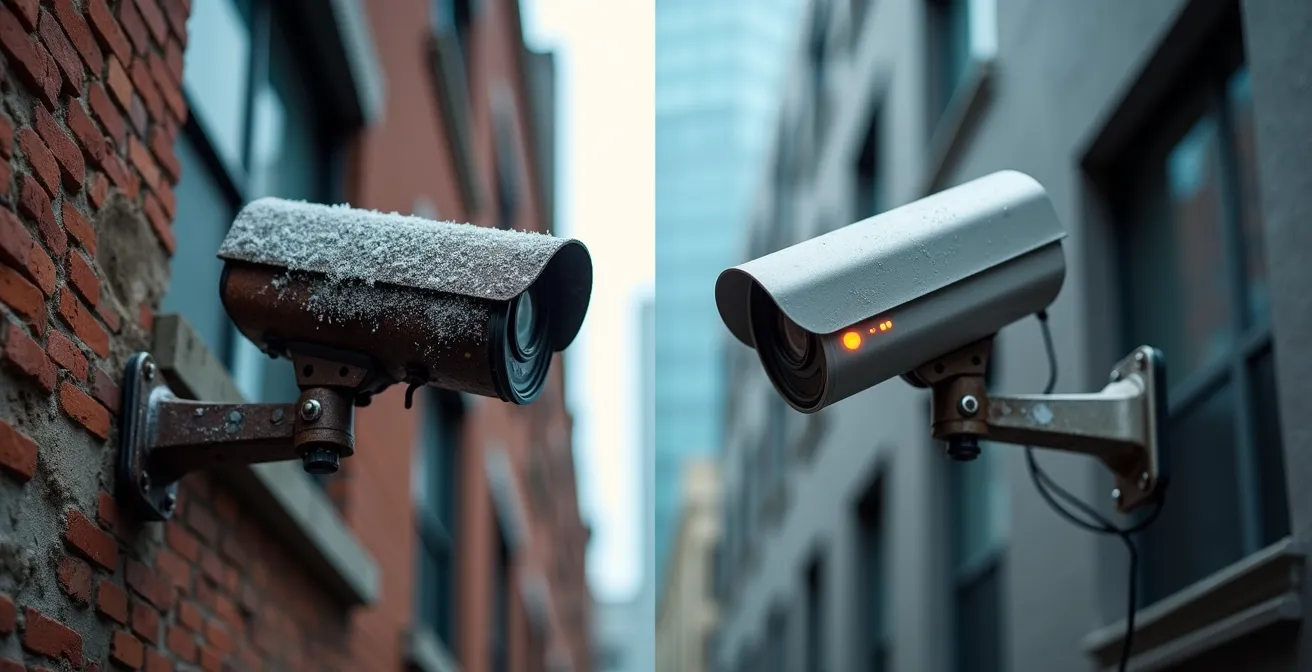
Here are three clear indicators that it’s time to architect an upgrade:
- Your AI generates “environmental noise”: A primary sign of an outdated AI is its inability to distinguish between relevant events and environmental changes. As one Security Technology Expert noted in a Montreal-specific analysis, “Your AI is no longer ‘smart’ enough for Montreal’s changing environment when your old system can’t differentiate between the new REM light rail trains and regular vehicles.” If your system is constantly triggering false alerts from new, predictable elements in its environment, its analytical engine is obsolete.
- Inability to perform forensic search: Modern surveillance is defined by the ability to search for specific events, not just scrub through hours of footage. If you cannot ask your system to “show me all red vehicles that passed through this area between 2 and 3 p.m.,” your Video Management System (VMS) lacks the metadata-tagging capabilities of current technology. This severely limits your ability to respond to and investigate incidents effectively.
- Lack of integration and cybersecurity updates: An older camera, especially an analog one, is often a closed-off data silo. If it cannot integrate with other systems (e.g., access control, alarm systems) via a secure API, it is a weak link in your security chain. Furthermore, if the manufacturer no longer provides regular firmware updates to patch cybersecurity vulnerabilities, each camera becomes a potential entry point for attackers into your network.
An outdated system isn’t just less effective; it’s a risk. Proactively planning for upgrades ensures your security investment continues to deliver value and protection in a changing urban landscape.
When to add edge computing to your camera network?
As your smart surveillance network grows, a critical architectural decision emerges: where should the video analysis happen? In a traditional cloud-based model, raw video is streamed from the camera to a central server (in the cloud) for processing. However, an increasingly powerful alternative is edge computing, where the AI analysis happens directly on the camera or a nearby device. For Montreal’s administrators, understanding when to deploy edge computing is key to optimizing performance, enhancing privacy, and ensuring reliability.
You should consider adding edge computing to your network in three primary scenarios. First, when real-time response is non-negotiable. Sending video to the cloud and back introduces latency. For applications like license plate recognition for access control or immediate alerts for an intrusion, the sub-second response time of edge processing is essential. Second, when network bandwidth is limited or unreliable. In areas with congested connectivity or during major events (or an ice storm), streaming multiple high-definition video feeds to the cloud can be impossible. Edge cameras analyze video locally and only send small packets of data (e.g., an alert, a license plate number), drastically reducing bandwidth needs. Third, to strengthen Law 25 compliance. By processing video on the edge, sensitive raw footage of individuals may never need to leave the premises, minimizing data transfer and making it easier to manage privacy obligations.
Case study: Edge computing in high-traffic montreal zones
To manage security in challenging environments like the parking areas around Stanley Street, monitoring firm Sirix deployed an edge computing solution. Cameras with on-board AI processing were installed to handle the high volume of vehicle and pedestrian traffic. According to their findings, this approach reduced false alarms by over 60% compared to a purely cloud-based system, as the edge AI could more effectively filter out irrelevant motion. Crucially, it enabled sub-second response times for security incidents, as alerts were generated instantly on-site without waiting for a round trip to a data center, proving invaluable during peak hours when cloud connectivity was strained.
The choice between edge and cloud is not mutually exclusive. A hybrid approach often works best, using edge computing for critical real-time tasks and cloud processing for long-term storage and large-scale analytics. This table outlines the key differences:
| Factor | Edge Computing | Cloud Processing |
|---|---|---|
| Latency | <50ms response | 200-500ms response |
| Bill 25 Compliance | Data stays local | Requires Canadian servers |
| Internet Dependency | Works offline | Requires constant connection |
| Initial Cost | Higher hardware investment | Lower initial cost |
| Scalability | Hardware-limited | Easily scalable |
Why automated phishing bots can bypass your legacy spam filters?
While we focus on the physical security provided by cameras, the cybersecurity of the surveillance network itself is a critical, often overlooked, vulnerability. A sophisticated surveillance system is a high-value target. Gaining access doesn’t just mean a loss of privacy; it could mean deactivating cameras before a crime, manipulating footage, or using the network as a launchpad to attack your entire IT infrastructure. Legacy security measures are no match for modern threats, particularly automated phishing bots that specifically target system operators.
These bots are designed to bypass standard spam filters by using Quebec-specific social engineering tactics, such as fake notifications from Hydro-Québec or communications disguised as official Law 25 compliance requests. As a cybersecurity expert from a Montreal Business Security Assessment warned, “Legacy VMS are often run on standard Windows machines that are vulnerable. A successful phishing attack on the operator’s PC can give an attacker full control.” Once an operator clicks a malicious link and enters their credentials, the attacker can gain complete control over the Video Management System (VMS) and, by extension, the entire camera network.
Protecting your smart surveillance system requires a dedicated, multi-layered cybersecurity strategy that goes beyond the default protections. This is not standard IT security; it’s about securing a critical operational technology (OT) asset. Hardening the system against these attacks is essential for maintaining its integrity and ensuring it remains a tool for security, not a liability.
Key measures to secure your Montreal surveillance network include:
- Mandatory Two-Factor Authentication (2FA): Implement 2FA on all access points to the VMS. A stolen password alone should never be enough to grant access.
- Network Segmentation: Isolate the camera network from the main office IT network. A breach on an office computer should not be able to spread to the surveillance system.
- Dedicated VMS Machines: The computer used to manage the VMS should be a dedicated machine with highly restricted internet access and no email client to minimize the attack surface.
- Phishing Simulation Training: Conduct regular training for operators using phishing simulations that mimic Quebec-specific scenarios to build resilience and awareness.
- Suspicious Login Alerts: Establish automated alert protocols for any login attempts from unusual IP addresses, locations, or at odd hours.
Key takeaways
- Intelligence over Density: The effectiveness of a surveillance system is measured by the quality of its actionable intelligence, not its camera count.
- Compliance by Design: In Quebec, Law 25 is not an afterthought. System architecture, especially data storage, must be designed from the ground up to ensure compliance.
- Environmental Resilience is ROI: For a system in Montreal to be effective, it must be built to withstand and operate flawlessly through harsh winter conditions. A seasonal system is a failed investment.
Leveraging connected camera networks for traffic and emergency response
The ultimate goal of a truly smart city surveillance architecture is to move beyond a reactive security tool and become a proactive, integrated platform for urban management. A well-designed network can provide invaluable data for traffic optimization, emergency response coordination, and municipal planning. This represents the highest level of ROI, where the system not only helps reduce crime but also improves the daily quality of life for citizens. Montreal is already seeing the positive impact of integrated security strategies, with the SPVM confirming another decrease in armed violence in 2024.
Imagine a scenario: an accident occurs on the Décarie Expressway. A connected camera network automatically detects the stopped traffic, identifies the vehicles involved, and relays this information in real-time to the SPVM, emergency medical services (SIM), and the city’s traffic management center. Traffic signals on feeder roads are automatically adjusted to redirect flow, digital signs are updated to warn other drivers, and first responders arrive on the scene with full situational awareness. This level of coordination is only possible when private and public surveillance systems can securely share data within a pre-defined legal framework.
Building these public-private partnerships (PPPs) is the next frontier for urban security in Montreal. It requires establishing clear data-sharing agreements that are fully compliant with Law 25, implementing technology that can anonymize data for non-security applications (like traffic flow analysis), and creating a transparent communication strategy to maintain public trust. For a municipal or HOA manager, initiating or participating in such a network amplifies the value of your initial investment exponentially.
A framework for a successful public-private surveillance partnership in Montreal should include:
- Clear Data-Sharing Agreements: Legally vetted agreements that specify exactly what data can be shared, with whom, and for what purpose, all in strict compliance with Law 25.
- Temporary Access Protocols: A “break-glass” protocol allowing authorized emergency responders (SPVM, SIM) temporary, auditable access to relevant private camera feeds during a verified major incident.
- Anonymization Technology: Implementing AI that can strip personally identifiable information from footage used for analytics, such as pedestrian footfall or traffic pattern analysis.
- Secure API Connections: Building secure, encrypted Application Programming Interfaces (APIs) to allow for the automated and safe exchange of data between systems.
- Transparent Public Strategy: A public-facing policy that clearly explains how the data is being used to improve city services, the safeguards in place, and the benefits to the community.
To effectively implement these advanced strategies, the essential next step is to conduct a comprehensive Privacy Impact Assessment and technology audit for your specific environment. This foundational analysis will ensure your surveillance architecture is not only effective and resilient but also fully compliant with Quebec law, setting the stage for a truly intelligent urban security ecosystem.
Frequently asked questions on Montreal surveillance and Law 25
What information must surveillance signage contain under Quebec law?
Signs must include the purpose of surveillance (e.g., “for security and theft prevention”), the contact information for the person or department responsible for personal information protection (the Privacy Officer), and a clear indication that video recording is taking place.
How quickly must businesses respond to footage access requests?
Under Law 25, privacy officers must respond to requests for access to personal information, including video footage, within 30 days of receipt. An extension may be possible under specific, legally defined circumstances, but the 30-day timeline is the standard.
What are the minimum fines for corporations violating Law 25?
The minimum administrative monetary penalty (fine) for a corporation found to be in violation of Law 25 is $15,000. These fines can double for subsequent offences and, for major infractions, can escalate to a maximum of $25 million or 4% of global revenue, whichever is higher.