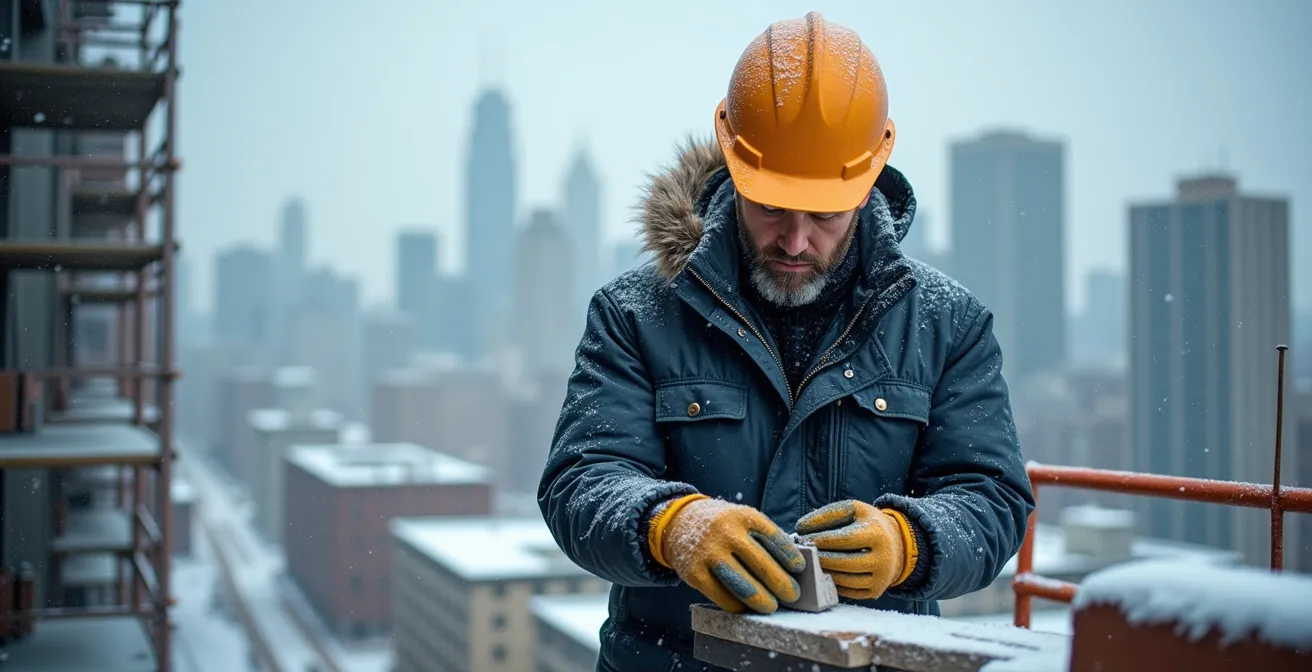
Standard personal protective equipment (PPE) specifications are inadequate for Montreal’s unique winter, leading to accelerated equipment failure, increased incidents, and hidden operational costs.
- Material degradation from extreme cold and UV-reflection from snow drastically shortens the functional lifespan of gear like hard hats and boots.
- Performance metrics like “thermal rating” are often misleading without practical, on-site testing for dexterity and grip in real-world conditions.
Recommendation: Shift from a simple compliance-based procurement checklist to a risk-based lifecycle management system that incorporates local environmental stressors and rigorous field testing.
A January morning on a downtown Montreal construction site is a world of its own. The temperature hovers at -25°C, wind whips snow into a blinding `poudrerie`, and every metal surface is coated in a treacherous layer of ice. As a safety officer, you’ve ensured your team is equipped with certified winter gear. Yet, incidents persist: workers fumbling with tools because of bulky gloves, safety glasses fogging into opacity, and unexpected slips on seemingly flat surfaces. The common advice to “buy insulated gear” or “check for CSA-approved logos” is a starting point, but it fundamentally fails to address the true adversary.
The real challenge isn’t just the cold; it’s the combination of unique environmental stressors that actively work to degrade the materials of the very equipment designed to protect your team. Intense UV radiation reflected off snow, the constant freeze-thaw cycles that weaken plastics, and the specific humidity conditions that defeat standard anti-fog coatings are factors that spec sheets rarely account for. This is where a procurement strategy based on simple compliance falls short.
What if the key wasn’t just buying PPE, but engineering a procurement and management system that anticipates this accelerated degradation? This guide moves beyond the manufacturer’s tag. We will dissect the material science behind winter PPE failure and provide a practical framework for safety officers in Montreal. We’ll explore how to specify, test, and manage the lifecycle of your equipment to ensure it performs not just on day one, but on day sixty of a brutal Quebec winter.
This article provides a detailed roadmap for building a winter-resilient PPE strategy. Explore the sections below to understand the specific failure points of each equipment category and learn actionable solutions tailored for the Montreal environment.
Table of Contents: A Guide to Winter-Proofing Your Site’s PPE Strategy
- How to Choose Thermal Gloves That Still Allow Fine Motor Control?
- Anti-Fog Safety Glasses: Which Coating Actually Works in High Humidity?
- Why Your Hard Hat Might Expire Sooner Due to UV and Cold Exposure?
- The Boot Sole Mistake That Leads to Ice Falls on Construction Sites
- How to Source PPE That Properly Fits Female Workers?
- How to Choose Surveillance AI That Works During Quebec’s Harsh Winters?
- How to Train Temporary Workers on Hygiene Gear in Under 15 Minutes?
- Implementing Strict Sanitary Protocols in Montreal Offices to Reduce Sick Leave
How to Choose Thermal Gloves That Still Allow Fine Motor Control?
The classic dilemma for any winter worksite is the trade-off between thermal protection and dexterity. A glove rated for -30°C is useless if the worker has to remove it to handle a small screw or operate a touchscreen, exposing their skin to the cold. The solution lies in moving beyond temperature ratings and focusing on performance verification. Insulation materials like Thinsulate offer excellent warmth-to-thickness ratios, but the real test is how they combine with the glove’s outer shell and liner to permit fine motor tasks.
Instead of relying solely on manufacturer claims, a safety officer should establish a pre-purchase testing protocol. This involves simulating job-specific tasks to measure true dexterity. For example, a worker’s ability to pick up a coin, tie a knot, or operate their specific tool while wearing the gloves provides immediate, tangible feedback on the glove’s real-world performance. This data-driven approach allows you to select a glove like a model with a thermal lining and an all-weather grip for cable work, or a grain leather glove that offers flexibility for electrical tasks, ensuring both safety and productivity.
The key is to create a “dexterity matrix” that maps glove models to specific job functions on your site. This ensures you’re not just buying “warm gloves,” but the *right* warm glove for each task, minimizing the moments where workers are forced to choose between safety and getting the job done.
Your 3-Step Pre-Purchase Field Test Protocol
- The Coin Test: The worker must be able to pick up and manipulate a coin from a flat surface within 10 seconds while wearing the gloves at room temperature. This tests fingertip sensitivity and precision.
- The Knot Test: The worker must tie a standard bowline knot with a 6mm rope within 30 seconds. This evaluates finger independence, grip strength, and the material’s flexibility.
- The Tool Test: The worker must operate their specific job tool (e.g., wrench, scanner, electrical tester) for 60 seconds, performing typical tasks. This validates practical, real-world application and confirms the glove doesn’t hinder job performance.
Ultimately, a small investment in a structured testing phase can prevent significant losses in productivity and reduce the risk of cold-related injuries like frostbite, which often occur during these brief periods of exposure.
Anti-Fog Safety Glasses: Which Coating Actually Works in High Humidity?
Fogging is one of the most persistent and dangerous winter PPE failures. When a worker moves from a warm truck cab to the freezing outdoor air, the sudden temperature drop causes moisture to condense on their safety glasses, instantly obscuring their vision. Using anti-fog wipes is a temporary fix, but the root of the problem lies in the physics of the lens coating. There are two main types: hydrophobic and hydrophilic. A hydrophobic (water-fearing) coating causes water to bead up into tiny droplets, which can still distort vision. A superior hydrophilic (water-loving) coating, however, causes moisture to spread into an invisibly thin, transparent film, maintaining clear sight.

For Montreal’s high-humidity cold, a hydrophilic coating is non-negotiable. As the extreme close-up above illustrates, the behavior of water at the microscopic level is the difference between safety and a hazard. When procuring safety glasses, specifying “hydrophilic coating” is crucial. Furthermore, ventilation is a key part of the system. Vents at the top and bottom of the goggle frame allow air to circulate, helping to equalize the temperature and humidity between the face and the lens, further reducing the potential for condensation. The impact is significant; data shows that anti-fog safety goggles with proper ventilation can reduce visibility-related incidents by up to 73% in sub-zero conditions.
A safety officer should look for products that explicitly market a permanent, bonded hydrophilic coating, as opposed to a simple spray-on treatment that can wear off. Pairing this technology with a well-ventilated frame creates a robust system that actively combats fogging, rather than just reacting to it.
This focus on the underlying technology ensures that your investment in eye protection directly translates to improved safety and operational continuity, eliminating one of the most common complaints from workers on winter sites.
Why Your Hard Hat Might Expire Sooner Due to UV and Cold Exposure?
A standard hard hat has a manufacturer-recommended lifespan, typically around five years. However, this is based on average use conditions. A Montreal winter is anything but average. The combination of extreme cold and intense ultraviolet (UV) radiation creates a perfect storm for accelerated material degradation. The High-Density Polyethylene (HDPE) plastic that most hard hats are made of becomes brittle at low temperatures. According to CSA testing standards, HDPE can begin losing its impact resistance below -20°C, with a significant reduction in protective capability at -30°C.
This problem is compounded by UV radiation. Snow on the ground can reflect up to 80% of the sun’s UV rays, meaning a hard hat is being bombarded from above and below. This constant UV exposure breaks down the polymer chains in the plastic, making it chalky and weak. Even the adhesives in stickers can react with the plastic during freeze-thaw cycles, creating micro-cracks that compromise the shell’s integrity. The result is that a hard hat’s real-world useful life on a Montreal winter site can be far shorter than its stamped expiry date suggests.
A proactive approach, as documented by one Quebec construction firm, is to implement a ‘winter adjustment factor‘. This company found that their hard hats showed 40% faster degradation rates in winter conditions. As a result, they reduced the standard 5-year replacement cycle to 3 years for equipment used outdoors in winter. This proactive lifecycle adjustment, based on local environmental stressors, led to zero hard hat failures over a two-year monitoring period. As a safety officer, this means visually inspecting hard hats not just for obvious cracks, but for signs of UV damage like discoloration or a chalky finish, and considering a formal policy to shorten the replacement cycle for all winter-exposed head protection.
This moves PPE management from a passive, compliance-based activity to an active, risk-management function that truly reflects the on-site reality.
The Boot Sole Mistake That Leads to Ice Falls on Construction Sites
Slips, trips, and falls are a leading cause of workplace injuries, and their frequency spikes dramatically in winter. In fact, a recent federal report noted that 18,796 disabling injuries were reported in Canadian workplaces in 2023, with winter months showing a 35% increase in slip-and-fall incidents. The common mistake in PPE procurement is assuming any boot with a deep tread is suitable for ice. The reality is that the sole’s rubber compound is far more important than the tread pattern when it comes to icy surfaces.
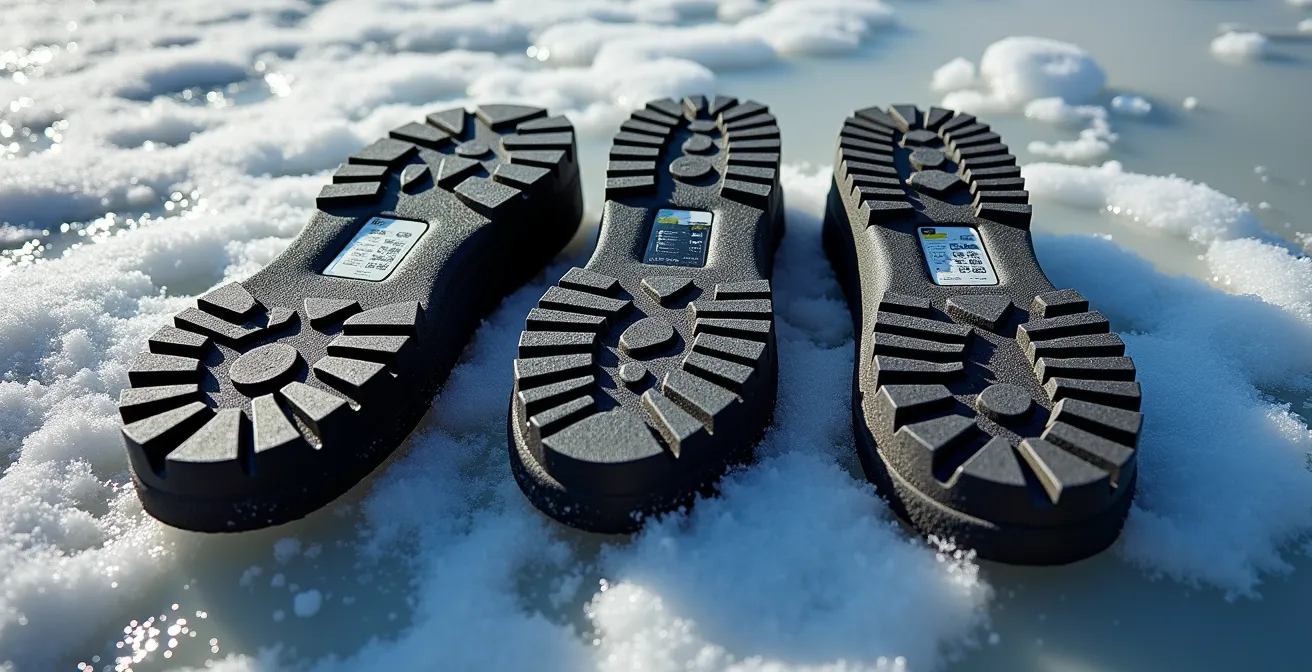
Standard rubber hardens in extreme cold, becoming more like plastic and losing its ability to grip. Specialized winter boots use compounds, such as Arctic Grip or Green Diamond, that are designed to stay soft and pliable at low temperatures, allowing them to maintain traction on ice. The tread pattern’s job is to channel away slush and water, but it’s the compound that provides the micro-grip on the ice itself. Simply looking for an aggressive tread is a critical oversight.
Furthermore, no single boot is perfect for all surfaces. A Montreal construction site presents a variety of treacherous terrains: sloped metal roofs, icy scaffolding, flat concrete covered in black ice, and areas with heavy de-icing salt. The correct strategy is to pair the right boot with the right supplementary traction aid. For example, carbide stud ice cleats are ideal for thick ice on roofs, while flexible coil-type grippers are better for the uneven surfaces of scaffolding. For areas with corrosive de-icing salt, it’s crucial to select cleats made from corrosion-resistant stainless steel. A safety officer’s role is to analyze the specific surfaces on their site and specify a *system* of boot and cleat, not just a boot.
This system-based approach to foot protection is the only way to effectively mitigate the heightened risk of falls that characterizes a Montreal winter project.
How to Source PPE That Properly Fits Female Workers?
For years, providing PPE for women in construction often meant following a simple, flawed logic: “shrink it and pink it.” This approach of simply offering smaller sizes of gear designed for male bodies is not just inconvenient; it’s dangerous. Poorly fitting gear can create significant hazards: baggy coveralls can get caught in machinery, oversized gloves reduce dexterity, and improperly sealed respirators can fail to provide adequate protection. The issue is not just size, but anatomical design. Women, on average, have different torso-to-leg ratios, shoulder widths, and hip measurements that a unisex design cannot properly accommodate.
Sourcing properly fitting PPE requires moving beyond distributors that only offer standard sizing and actively seeking out manufacturers who design their products specifically for the female form. This is not about aesthetics, but about function and safety. As one industry expert noted, the goal is a better fit and comfort to blend in, not to stand out. As Matt Glass, a representative for Helly Hansen Workwear, stated, “Most companies ‘shrink it and pink it,’ whereas at Helly Hansen we took feedback from professional women in the trades which focused on fit, comfort and blending in”.
Most companies ‘shrink it and pink it,’ whereas at Helly Hansen we took feedback from professional women in the trades which focused on fit, comfort and blending in
– Matt Glass, Helly Hansen Workwear Representative
The impact of providing properly designed gear is measurable. In a powerful case study, USW Local 9422 partnered with Canadian manufacturer Covergalls to completely redesign coveralls based on direct feedback from female miners. By incorporating features like adjusted anatomical proportions and two-way zippers for functionality, the union reported a staggering 60% reduction in clothing-related safety incidents and saw a marked improvement in overall PPE compliance. For a safety officer, this means initiating conversations with your female workers, conducting fit tests, and being willing to expand your supplier list to include brands that prioritize ergonomic and anatomical design for all genders.
Ensuring every worker has correctly fitting gear is not a special accommodation; it is a core requirement for a safe and equitable worksite.
How to Choose Surveillance AI That Works During Quebec’s Harsh Winters?
Extending a site’s safety perimeter with technology like AI-powered surveillance is a modern approach, but standard systems often fail in the face of Quebec’s environmental stressors. A camera that works perfectly in September can become useless in January. Blowing snow (`poudrerie`) can trigger thousands of false motion alerts, ice can coat lenses, and extreme cold can drain batteries and cause hardware failure. Choosing a winter-ready system requires looking at specifications far beyond resolution and storage capacity.
The key is specifying components rated for arctic conditions. This means camera housings that are not just weatherproof (IP65) but fully waterproof and corrosion-resistant (IP68 and NEMA 4X), with built-in heaters and defrosters to keep the lens clear. Internally, the components must be rated to operate down to -40°C. The AI software itself is also critical. Standard motion detection is easily fooled by blowing snow or steam from vents. A winter-adaptive AI must be calibrated to recognize and ignore these environmental patterns, using algorithms specifically designed to filter out `poudrerie`. It should also be able to adjust its thermal imaging thresholds to accurately detect people who are heavily bundled in winter clothing.
Procuring such a system requires a detailed specification sheet that goes well beyond the norm. The following table outlines the critical shift from standard specs to those required for a Montreal winter.
| System Component | Standard Spec | Montreal Winter Spec | Key Feature for -30°C |
|---|---|---|---|
| Camera Housing | IP65 | IP68 + NEMA 4X | Built-in heater/defroster |
| Operating Temperature | -10°C to +50°C | -40°C to +50°C | Arctic-rated components |
| Motion Detection | Standard sensitivity | Weather-adaptive AI | Poudrerie filter algorithm |
| Power System | Standard battery | Cold-weather lithium | Insulated battery compartment |
By specifying equipment with these robust features, a safety officer can ensure that their technological oversight remains a reliable asset, rather than a frustrating liability, throughout the harshest months of the year.
How to Train Temporary Workers on Hygiene Gear in Under 15 Minutes?
Construction sites in Montreal often rely on a multilingual, temporary workforce, which presents a significant challenge for safety training. A lengthy, text-heavy orientation on how to properly don, doff, and dispose of hygiene gear like masks and gloves is often ineffective due to language barriers and time constraints. The solution is to shift from a text-based to a visual, pictogram-based training model. The human brain processes images exponentially faster than text, and universal symbols transcend language barriers.
A highly effective 15-minute training session can be built around three core principles: pictograms, demonstration, and a buddy system. Start by posting large, clear pictograms at all hygiene stations, showing the step-by-step process for each piece of equipment. The trainer then performs a slow, exaggerated demonstration, mirroring the pictograms exactly. Finally, workers are paired up in a buddy system to practice on each other, with the trainer providing immediate, hands-on correction. This tactile, “see-one, do-one, teach-one” approach builds muscle memory and ensures comprehension regardless of language proficiency.
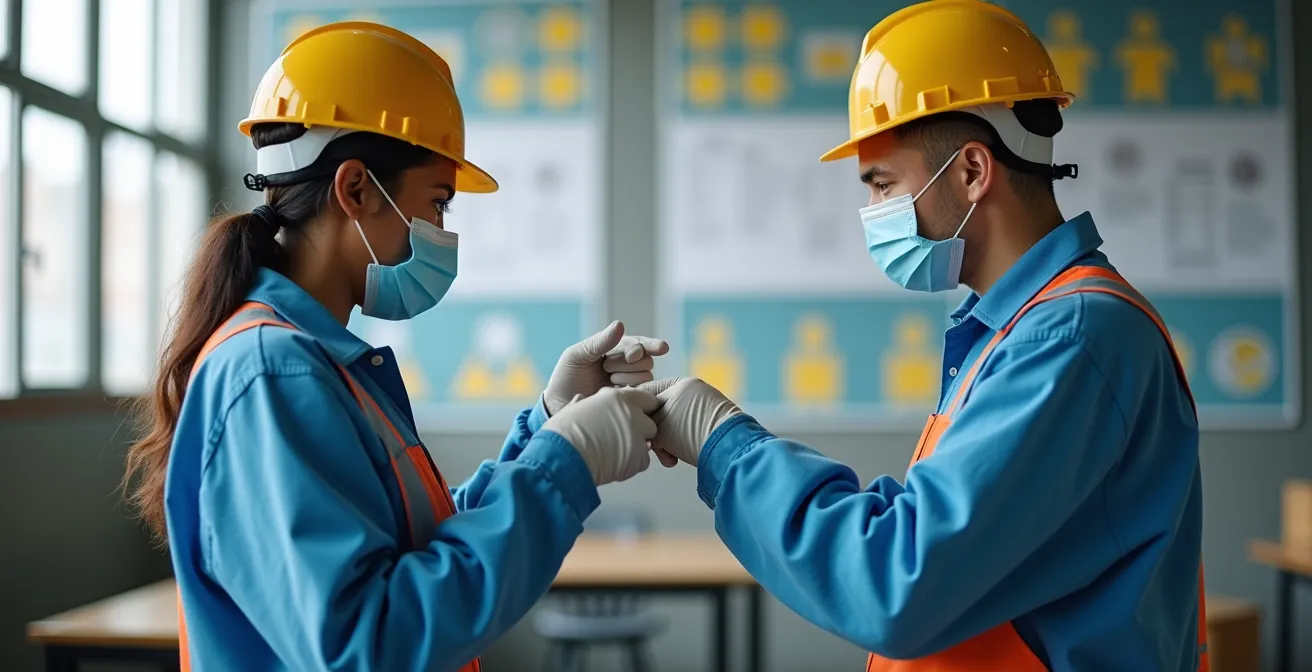
This method is not just theory; it is backed by data. According to research from Canadian workplace safety studies, visual pictogram-based training reduces safety protocol violations by a remarkable 68% among workers with limited language proficiency. By investing in professionally designed visual aids and a hands-on training protocol, a safety officer can achieve a higher level of compliance and safety in a fraction of the time, creating a safer environment for the entire team, both permanent and temporary.
This strategy transforms safety training from a passive administrative task into an active, engaging, and highly effective learning experience that protects every worker on site.
Key Takeaways
- Standard PPE expiry dates are unreliable in Montreal’s winter; a “winter adjustment factor” is needed to account for accelerated degradation from cold and UV.
- Effective anti-fog solutions for safety glasses depend on hydrophilic coatings and ventilation, not temporary wipes.
- Winter boot selection must prioritize the sole’s rubber compound for ice grip over tread pattern, and be paired with surface-specific traction aids.
Implementing Strict Sanitary Protocols in Montreal Offices to Reduce Sick Leave
Personal protective equipment is the last line of defense. A truly comprehensive safety strategy, especially in winter, extends to the environment the worker occupies. For office personnel and site managers in Montreal, this means creating a system-level hygiene protocol that addresses the unique challenges of the season. Winter forces everyone indoors, increasing the risk of airborne virus transmission, while the constant traffic from the wet, salty outdoors introduces moisture and contaminants. A passive approach to cleaning is insufficient.
An effective protocol starts at the building entrance. The “Metro to Desk” journey is a critical pathway for contamination. Implementing heated boot cleaning stations at entrances, especially those connected to the metro, can capture a significant amount of slush and salt. Providing ventilated lockers with UV-C sanitization cycles for wet winter gear prevents moisture and mold from accumulating in personal workspaces. Inside the office, the focus must be on Indoor Air Quality (IAQ). Upgrading HVAC systems with MERV-13 filters, which can capture airborne virus particles, and increasing fresh air circulation (despite heating costs) are crucial investments. Displaying real-time CO2 and humidity levels can also empower employees to manage their local environment.
The return on this investment is tangible. One downtown Montreal office building with 2,000 employees implemented such a winter protocol. After just one season, they documented a 42% reduction in sick days and a 31% decrease in reported respiratory symptoms, achieving a positive ROI within six months through reduced absenteeism costs alone. This demonstrates that sanitary protocols are not a cost center, but a strategic investment in workforce health and productivity.
As a safety officer, your final step is to audit your current procurement and management process. It is time to move beyond the spec sheet and build a safety system that is as resilient and adaptable as the workforce it protects.
Frequently Asked Questions on Selecting Protective Equipment That Withstands Montreal’s Winter Extremes
At what temperature does HDPE plastic lose impact resistance?
HDPE hard hats begin losing impact resistance below -20°C, with a 25% reduction in protection at -30°C according to CSA Z94.1-15 testing standards.
How does UV reflection from snow affect hard hat lifespan?
UV radiation reflected from snow can be 80% more intense than direct sunlight, accelerating plastic degradation by up to 2x during winter months.
Can stickers on hard hats accelerate cold weather damage?
Yes, adhesive chemicals in stickers can react with the plastic shell during freeze-thaw cycles, creating micro-cracks that expand in cold temperatures.