
For a Montreal factory manager, non-compliance with hazardous waste regulations is not an environmental issue; it is a direct and severe financial liability.
- Failure to maintain proper documentation, like a waste manifest, can trigger fines up to $500,000 for your company.
- Your legal responsibility for waste is “cradle-to-grave,” meaning you remain liable even if your disposal broker causes the violation.
Recommendation: Immediately implement a stringent internal audit of your waste storage, documentation, and service provider contracts to build a legal and financial firewall against MELCCFP enforcement actions.
As a factory manager in Montreal, your daily operations likely involve solvents, oils, and other chemicals that become hazardous waste. The conventional wisdom is simply to “follow the rules” to stay compliant. But this view is dangerously incomplete. It treats compliance as a passive, bureaucratic task rather than what it truly is: an active risk management strategy. The regulations set by Quebec’s Ministère de l’Environnement, de la Lutte contre les changements climatiques, de la Faune et des Parcs (MELCCFP) are not suggestions; they are a legal framework where any misstep can lead to catastrophic financial penalties and operational shutdown.
The core principle you must understand is cradle-to-grave liability. From the moment a hazardous substance is generated in your facility until its final, certified destruction, your company—and you, personally, in some cases—are legally responsible for it. This liability cannot be fully outsourced. Hiring a disposal service is not a transfer of responsibility; it’s the delegation of a task for which you retain ultimate accountability.
This guide moves beyond generic advice. We will dissect the most common and costly compliance failures for Quebec industries, from improper documentation and storage to the hidden risks of choosing the wrong service provider. The true key to managing hazardous waste is not just to dispose of it, but to build an unbreachable financial and legal shield around your operations. This article will show you how to construct that shield, one critical protocol at a time.
To navigate these complex requirements effectively, this guide breaks down the most critical areas of risk and compliance. The following sections provide detailed insights and actionable steps to protect your facility.
Summary: Navigating Quebec’s Hazardous Waste Protocols
- Why Losing a Waste Manifest Can Cost You Thousands in Fines?
- How to Store Acids and Bases to Prevent an Explosion in Your Waste Room?
- Broker vs Direct Disposal: Which Service Provider Risks Your Liability?
- The “Just Pour It Down the Sink” Habit That Pollutes Municipal Water
- How to Calculate Waste Generation Rates to Optimize Pick-Up Frequency?
- Why Your “Recyclable” Office Waste Is Likely Going Straight to the Landfill?
- Why Mixing Biomedical Waste with Regular Trash Can Cost You Your Permit?
- Meeting Provincial Environmental Standards for Brownfield Redevelopment in Montreal
Why Losing a Waste Manifest Can Cost You Thousands in Fines?
In Quebec’s regulatory landscape, the hazardous waste manifest is more than just a shipping document; it is the primary legal proof of your compliance with cradle-to-grave liability. This document, tracked through the provincial GTR system, creates an unbroken chain of custody from your factory (the generator) to the transporter and finally to the treatment, storage, and disposal facility (TSDF). Losing a manifest or failing to complete it accurately is equivalent to destroying the evidence that you handled your waste legally. For the MELCCFP, an undocumented shipment is an illegally disposed shipment until proven otherwise.
The financial consequences of this single administrative failure are severe. You are not merely risking a slap on the wrist. According to Quebec’s environmental enforcement guidelines, violations related to manifest documentation can result in fines ranging from $5,000 to $500,000 for corporations. These penalties are designed to be punitive, reflecting the seriousness of unaccounted-for hazardous materials entering the environment. For a factory manager, treating manifest management as a low-priority clerical task is a direct path to incurring massive, and entirely preventable, corporate liability.
Action Plan: 5 Steps to Prevent Manifest Loss and Penalties
- Implement digital tracking for all hazardous waste shipments using Quebec’s official GTR (Gestion des matières résiduelles) system.
- Maintain triplicate physical or digital copies of all manifests: one for the generator (you), one for the transporter, and one for the disposal facility.
- Conduct rigorous monthly audits, cross-referencing manifest records against your internal shipment and production logs to identify any discrepancies immediately.
- Train all personnel involved in shipping and logistics on the legal importance of cradle-to-grave documentation requirements under specific Quebec regulations.
- Establish a backup documentation protocol, including photographic records of sealed and labeled shipments before they leave your facility, as secondary evidence.
Ultimately, diligent manifest management is the most cost-effective insurance policy against regulatory action. It is the definitive proof that you have met your legal obligations.
How to Store Acids and Bases to Prevent an Explosion in Your Waste Room?
The chemical waste room is one of the highest-risk areas in any industrial facility. The common mistake of storing all waste “together” out of convenience can lead to a literal catastrophe. Storing strong acids and strong bases in proximity, for example, creates a significant risk of violent exothermic reaction if containers leak. This can release toxic fumes, cause fires, or even lead to an explosion. Similarly, placing flammable solvents near oxidizing agents is a recipe for disaster. Proper segregation is not a suggestion; it is a non-negotiable safety and compliance imperative.
Your responsibility under Quebec law is to ensure that all hazardous waste is stored in a way that prevents dangerous reactions. This involves using dedicated, chemically-compatible storage cabinets and ensuring clear physical separation between incompatible chemical families. For a factory manager, an incident in the waste room is a worst-case scenario: it endangers employees, triggers an immediate MELCCFP investigation, and can halt all site operations indefinitely.

The following matrix provides a simplified but critical guide for segregating common industrial chemical wastes. Failure to adhere to these basic compatibility rules is a primary red flag for any environmental inspector and a significant source of liability.
| Chemical Class | Compatible Storage | Incompatible With | Containment Required |
|---|---|---|---|
| Strong Acids | Acid cabinet, corrosive-resistant | Bases, metals, organics | 110% of largest container |
| Strong Bases | Base cabinet, separate from acids | Acids, aluminum, zinc | Secondary containment tray |
| Oxidizers | Cool, dry, isolated storage | Flammables, organics, reducers | Fire-resistant cabinet |
| Flammables | Flammable cabinet, grounded | Oxidizers, heat sources | Approved safety cans |
Investing in proper storage infrastructure and training is not an expense, but a critical safeguard against a preventable disaster that could cost far more than just money.
Broker vs Direct Disposal: Which Service Provider Risks Your Liability?
A common misconception among factory managers is that hiring a waste broker or a third-party disposal service transfers all legal risk. This is fundamentally false in Quebec. The principle of cradle-to-grave liability means that you, the generator, are permanently tied to your waste. If your chosen service provider illegally dumps your solvents, uses an unlicensed facility, or falsifies manifests, the MELCCFP will hold *your* company responsible for the violation.
Choosing a service provider based solely on the lowest price without rigorous due diligence is one of the most significant financial risks you can take. A non-compliant partner exposes your company to the full spectrum of fines and cleanup costs, regardless of any contracts you have in place. The responsibility cannot be delegated away.
Case Study: Montreal Manufacturer’s $250,000 Liability from a Non-Compliant Broker
A Montreal-based aerospace parts manufacturer faced a staggering $250,000 in fines and cleanup costs when their contracted waste broker was discovered illegally disposing of solvent waste at an unlicensed farm property. Despite having a detailed service agreement with the broker, the manufacturer was deemed fully liable under Quebec’s cradle-to-grave principle. The case serves as a stark reminder that the generator’s responsibility is absolute and cannot be transferred to an intermediary.
Therefore, vetting a potential waste management partner is a critical step in protecting your liability. Your due diligence must include verifying their MELCCFP operating permits, checking their status in Quebec’s Registry of Inadmissible Enterprises (RENA), requesting proof of substantial Environmental Impairment Liability insurance, and conducting site visits to their disposal facilities. Anything less is an open invitation to risk.
A slightly higher price for a fully vetted, transparent, and compliant disposal partner is insignificant compared to the six-figure fines and reputational damage that come from a poor choice.
The “Just Pour It Down the Sink” Habit That Pollutes Municipal Water
The seemingly innocuous act of pouring small amounts of leftover chemicals, solvents, or acidic/basic cleaning solutions down the drain is a major compliance violation in Montreal. It is not a harmless shortcut; it is the direct discharge of prohibited substances into a municipal water system that is not designed to treat them. The City of Montreal has strict regulations (By-law RCG 2008-47) governing industrial wastewater, and its enforcement division actively monitors discharge points for non-compliance.
Violating these by-laws has immediate and severe financial repercussions. Beyond the environmental damage, your facility can face penalties from $10,000 to $40,000 per violation. Furthermore, the city can impose a crippling 300% surcharge on your entire water bill until the issue is rectified. For a water-intensive industrial process, this can translate to tens of thousands of dollars in additional costs. The “out of sight, out of mind” mentality is a direct path to a financial penalty from the city, on top of any potential action from the provincial MELCCFP.
To aid industries in compliance, Montreal provides a clear classification system for substances. Understanding this system is fundamental to preventing illegal discharges. Any substance classified as “Red” has zero tolerance for drain disposal.
| Classification | Substance Type | Concentration Limit | Disposal Method |
|---|---|---|---|
| RED – Prohibited | Heavy metals, solvents, oils | Zero tolerance | Licensed hazardous waste disposal |
| YELLOW – Restricted | pH outside 5.5-9.5, detergents | Specific limits apply | Pre-treatment required |
| GREEN – Acceptable | Biodegradable soaps, food waste | Below regulatory limits | Direct discharge allowed |
Ultimately, the drain is an extension of the environment, and treating it as a waste bin will inevitably result in severe penalties that directly impact your operational budget.
How to Calculate Waste Generation Rates to Optimize Pick-Up Frequency?
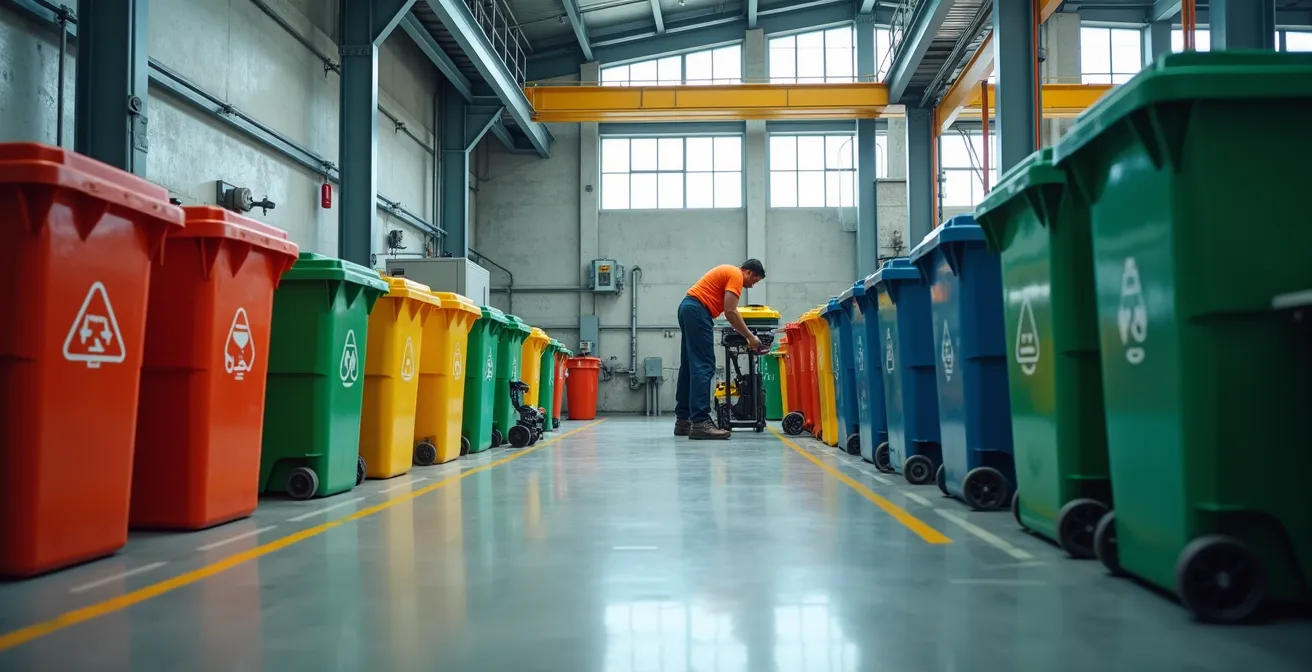
Optimizing hazardous waste pick-up frequency is a delicate balance between cost-efficiency and compliance. Arranging pick-ups too often leads to unnecessary transportation costs, while waiting too long can result in a serious violation of accumulation limits. In Quebec, Small Quantity Generators (SQGs) are generally permitted to accumulate hazardous waste on-site for a maximum of 90 days. Exceeding this limit is a common and easily-cited violation during an inspection.
A “one-size-fits-all” monthly pick-up schedule is rarely optimal. The key is to accurately calculate your waste generation rate for each distinct waste stream (e.g., used solvents, contaminated rags, acidic solutions). This requires a systematic process of tracking the volume and weight of waste produced over a set period. This data-driven approach allows you to forecast when your containers will reach their limits and schedule pick-ups just in time, minimizing both cost and compliance risk. In fact, MELCCFP compliance data shows that improper frequency calculation is a leading cause for the 87% of Quebec SQGs that exceed 90-day limits at least once annually.
Case Study: Saint-Laurent Garage vs. Anjou Food Processor
The value of tailored calculation is clear in two Montreal examples. A Saint-Laurent auto repair shop generating a steady 50kg/month of used oil filters and solvents analyzed its rates and switched from weekly to bi-weekly pick-ups, saving over $6,000 annually in transport fees. Conversely, an Anjou food processor producing 300kg/week of acidic organic waste discovered they needed to increase pick-ups to every other day. This was essential to stay compliant with the MELCCFP’s stricter 72-hour accumulation limits for putrescible (easily decomposable) materials, avoiding fines for improper storage.
By understanding your waste generation patterns, you can create a pick-up schedule that is both economically sound and regulatorily compliant, protecting your bottom line from both overspending and fines.
Why Your “Recyclable” Office Waste Is Likely Going Straight to the Landfill?
While the primary focus for a factory manager is hazardous industrial waste, the management of “simple” office recycling provides a powerful indicator of your facility’s overall compliance culture. If your company cannot correctly manage paper, cardboard, and plastic, it raises serious questions for a regulator about your ability to handle highly toxic chemicals. In Montreal, this is not a theoretical problem; it’s a systemic one. The single biggest reason that recyclable materials end up in a landfill is contamination.
When non-recyclable items like coffee pods, soiled food containers, black plastic, or chip bags are mixed into the recycling bin, they can contaminate the entire batch. Sorting facilities have little choice but to reject the load and send it to a landfill. According to official reports, Montreal’s recycling facilities report that one in four recycling loads are rejected due to high contamination rates. This means there is a significant chance your company’s well-intentioned recycling efforts are completely wasted, actively contributing to the landfill problem you are trying to avoid.
For a factory manager, this issue is twofold. First, it represents an inefficient system where you are paying for a recycling service that provides no environmental benefit. Second, and more importantly, it signals a lack of procedural discipline and training among staff. An MELCCFP inspector who observes poor sorting practices in your office or cafeteria will logically conclude that similarly poor practices are likely happening in your hazardous waste storage area. Implementing a simple office waste audit to identify your top contaminants and provide targeted employee education is a low-cost way to improve your environmental performance and demonstrate a culture of compliance that will be viewed favorably during any inspection.
Fixing your office recycling is not just about the environment; it is about proving your organization’s capability to follow critical protocols from the front office to the factory floor.
Why Mixing Biomedical Waste with Regular Trash Can Cost You Your Permit?
For facilities that generate any amount of biomedical waste—even from a small on-site first-aid station—the rules for segregation are absolute and the penalties for failure are the most severe. Biomedical waste includes items contaminated with blood or bodily fluids, such as used bandages, gloves, or sharps. Under Quebec law, these materials cannot, under any circumstances, be mixed with regular municipal trash or recycling. The risk of disease transmission and public health impact is considered so high that compliance is enforced with zero tolerance.
Unlike other waste violations that may result in fines, the improper disposal of biomedical waste can lead directly to the revocation of your facility’s operating permits. It represents a fundamental breach of public trust and regulatory requirements. The MELCCFP’s position on this is unequivocal, as stated by their enforcement division.
Any facility generating biomedical waste must segregate it at the point of generation and maintain strict separation through disposal, with violations subject to immediate permit revocation.
– MELCCFP Enforcement Division, Quebec Regulation respecting biomedical waste, Article 15
The financial logic is stark. While the cost of proper biomedical waste disposal is higher on a per-kilogram basis (typically $2.50-$4.00/kg) compared to regular trash ($0.15/kg), the cost of non-compliance is existential. A minimum fine of $50,000 is a near certainty for a first offense, but the true penalty is the loss of your permit, which means a complete shutdown of your business. This is not a fine you can absorb as a cost of doing business; it is an operational catastrophe.
For any manager, the message is clear: the cost of a dedicated, compliant biomedical waste stream is infinitesimal compared to the ultimate price of a single mistake—the closure of your entire operation.
Key Takeaways
- Your legal responsibility for hazardous waste is “cradle-to-grave” and cannot be transferred to a service provider.
- Administrative errors, like losing a manifest, carry the same weight as environmental violations, with fines reaching up to $500,000.
- Proper chemical segregation and data-driven pick-up schedules are not just best practices; they are critical components of your financial and legal shield.
Meeting Provincial Environmental Standards for Brownfield Redevelopment in Montreal
While much of hazardous waste management focuses on avoiding penalties, a deep understanding of Quebec’s environmental standards can also unlock significant opportunities, particularly in the context of urban industrial sites. Many older industrial properties in Montreal are classified as “brownfields”—land that is potentially contaminated from past activities. These sites often carry a stigma that devalues the property and deters investment. However, Quebec’s pragmatic approach to environmental regulation provides a clear pathway for their safe and profitable redevelopment.
Rather than mandating that every site be returned to a pristine, pre-industrial state, the province allows for risk-based remediation. This means decontamination efforts are tailored to the future use of the land. For example, the soil standards for a future parking lot or commercial building are less stringent than those for a residential area or a children’s park. This approach makes redevelopment economically feasible by allowing some controlled contamination to remain safely in place, managed through engineered barriers or other long-term controls.
Success Story: Griffintown’s Industrial Transformation
The successful redevelopment of Montreal’s Griffintown district is a prime example of this policy in action. Former contaminated industrial lands were transformed into a thriving mixed-use neighborhood. By applying site-specific risk assessments and remediation standards, developers were able to manage historical contamination effectively while ensuring public safety, unlocking immense real estate value and revitalizing a key urban area.
Furthermore, the City of Montreal actively encourages this transformation through financial incentives. The ClimatSol-Plus program provides substantial funding for brownfield projects, covering up to 75% of decontamination costs, with a maximum of $5 million per project. For a factory manager or property owner, this transforms environmental liability into a potential asset, creating a funded path to increase property value and contribute to urban renewal.
The logical next step is a comprehensive audit of your current hazardous waste streams and protocols, not only to ensure compliance but also to identify potential opportunities for operational and financial optimization.