
Effective active threat drills in Montreal require moving beyond generic advice to a framework that is trauma-informed, compliant with Quebec regulations (CNESST, Bill 25), and adapted to the city’s unique urban fabric.
- Psychological safety is not a barrier to preparedness; it is a prerequisite for building a genuinely resilient workforce.
- Drill design must account for Montreal-specific challenges, including high-rise towers, RESO connectivity, heritage buildings, and seasonal conditions.
Recommendation: Shift your focus from simply running a drill to implementing a continuous improvement cycle of planning, role-specific training, contextualized simulation, and structured debriefing.
As a Human Resources or Security Director in Montreal, you are tasked with a critical responsibility: ensuring your employees are prepared for the unthinkable. The standard advice often revolves around the ‘Run, Hide, Fight’ model, but in a complex urban environment like ours, this is merely the starting point. How do you apply these principles in a downtown high-rise connected to the RESO, during a winter storm, while respecting a bilingual workforce and stringent CNESST regulations? The challenge is not just to have a plan, but to have one that works in practice and doesn’t inflict unnecessary psychological distress on your team.
Many organizations fall into the trap of either conducting drills that are so realistic they become traumatic, or so theoretical they are ineffective. Both approaches fail to build true resilience. A significant portion of the workforce already feels a lack of psychological safety at work; a poorly executed drill can shatter that trust entirely. According to a 2024 workplace safety study, 23% of employed Canadians believe their workplace is not psychologically safe, a foundation that preparedness exercises must build upon, not erode. Following the tragic shooting at Dawson College in 2006, the coroner’s recommendations pushed Montreal institutions to better equip themselves, leading to comprehensive integration programs with the Service de police de la Ville de Montréal (SPVM).
But what if the key to effective preparedness wasn’t realism-at-all-costs, but a commitment to a trauma-informed, compliance-focused framework? This guide moves beyond generic advice to provide a concrete methodology for Montreal-based organizations. We will explore how to conduct drills that protect employee well-being, how to assign roles that match our city’s unique building stock, how to choose the right type of exercise for your team, and how to create a debriefing process that leads to real, measurable improvements. This is about building a culture of preparedness, not a culture of fear.
For those who prefer a visual format, the following video provides a clear overview of the civilian response principles that form the basis of any effective active shooter preparedness program.
This article provides a detailed roadmap for implementing these principles within the specific context of a Montreal office. The following sections break down each critical component, from psychological safety to post-drill analysis, to help you build a truly effective emergency response capability.
Summary: A Director’s Guide to Active Threat Preparedness in Montreal
- How to Run a Lockdown Drill Without Traumatizing Your Employees?
- Floor Warden or Sweeper: How to Assign Emergency Roles Effectively?
- Tabletop Exercise vs Full-Scale Simulation: What Does Your Team Need?
- The Stairwell Behavior That Slows Down High-Rise Evacuations
- How to Conduct a Post-Drill Debrief That Actually Improves Future Response?
- How to Run a Ransomware Tabletop Exercise with Your Executive Team?
- The Emergency Exit Layout That Fails Inspection in 50% of Old Buildings
- Meeting Municipal Safety Standards for Large Outdoor Events in Montreal
How to Run a Lockdown Drill Without Traumatizing Your Employees?
The primary goal of a lockdown drill is to build muscle memory and confidence, not to induce panic. A traumatized employee is an ineffective responder. The foundation of a successful drill is therefore psychological safety. This means abandoning surprise “gotcha” simulations in favor of a transparent, supportive, and structured approach. The objective is to empower your staff with knowledge and practice, ensuring they feel respected and prepared, not ambushed. A pre-announced, walkthrough drill is infinitely more valuable for building practical skills than a high-stress simulation that causes people to freeze or disengage.
A trauma-informed methodology involves a phased rollout that respects individual comfort levels and provides necessary support. This begins with clear communication, providing advance notice of any drill, explaining its purpose, and offering opt-out provisions for those who may find it too distressing. The process must be framed as a collaborative safety effort, not a test. By integrating mental health professionals and providing resources, you demonstrate that the organization prioritizes its people’s well-being alongside their physical safety. This approach also ensures you meet your obligations for maintaining a psychologically healthy workplace, a key component of modern health and safety standards in Quebec.
Your Action Plan: The 3-Phase Trauma-Informed Drill
- Phase 1: Information and Support. Host an information session with ample advanced notice. Clearly explain the purpose and procedure of the drill. Allow for opt-out options without penalty and proactively provide resources for psychological support.
- Phase 2: Voluntary Tabletop Exercises. Before any physical drill, conduct small-group tabletop exercises. These low-stress sessions allow employees to walk through scenarios conversationally, ask questions, and understand their roles with mental health professionals present for support.
- Phase 3: Pre-Announced Walkthrough Drill. Execute the physical drill with clear, advanced announcements. Continuously communicate throughout that “this is a drill.” The focus should be on the physical actions of locking down, finding cover, and remaining quiet, not on simulating a threat.
- Phase 4: Structured Debriefing. Conduct debrief sessions within 24-48 hours. Crucially, hold separate sessions: one for operational feedback (what worked, what didn’t) and another focused on psychological support.
- Phase 5: Documentation. Document all procedures, communications, and feedback. This creates a clear paper trail for your Health & Safety Committee (Comité de santé et de sécurité) and demonstrates due diligence for CNESST compliance.
By adopting this methodology, you transform the drill from a potential source of anxiety into a powerful tool for building collective confidence and genuine preparedness.
Floor Warden or Sweeper: How to Assign Emergency Roles Effectively?
Assigning emergency roles is more than just handing out a high-visibility vest; it’s about defining role-specific competency. A “floor warden” in a modern downtown Montreal high-rise has vastly different responsibilities than a “sweeper” in a single-story office in an industrial park. Effective role assignment requires a clear analysis of your specific environment and matching it with employees who have the right skills, temperament, and training. Simply picking volunteers is not enough; you must be strategic, ensuring key positions are filled by individuals capable of performing under pressure and communicating clearly in both French and English, a mandatory requirement in many scenarios.
For example, a key competency for a warden in a RESO-connected building is underground navigation, while a warden in a heritage building in Old Montreal needs intimate knowledge of its unique, often confusing, layout. Furthermore, compliance with Quebec’s regulations is non-negotiable. Designated first aiders on your emergency team must have successfully completed the official training as mandated by CNESST for designated workplace first aiders, which typically involves a 16-hour course repeated every three years. Building your team around these specific, verifiable competencies is what separates a nominal emergency plan from a functional one.
The following table, based on an analysis of Quebec’s OHS requirements, breaks down the key roles and their specific requirements based on typical Montreal office environments. This helps to clarify the distinct skill sets needed beyond a generic “warden” title.
| Building Type | Key Role | Special Requirements | Bilingual Requirement |
|---|---|---|---|
| High-Rise Tower | High-Rise Warden | Stairwell pressurization knowledge | Mandatory French/English |
| RESO-Connected | RESO-Connector Warden | Underground navigation expertise | Mandatory French/English |
| Heritage Building | Heritage Building Warden | Knowledge of unique layouts | Mandatory French/English |
| Standard Office | Floor Sweeper | Basic evacuation protocols | Strongly recommended |
Ultimately, your goal is to create a response structure where every designated person not only knows their title but has been trained and equipped with the specific skills needed to execute their duties effectively in your unique Montreal workplace.
Tabletop Exercise vs Full-Scale Simulation: What Does Your Team Need?
As the SMIQ Training Institute in Montreal emphasizes, effective training focuses on building practical skills. As they note in their guidance on active shooter response, “Training programs in Montreal focus on critical response techniques such as recognizing threats, reacting swiftly, and retreating safely if necessary.” The choice between a tabletop exercise and a full-scale simulation is not a question of which is better, but which is appropriate for your team’s current stage of readiness. A full-scale simulation for an unprepared team is a recipe for failure and anxiety. The two formats should be seen as a continuum of training, not an either/or choice.
A tabletop exercise is a low-stress, discussion-based session where team members gather to talk through a simulated scenario. It is the ideal starting point. Its purpose is to familiarize staff with the emergency plan, clarify roles and responsibilities, and identify gaps in your procedures in a safe, controlled environment. For your executive team and crisis management leaders, this is the essential tool for testing decision-making processes without disrupting operations. On the other hand, a full-scale simulation is a hands-on drill that involves physically practicing the actions of an evacuation or lockdown. It should only be conducted after teams have mastered the plan through multiple tabletop exercises. Its purpose is to test logistics, communication systems, and employee actions in a real-world (but pre-announced and controlled) context. Always remember to notify your local poste de quartier (PDQ) before any full-scale simulation to avoid confusion with a real event.
To make these exercises truly effective, they must be grounded in plausible, Montreal-specific contexts. A generic scenario is far less useful than one that forces your team to consider local realities.
Checklist: Montreal-Specific Scenarios for Your Next Exercise
- Grand Prix Congestion: An active threat scenario occurring during the Grand Prix weekend, with significantly increased crowd density downtown and delayed SPVM response times due to traffic.
- Festival Season Lockdown: A lockdown is required during a major protest in the Quartier des Spectacles, with primary and secondary access routes to your building blocked.
- Winter Deep Freeze: An incident occurs during a -20°C winter day with heavy snowfall, impacting evacuation gathering points and delaying emergency services response.
- RESO Rush Hour: A decision to evacuate is made during peak rush hour, requiring wardens to navigate crowded corridors in the underground city (RESO).
By starting with tabletop exercises to build a solid foundation and then progressing to carefully planned, context-rich simulations, you create a training program that builds competence and confidence, rather than just compliance.
The Stairwell Behavior That Slows Down High-Rise Evacuations
In a Montreal high-rise evacuation, the stairwell is your lifeline. However, instinctual human behaviors can turn this pathway to safety into a bottleneck. The single most critical factor slowing down evacuations is not panic, but a breakdown in efficient movement. This includes people attempting to carry personal items like laptops or backpacks, failing to use handrails for stability, and moving in clusters rather than a steady, single-file line. Each of these actions, however small, has a cumulative effect that can add critical minutes to the total evacuation time.
Training must therefore focus on instilling counter-intuitive but life-saving habits. The principle of “two points of contact”—one foot on a stair and one hand on a rail—should be non-negotiable. This simple action dramatically increases stability and speed, especially for those who may be less mobile. The image below highlights the proper technique, focusing on the essential connection between hand and handrail.
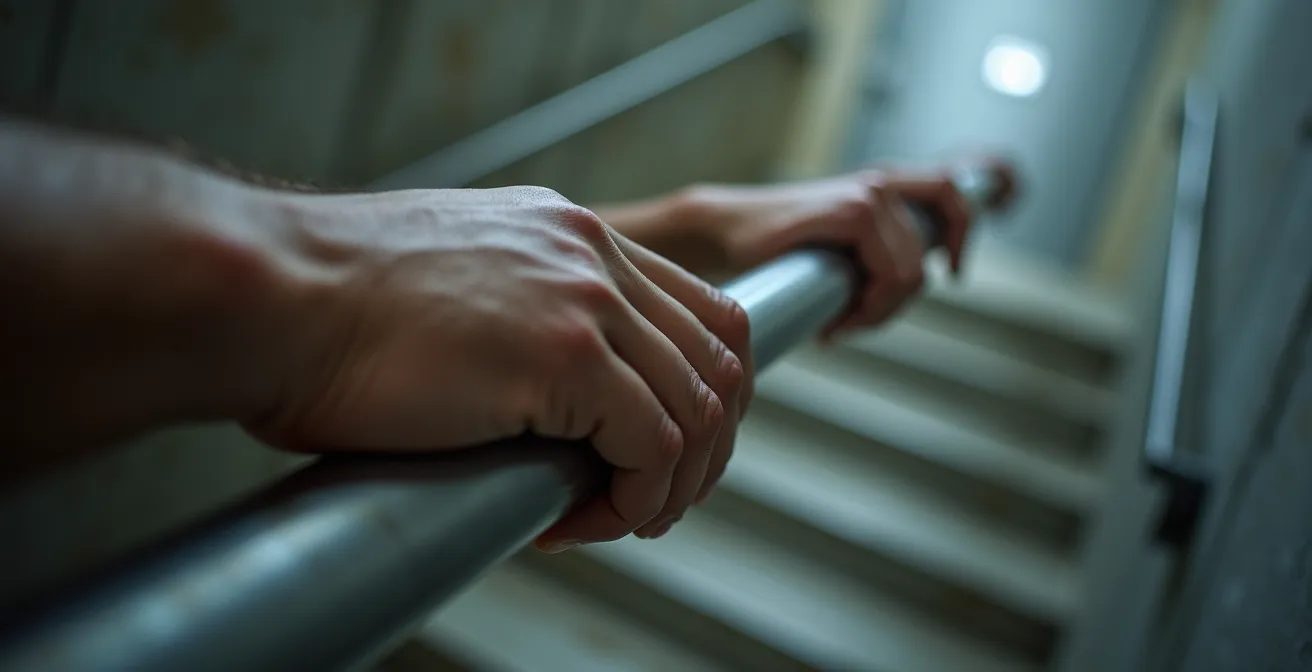
As this image illustrates, the focus is on a firm, continuous grip. This technique, combined with a strict “single-file” and “no-items” policy, creates a smooth, predictable flow of people. It prevents the stop-and-go dynamic that occurs when someone drops an item or loses their balance. High-rise wardens must be trained to enforce these rules vigorously but calmly, reminding evacuees that personal property is replaceable, but time is not. This disciplined approach to stairwell movement is a core competency for any high-rise emergency plan in a vertical city like Montreal.
By making these specific behaviors a central part of your evacuation drills, you can significantly reduce your building’s overall egress time and improve the safety of every single employee.
How to Conduct a Post-Drill Debrief That Actually Improves Future Response?
A drill without a debrief is simply a disruptive event. A debrief without structure is just a conversation. To extract real value and drive continuous improvement, you need a formal, multi-faceted performance debrief process. This process must address two distinct but equally important streams: operational effectiveness and psychological impact. Too often, leaders focus only on the tactical and logistical elements, ignoring the human factor. This is a critical mistake, especially when Mental Health Research Canada found that only 52% of managers believe they can identify when team members are struggling. A structured debrief creates a formal channel to gather this vital feedback.
The operational component, often called a “hot wash,” should occur almost immediately after the drill. This session is for designated responders (wardens, first aiders) to provide raw, unfiltered feedback on what worked and what failed. Was communication clear? Were exits accessible? Were there any unexpected bottlenecks? This feedback is purely tactical. The psychological support session, however, should be scheduled 24-48 hours later. This delay gives employees time to process the experience. It must be facilitated by a qualified mental health professional and positioned as a confidential support resource, not an operational review.
For a Montreal-based organization, this entire process must be documented rigorously to demonstrate due diligence for your Comité de santé et de sécurité and to create a paper trail for potential CNESST audits. This isn’t just good practice; it’s a core component of your legal and regulatory obligations.
Your Action Plan: Structured Debrief for CNESST Compliance
- Immediate Hot Wash: Within 2 hours of the drill’s conclusion, gather all designated responders (wardens, etc.) to document immediate operational feedback.
- Bilingual Communication Audit: Specifically rate the effectiveness and clarity of bilingual communications (French and English) during the drill. Were announcements understood by everyone?
- Scheduled Psychological Support: Schedule a voluntary psychological support session for all employees, facilitated by a mental health professional, 24-48 hours post-drill.
- Formal Report Generation: Generate a formal report summarizing both operational findings and key themes from the psychological support session for the Comité de santé et de sécurité.
- Create an Improvement Action Plan: From the report, create a prioritized list of corrective actions with assigned owners and deadlines. This is your proof of continuous improvement.
- Archive for Compliance: Archive all drill documentation, reports, and action plans for the mandatory 5-year retention period as part of your compliance records.
This structured approach ensures that every drill, regardless of its outcome, becomes a valuable investment in your organization’s resilience.
How to Run a Ransomware Tabletop Exercise with Your Executive Team?
In today’s interconnected world, an “active threat” is not always a physical one. A ransomware attack that paralyzes your operations, compromises employee data, and locks down building systems is a full-blown crisis. For an HR or Security Director, understanding the intersection of physical and cyber threats is no longer optional. A ransomware tabletop exercise with your executive team is the single most effective way to prepare them for the rapid, high-stakes decisions required during such an event. The goal is to simulate the pressure of a combined incident, forcing leaders to grapple with operational continuity, legal obligations, and crisis communications simultaneously.
The complexity in Quebec is amplified by the dual regulatory frameworks you must navigate. A physical incident falls primarily under CNESST, focused on worker safety. A data breach, however, is governed by the Commission d’accès à l’information (CAI) under Quebec’s Bill 25 (now officially known as the *Act to modernize legislative provisions as regards the protection of personal information*). A hybrid attack, such as ransomware that also disables security systems, requires parallel reporting and a coordinated response to both bodies. Your tabletop exercise must force executives to confront this dual-compliance reality, making decisions on containment, notification, and reporting under immense time pressure.
This comparative overview, based on guidance from Quebec’s official publications, illustrates the distinct but overlapping regulatory pressures your executive team would face in a hybrid crisis. The tabletop scenario should force them to manage both columns at once.
| Crisis Type | Regulatory Body | Reporting Timeline | Key Requirements |
|---|---|---|---|
| Physical Threat | CNESST | Immediate to 48 hours | Worker safety, evacuation, first aid |
| Data Breach (Bill 25) | Commission d’accès à l’information | Without delay | Notification, containment, risk assessment |
| Combined Incident | Both bodies | Parallel reporting | Coordinated response plan required |
By simulating these converged threats, you move your executive team’s preparedness from theoretical knowledge of Bill 25 to a practical understanding of what it means to lead during a full-spectrum corporate crisis.
The Emergency Exit Layout That Fails Inspection in 50% of Old Buildings
All the training and planning in the world is rendered useless if the emergency exit is blocked. In Montreal, with its rich stock of heritage buildings in areas like Old Montreal, the Plateau, and Westmount, this is not a theoretical problem. The unique, often labyrinthine layouts of these older structures, combined with modern renovations, can create non-compliant and dangerous exit pathways. Fire safety plans are often outdated, and exits can be inadvertently obstructed by new furniture, temporary storage, or even the effects of weather, such as a door swelling in the summer humidity or being blocked by snow from city plows in winter.
The responsibility for ensuring clear egress falls directly on the building operator and the employer under the Civil Code of Quebec. Liability in the event of an incident where exits are found to be blocked can be severe. This requires a proactive, year-round inspection mindset that goes beyond an annual check. It requires a dynamic process that accounts for Montreal’s distinct seasons. An exit that is clear in September may be blocked by a snowdrift in February. A door that opens easily in the dry winter air may jam due to humidity in July. Regular, documented inspections are your best defense, both for safety and for liability.
The Service de sécurité incendie de Montréal (SIM) is unequivocal: all escape routes, including balconies, corridors, and stairwells, must be kept clear at all times. A simple but rigorous checklist is an essential tool for your facility managers or health and safety committee.
Your Audit Checklist: Montreal Seasonal Emergency Exit Inspection
- Winter Check (Dec-Mar): Verify that all ground-level exits are clear of snow and ice, paying special attention to areas where city plows may create blockages. Test doors for freezing.
- Summer Check (Jun-Aug): Inspect all exit doors, particularly wooden ones in older buildings, for swelling and jamming caused by high humidity. Ensure they open freely.
- Year-Round Storage Audit: On a monthly basis, walk all exit routes to verify that no storage boxes, furniture, cleaning equipment, or other items are obstructing the path or the door itself.
- Signage and Lighting Verification: Confirm that all exit signs remain illuminated whenever the building is occupied, as required. Test emergency lighting backup batteries quarterly.
- Lock and Latch Confirmation: Physically check every emergency exit door to confirm it has no illegal locks, chains, or bars that could trap people inside during an emergency. Ensure panic bars function correctly.
By implementing a rigorous, season-aware inspection protocol, you ensure that your building’s most fundamental safety feature is always ready to function as intended.
Key Takeaways
- Effective drills are built on psychological safety and transparency, not surprise and fear.
- Emergency roles must be assigned based on specific competencies tailored to Montreal’s unique building types (high-rise, RESO, heritage).
- A structured post-drill debrief, covering both operational and psychological feedback, is mandatory for continuous improvement and CNESST compliance.
Meeting Municipal Safety Standards for Large Outdoor Events in Montreal
Your duty of care as an employer doesn’t stop at the office door. For companies hosting or participating in large outdoor events in Montreal—be it a corporate gathering at Parc Jean-Drapeau during Osheaga or a client reception in the Quartier des Spectacles during the Jazz Festival—your emergency plan must extend to that environment. Here, your internal plan must integrate with a much larger, multi-agency security apparatus involving the SPVM, SIM, and Urgences-santé. The standards are rigorous and require a level of coordination far beyond a typical office evacuation.
The core principle is unified command. Your private security and designated staff must know how to communicate with and take direction from the on-site municipal commanders. This involves pre-planning and submitting your security plan to the Bureau des festivals et des événements culturels for approval. Your plan must identify designated ‘Run’ (evacuation) routes that account for city-specific bottlenecks like the Jacques-Cartier bridge, and ‘Hide’ locations within the venue. A critical component, often overlooked by non-local planners, is the designation of a fully bilingual spokesperson for crisis communications to ensure information reaches all attendees and stakeholders clearly and simultaneously in both French and English.
The protocol for coordinating with municipal services is detailed and specific to Montreal’s event landscape. It’s a masterclass in integrated security planning and provides a valuable framework for any organization operating in the city’s public spaces.
Your Action Plan: SPVM-SIM-Urgences-santé Coordination Protocol
- Establish Unified Command: Before the event, identify how your team will integrate with the unified command post, typically established by the SPVM or SIM for major events.
- Designate a Bilingual Spokesperson: Assign and train a primary and backup spokesperson fluent in both French and English, prepared to deliver coordinated messages approved by unified command.
- Map ‘Hide’ Locations: Pre-identify and map secure ‘Hide’ locations within the event venue (e.g., concrete structures, back-of-house areas) and communicate them to your staff.
- Plan ‘Run’ Routes: Develop primary and secondary ‘Run’ routes that specifically avoid known city bottlenecks (e.g., bridge access points, metro entrances during peak times).
- Integrate with SPVM: Ensure your private security team protocols are aligned with SPVM’s crowd control and response tactics. Conduct a joint briefing before the event.
- Submit for Approval: Submit your comprehensive security and emergency plan to the Bureau des festivals et événements culturels well in advance of the event date.
By understanding and integrating with these municipal standards, you ensure your organization is a responsible and prepared partner in the safety of our city’s vibrant public life, protecting your employees wherever they represent your company.