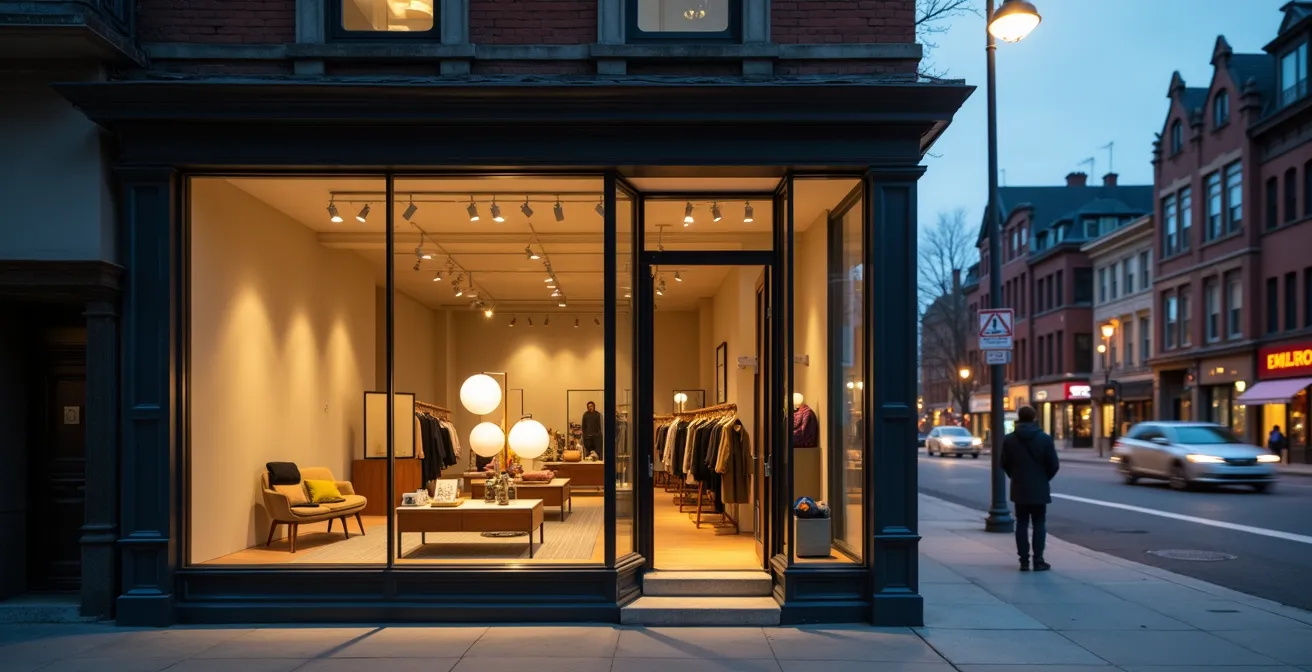
The effectiveness of storefront security in Montreal depends less on the material itself and more on the integrity of the entire window system.
- Basic security films often fail not because of the film, but because the entire pane of glass is pushed out of the frame during an attack.
- Quebec’s climate poses a unique thermal stress risk, potentially causing glass to fracture if the wrong film is applied to double-pane windows.
Recommendation: Prioritize professional installation with a structural attachment system and select a solution based on a specific threat assessment for your location, not just on material cost.
As a Montreal storefront owner, the threat of vandalism and smash-and-grab theft is a constant concern, particularly on bustling streets from Sainte-Catherine to Saint-Laurent. You’ve likely considered the standard solutions: security film or perhaps even robust polycarbonate shields. The common advice is to simply ‘reinforce the glass,’ but this perspective often misses the critical failure points that criminals exploit.
The debate isn’t merely about film versus plastic. It’s about understanding how these systems perform under real-world attack and within Montreal’s unique environmental and architectural landscape. Many business owners invest in a product only to find it fails because of a detail missed during installation or an incompatibility with their existing windows—a costly and frustrating mistake.
But what if the key to effective protection wasn’t just the strength of the film, but the bond that holds the entire system together? This guide moves beyond the surface-level comparison. We will analyze the specific vulnerabilities of glass security, from the force required to defeat different film thicknesses to the crucial installation techniques required for Quebec’s climate. We’ll examine why standard double-glazing is insufficient and how even your store’s layout plays a role in a holistic security strategy.
This article will provide a practical, consultant-level analysis to help you make an informed decision. The following sections break down the critical factors you must consider to truly secure your Montreal retail space, ensuring your investment provides genuine peace of mind.
Summary: A Consultant’s Guide to Montreal Retail Security
- Why 4-Mil Security Film Is Not Enough to Stop a Sledgehammer Attack?
- The Installation Step Most DIYers Miss That Makes Security Film Useless
- Clear Film vs Tinted Security Laminate: Which Best Suits High-End Boutiques?
- The Risk of Thermal Fracture When Applying Film to Double-Pane Windows
- When Is the Best Time of Year to Apply Security Film in Quebec?
- Why Standard Double Glazing Offers Zero Protection Against Smash-and-Grab Theft?
- How to Arrange Gondolas to Eliminate Blind Spots for Cameras?
- Which Proactive Threat Prevention Measures Best Secure Downtown Montreal Retailers?
Why 4-Mil Security Film Is Not Enough to Stop a Sledgehammer Attack?
When evaluating security film, it’s crucial to match the product’s strength to the anticipated threat. A common misconception is that any security film provides robust protection. However, the thickness of the film—measured in “mils” (thousandths of an inch)—directly correlates to its resistance against different types of force. For a determined attacker using a heavy tool like a sledgehammer, a standard 4-mil security film is often insufficient.
A 4-mil film is designed primarily for safety and basic smash-and-grab deterrence. It will hold shattered glass together, preventing dangerous shards from flying and making entry slightly more difficult for an unprepared vandal. However, it only offers a minimal delay. A persistent assault with a heavy object will quickly compromise the window. To effectively counter a more aggressive attack, you must consider thicker, more resilient options. An 8-mil or even 12-mil film significantly increases the time and effort required for a breach, moving from a few seconds of resistance to over a minute. This added delay is often the single most important factor in deterring theft, as it increases the criminal’s exposure and risk of being caught.
The following table illustrates how cost and protection level scale with film thickness, providing a clear framework for assessing your needs against your budget.
| Film Thickness | Cost per Square Foot (CAD) | Installation Time | Protection Level |
|---|---|---|---|
| 4-mil | $6-$8 | 30 seconds delay | Basic smash protection |
| 8-mil | $10-$15 | 45+ seconds delay | Enhanced security |
| 12-mil | $15-$25 | 60+ seconds delay | Maximum deterrent |
Ultimately, selecting a 4-mil film is a valid choice for mitigating accidental glass breakage or deterring a low-effort snatch-and-grab. But for any Montreal retailer concerned about determined criminals, it should be seen as the bare minimum, not a comprehensive solution.
The Installation Step Most DIYers Miss That Makes Security Film Useless
The single greatest point of failure for security window film is not the film itself, but the way it’s attached—or not attached—to the window frame. Many DIY installers, and even some inexperienced professionals, simply apply the film to the glass surface. While this will hold the pane together upon impact, it does nothing to stop a criminal from pushing the entire sheet of shattered-but-intact glass out of the frame in one piece. This is the critical, and often missed, step that renders the security investment worthless.
As security experts at Protex Canada note, the primary function of the film is to “retain shards of glass during an event of breakage.” But retention within the pane is only half the battle. To create a truly resilient barrier, the film must be physically anchored to the window frame.
This is achieved using a technique called an attachment system. The most common method involves applying a bead of specialized structural silicone around the perimeter of the window, bonding the edge of the security film directly to the frame. This creates a unified system where the film, glass, and frame work together to resist force. Without this bond, you don’t have a security window; you simply have a large, flexible sheet of broken glass that can be easily dislodged. For older buildings in areas like Old Montreal, verifying the condition of wooden frames is a crucial pre-installation step to ensure a solid anchor point.
Checklist for a Secure Installation in Montreal’s Climate
- Glass Compatibility: Clean the glass surface thoroughly and verify the glass type is compatible with the chosen film to prevent thermal issues.
- Frame Attachment: Insist on a structural silicone attachment system to bond the film directly to the window frame, creating system integrity.
- Optimal Temperature: Ensure the film is installed when the ambient temperature is between 5°C and 30°C for proper adhesive curing.
- Curing Time: Allow for a 24-48 hour curing period, which can vary based on Quebec’s fluctuating humidity levels, before cleaning the window.
- Final Inspection: Inspect the bond for proper adhesion to the frame, paying special attention to any signs of weakness, especially on older frames.
In short, skipping the attachment system is like buying a high-security lock but forgetting to install the deadbolt. The film might be strong, but without being anchored, it cannot do its job.
Clear Film vs Tinted Security Laminate: Which Best Suits High-End Boutiques?
For high-end boutiques in prestigious Montreal districts like Westmount or on Sherbrooke Street, storefront aesthetics are non-negotiable. The window display is a silent salesperson, and its clarity is paramount. This creates a dilemma: how to enhance security without compromising the visual appeal of luxury merchandise? The choice between a completely clear film and a tinted security laminate becomes a key strategic decision.
For most luxury retailers, optically clear security film is the superior choice. Modern clear films are virtually invisible once installed, ensuring that product visibility, colour accuracy, and natural light are unaffected. This allows for maximum aesthetic preservation, maintaining the high-end brand image that is crucial for attracting discerning clientele. The security function is completely discreet, providing robust protection without ever signaling its presence to customers.

While tinted films offer added benefits like daytime privacy and reduced glare, they fundamentally alter the appearance of the storefront. This can be undesirable for brands that rely on open, inviting, and transparent displays. However, it’s important to note that even clear films can offer advanced features. Many high-quality clear films are “spectrally selective,” meaning they block a significant amount of UV radiation and infrared heat without affecting visible light. This not only protects valuable merchandise from fading but can also lead to energy savings, adding a practical benefit beyond security. For instance, some solar films that offer these benefits can have an initial cost between $8-$14 per square foot while providing year-round energy savings in Quebec’s climate.
Unless a specific privacy goal is intended (e.g., for a private showroom or fitting area), high-end boutiques should almost always opt for a premium, clear, spectrally selective security film. It provides the necessary protection without sacrificing the most valuable asset: the store’s visual identity.
The Risk of Thermal Fracture When Applying Film to Double-Pane Windows
One of the most overlooked but critical risks when installing window film in Quebec is thermal stress fracture. This phenomenon occurs when a portion of the glass heats up faster than an adjacent portion, creating stress that can cause the pane to crack. Applying a solar control or security film, especially a tinted one, increases the amount of solar energy absorbed by the glass, raising its temperature and exacerbating this risk. This is particularly dangerous for double-pane (or insulated glass units – IGUs) and annealed glass, which is common in many commercial buildings.
In Montreal, with our intense summer sun and frigid winters, the temperature differential on a single pane of glass can be extreme. A south-facing window can absorb significant heat, and if a dark film is applied, the risk of fracture increases dramatically. As 3M Canada experts confirm, a professional installer must verify glass and film compatibility before any application to prevent this costly damage. Factors like window orientation, glass type (annealed vs. tempered), and the film’s Visible Light Transmission (VLT) percentage must be carefully assessed.
The chart below provides a simplified risk assessment based on these factors, highlighting high-risk scenarios for Montreal businesses. A dark film (low VLT) on a south-facing annealed glass window represents a significant gamble.
| Window Orientation | Glass Type | Film VLT % | Winter Risk Level |
|---|---|---|---|
| South-facing | Annealed | <30% | HIGH |
| South-facing | Tempered | <30% | MEDIUM |
| North-facing | Annealed | >50% | LOW |
| North-facing | Tempered | Any | LOW |
This is not a risk to be taken lightly. A thermal fracture will require a complete window replacement, negating any benefit from the film. Always work with an experienced consultant who can perform a proper thermal compatibility analysis before you commit to a specific film.
When Is the Best Time of Year to Apply Security Film in Quebec?
While security is a year-round concern, the physical installation of window film is a process highly sensitive to weather. In Quebec’s climate of extremes, choosing the right time of year for application is crucial for ensuring the film’s longevity and effectiveness. The key lies in the curing process of the film’s adhesive, which requires a specific range of temperature and humidity to bond properly to the glass.
As a HomeStars window installation guide points out, weather conditions like humidity and temperature can directly affect adhesion. Installing film when it’s too cold (below 5°C) can prevent the adhesive from activating correctly, leading to a weak bond, peeling, and bubbling. Conversely, installing on an extremely hot and humid day can cause the application solution to evaporate too quickly, making a smooth, bubble-free installation difficult.
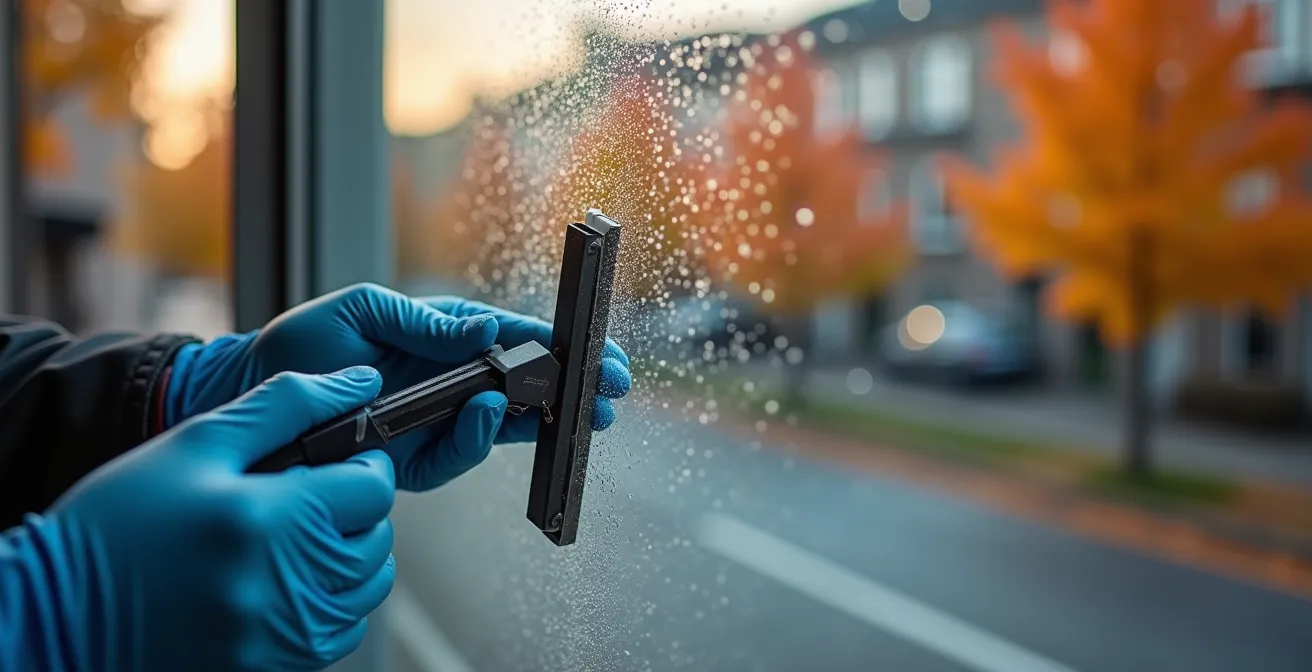
For Montreal retailers, the ideal installation windows are during the milder “shoulder seasons.” This ensures the temperature remains within the optimal range for the 24-48 hours required for the initial cure.
- Ideal Seasons: The stable temperatures of late spring (May-June) and early fall (September-October) are perfect. Humidity is typically lower, and the 15-25°C temperature range is optimal for adhesive bonding.
- Seasons to Avoid: It is strongly recommended to avoid installation during the coldest winter months (December through March). The frigid temperatures will almost certainly compromise the long-term integrity of the bond.
Beyond the weather, consider your business cycle. Scheduling the installation during a slower period, like late April after the Easter rush or early November before the holiday frenzy, can minimize disruption to your operations.
Why Standard Double Glazing Offers Zero Protection Against Smash-and-Grab Theft?
Many retailers believe that their modern, double-glazed windows offer a degree of security. This is a dangerous misconception. Standard double-glazing (or an Insulated Glass Unit) is designed for one primary purpose: thermal insulation, not impact resistance. The air or gas gap between the two panes of glass is excellent for reducing heat transfer, but it does nothing to strengthen the glass itself.
Both panes in a standard unit are typically made of annealed glass, the most common and weakest type of glass. It shatters easily upon impact. A brick, hammer, or even a spark plug thrown with force will instantly break the outer pane, and a second quick strike will defeat the inner one. For a smash-and-grab thief, this process takes less than two seconds. While some Canadian cities are seeing a major rise in such crimes, with a 31.5% jump in Toronto break-ins, the situation in Montreal is more nuanced. According to the SPVM, “no significant increase of breaking and entering was observed” in the past year. However, this statistic doesn’t mean retailers are safe. The threat simply shifts to the fast, opportunistic smash-and-grab, a crime that standard windows are powerless to stop.
The false sense of security provided by double-glazing is a significant vulnerability. It’s not a barrier; it’s a target waiting to be broken. The only way to add impact resistance is by reinforcing the glass with security film or replacing it entirely with a stronger material like laminated glass or polycarbonate.
Treating your existing windows as a thermal barrier and nothing more is the first step toward building a realistic and effective security plan. They offer no meaningful delay against a physical attack.
How to Arrange Gondolas to Eliminate Blind Spots for Cameras?
A truly secure retail environment extends beyond the front window. A holistic approach—what we call system integrity—considers what happens after a breach. Your store’s internal layout, specifically the arrangement of shelves and gondolas, plays a vital role in surveillance and loss prevention. A poorly planned layout creates blind spots, giving thieves opportunities to conceal themselves and merchandise, rendering your security cameras ineffective.
The goal is to create clear, unobstructed sightlines from your cash wrap and camera locations to all corners of the store. This “fishbowl effect” makes it difficult for anyone to go unnoticed. By strategically arranging your fixtures, you can maximize visibility and deter internal theft just as much as external threats.
Here are key principles for optimizing your store layout, based on recommendations for Montreal retail spaces:
- Keep Central Aisles Low: Use low-profile gondolas, ideally no taller than 4 feet (approx. 1.2 meters), in the center of your store. This allows staff and cameras to see over the fixtures easily.
- Lower Perimeter Shelving: Keep shelving along the walls below 5 feet (approx. 1.5 meters) where possible to maintain open sightlines across the entire floor.
- Increase the Grab-Zone Distance: Place high-value, easily portable items at least 10 feet away from the entrance. This increases the distance a smash-and-grab thief would need to cover, buying valuable seconds.
- Optimize Camera Placement: Install cameras in the diagonal corners of your retail space to create overlapping fields of view and eliminate blind spots.
- Ensure Proper Clearance: Maintain a minimum of 3 feet of clearance between gondolas and other fixtures to ensure wide, clear pathways and camera angles.
This internal arrangement is a low-cost, high-impact measure that complements your physical barriers. It creates an environment where potential thieves feel exposed and visible, a powerful deterrent in itself.
Key takeaways
- Standard 4-mil film is a minimal deterrent; 8-mil or 12-mil films are necessary to significantly delay a determined attacker.
- The single most critical installation step is bonding the film to the window frame with a structural silicone attachment system.
- In Quebec’s climate, a thermal stress analysis is mandatory before applying film to double-pane windows to prevent glass fracture.
Which Proactive Threat Prevention Measures Best Secure Downtown Montreal Retailers?
We’ve established that the choice of security is a complex one, involving threat levels, aesthetics, and climate-specific risks. Now we return to the central question: for a downtown Montreal retailer, what is the best proactive measure—security film or polycarbonate shields? The answer depends on a final analysis of your specific needs, balancing budget, desired security level, and aesthetic constraints, especially for those in heritage-designated areas.
Security Film (8-mil or thicker) represents the best balance for most retailers. When professionally installed with a proper attachment system, it provides a high level of deterrence against smash-and-grab attacks. Its primary advantage is its invisibility. It doesn’t alter the look of your storefront, making it the go-to choice for high-end boutiques and a mandatory one for many heritage buildings in Old Montreal where external modifications are forbidden. It’s a cost-effective, discreet, and powerful upgrade.
Polycarbonate Shields, on the other hand, represent maximum security. These clear, shatterproof panels are installed over your existing glass. They are significantly stronger and more expensive than film and can stop even the most determined attacks with heavy tools. However, their main drawback is their visibility. While clear, they are a visible barrier that can detract from a high-end aesthetic and may not be approved for use on heritage properties. They are the best choice for businesses that prioritize security above all else, such as jewelers or electronics stores in high-risk areas.
| Feature | Security Film | Polycarbonate Shields |
|---|---|---|
| Cost per sq ft | $10-$25 installed | $40-$80 installed |
| Aesthetics | Invisible/Clear | Visible barrier |
| Heritage compliance | Usually approved | Often restricted |
| Installation time | 1-2 days | 3-5 days |
| Protection level | High deterrent | Maximum security |
The optimal strategy involves a professional consultation to assess your specific vulnerabilities. By analyzing your location, merchandise, and building type, a security expert can recommend the ULC-certified solution that provides the most effective protection for your investment.
Frequently Asked Questions About Storefront Security in Montreal
Can security film be installed on heritage buildings in Old Montreal?
Yes, clear security film is typically the only approved security upgrade for heritage-designated buildings as it doesn’t alter the window’s appearance. It strengthens the existing glass without changing the historical aesthetic, making it a preferred solution for compliance.
Will security film qualify for insurance discounts in Quebec?
It often can, but policies vary. It is essential to contact your Quebec insurance broker to verify which ULC-certified solutions (Underwriters Laboratories of Canada) qualify for commercial premium discounts before you invest in a system.
How long does security film last in Montreal’s climate?
When professionally installed, quality films from leading manufacturers like 3M or LLumar typically have a lifespan of 15-20 years. The warranty covers issues like peeling or bubbling, ensuring long-term performance even with Montreal’s extreme temperature swings.
Does security film make windows bulletproof?
No. Standard security films are designed to resist impact from blunt objects like hammers or bricks. They are not rated for ballistic threats. Bullet-resistant glass is a much thicker, multi-layered specialty product and is significantly more expensive.