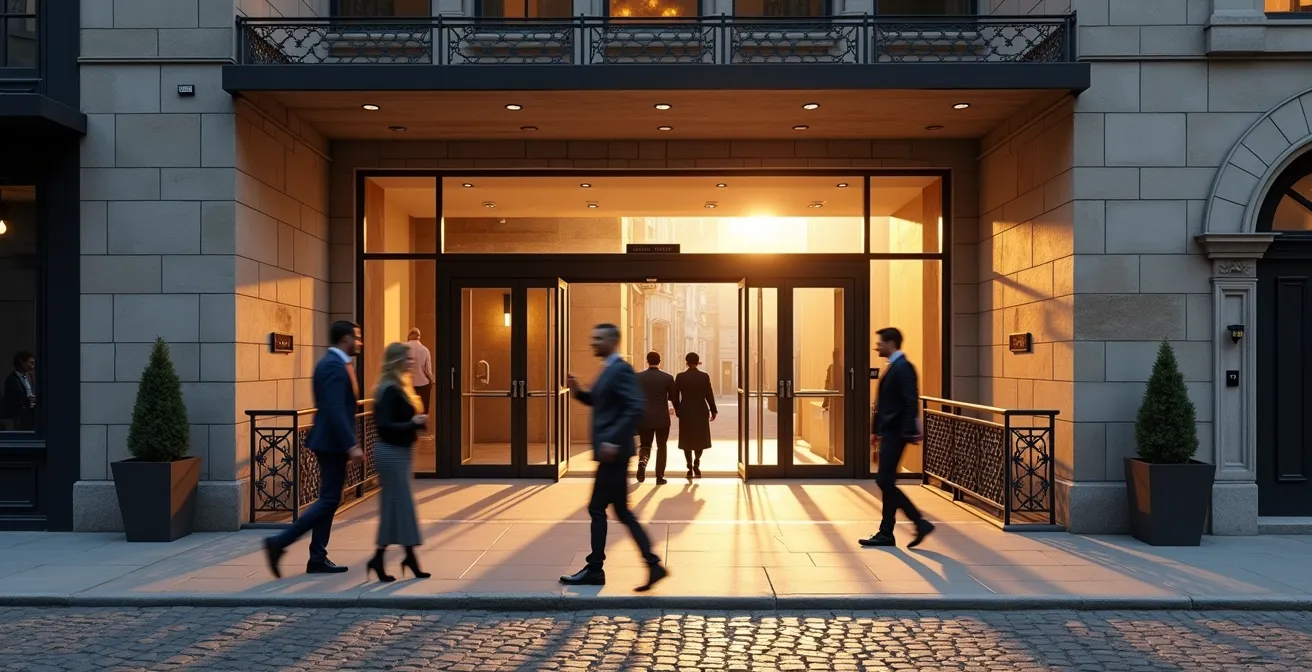
Upgrading your Old Montreal shop for accessibility isn’t about avoiding fines; it’s a strategic investment that boosts business by creating a welcoming space for everyone.
- Heritage constraints can be catalysts for beautiful, compliant designs that enhance your building’s character.
- Financial support, like Montreal’s PAAC subsidy program, exists specifically to help small businesses fund these crucial retrofits.
Recommendation: Start with a simple self-audit of your entrance, signage, and washrooms to identify high-impact, low-cost improvements you can make today.
As a shop owner in Old Montreal, the charm of your historic building is your greatest asset and, seemingly, your biggest challenge. You want to create a space that’s open and welcoming to every potential customer, but the thought of navigating heritage regulations and complex building codes to improve accessibility can feel overwhelming. The fear of costly fines or making a mistake that compromises your building’s integrity is real. Many owners feel trapped, believing that true accessibility is an expensive, bureaucratic nightmare reserved for new constructions. This often leads to inaction, leaving potential revenue and goodwill on the table.
The common advice to “just follow the law” or “install a ramp” barely scratches the surface of the issue. It ignores the unique context of a cobblestone street and a 19th-century facade. But what if the key wasn’t just about compliance, but about opportunity? What if retrofitting for accessibility could be a creative process that enhances your brand and directly contributes to your bottom line? The truth is, a more accessible storefront is a more profitable one. With Montreal’s overall foot traffic having seen an 11% increase since March 2020, capturing every possible visitor is more important than ever.
This guide is designed to shift your perspective from obligation to opportunity. We will move beyond the fear of fines and into the realm of proactive, intelligent design. We will explore practical, heritage-sensitive solutions for everything from your entrance and signage to the often-overlooked well-being of your own staff. You will discover how to turn regulatory constraints into a competitive advantage, making your historic shop a model of modern inclusivity and a more successful business.
This article provides a detailed roadmap for retrofitting your space. Below, you will find a summary of the key areas we will cover to help you navigate this process with confidence.
Summary: A Proactive Guide to Accessibility in Old Montreal
- Why Accessible Entrances Increase Retail Foot Traffic by Over 20%?
- How to Design a Wheelchair Ramp When You Have Limited Sidewalk Space?
- Push Plate or Motion Sensor: Which Automated Door Opener Suits Winters Best?
- The Grab Bar Mistake That Makes Your ‘Accessible’ Washroom Non-Compliant
- How to Audit Your Wayfinding Signage for Visual Impairment Compliance?
- How to Retrofit Historic Old Montreal Facades with Modern Security Frames?
- How to Adjust a Kitchen Chair for 8 Hours of Work Without Back Pain?
- Key Municipal Standards: 3 Compliance Traps for Montreal Property Managers
Why Accessible Entrances Increase Retail Foot Traffic by Over 20%?
An accessible entrance is more than a legal requirement; it’s your most powerful invitation. For every person who uses a wheelchair, many more benefit from a barrier-free entryway: parents with strollers, seniors with limited mobility, delivery personnel, and even shoppers carrying heavy bags. By removing a simple one-step barrier, you are not just accommodating a few individuals, you are signaling to the entire community that your business is thoughtful, modern, and open to all. This perception has a direct and measurable impact on foot traffic and sales. It’s a simple equation: the easier it is to get into your store, the more people will enter.
The business case is compelling. For example, studies have shown that foot traffic in retail stores located near public transportation hubs increased by 25% in 2023. This highlights a population that relies on accessible pathways from transit to storefront. An inaccessible entrance breaks that chain and forfeits that customer. The positive impact extends beyond a single transaction. A welcoming experience builds loyalty and generates positive word-of-mouth, turning your shop into a preferred destination for a diverse customer base.
Recognizing this, the City of Montreal has created a powerful incentive. The Retail Business Accessibility Program (PAAC) is specifically designed to help you make these upgrades. The program offers a subsidy that can cover up to 90% of the cost of eligible work, with a maximum of $40,000. This isn’t just about avoiding fines; it’s a partnership. The city is actively investing in businesses like yours because it understands that universal accessibility is a cornerstone of a vibrant, thriving commercial district. This program transforms a potential capital expense into a manageable, high-ROI project.
How to Design a Wheelchair Ramp When You Have Limited Sidewalk Space?
The narrow, historic sidewalks of Old Montreal present a classic accessibility dilemma. How do you install a compliant ramp without obstructing pedestrian flow or violating heritage bylaws? The answer lies in smart, integrated design, not bulky, temporary solutions. The goal is heritage integration—making the ramp look like it has always been a part of the building’s original character. This requires a shift from thinking about a ramp as an add-on to seeing it as a seamless architectural feature. Solutions can include recessed ramps, low-profile designs that follow the building’s lines, or elegant, removable systems approved for historic districts.

As shown in the image, modern materials can blend beautifully with historic ones when the design is thoughtful. The choice of material is critical for both compliance and aesthetics. A generic aluminum ramp can feel out of place, but materials like wrought iron or reclaimed stone can enhance your facade’s prestige. Your choice will impact cost, maintenance, and, most importantly, the likelihood of approval from heritage authorities.
To demystify this choice, consider the following comparison based on solutions commonly reviewed for Montreal’s heritage buildings. This table helps you weigh the options not just on price, but on their long-term viability and aesthetic fit.
| Material | Heritage Approval Likelihood | Cost Range | Maintenance |
|---|---|---|---|
| Wrought Iron | High | $$$ | Annual painting |
| Reclaimed Stone | Very High | $$$$ | Minimal |
| Steel with Heritage Finish | Medium-High | $$ | 5-year coating |
| Modular Aluminum | Medium | $ | Low maintenance |
Push Plate or Motion Sensor: Which Automated Door Opener Suits Winters Best?
An automated door is a cornerstone of a truly accessible entrance. For a business in Montreal, however, the choice of activation system—a classic push plate versus a modern motion sensor—comes with a critical consideration: winter. The harsh cold, ice, and snow can significantly affect the performance and reliability of these systems. While motion sensors offer a convenient, hands-free experience, their technology can be vulnerable in extreme weather. Studies and field reports show that extreme cold can affect the sensitivity of motion sensors, potentially causing them to malfunction or fail to detect a person, especially if obstructed by snow or frost.
Push plates, on the other hand, are generally more robust in frigid conditions. Their mechanical or hard-wired nature makes them less susceptible to temperature-induced failures. They provide a clear, intentional point of activation that is reliable year-round. For winter performance, the winner is clear: a well-placed, large-format push plate is the most dependable choice for an Old Montreal storefront. It guarantees that the door will open when needed, regardless of whether it’s -20°C or a sunny July afternoon. The design should be large enough to be easily pressed by someone with gloves or limited hand dexterity.
Winterizing your chosen system is also crucial. For push plates, ensure they are mounted at a height (typically 36-48 inches) that is accessible from a seated position and not likely to be buried by snowfall. If you must use a motion sensor for a specific application, consider investing in a unit with a built-in heater or a weather-protection cover. Furthermore, selecting a system with a flexible 12/24V AC/DC power input often ensures better reliability in cold weather compared to battery-operated models. The goal is to provide consistent, reliable access every day of the year.
The Grab Bar Mistake That Makes Your ‘Accessible’ Washroom Non-Compliant
Installing grab bars in your washroom seems straightforward, but it’s one of the most common areas for compliance failures. The single biggest mistake is improper mounting. A grab bar that is not anchored correctly into wall studs or solid blocking is not just non-compliant; it’s a dangerous liability. In many of Old Montreal’s heritage buildings, walls are made of lath and plaster, which provides no structural support on its own. Simply using drywall anchors is a recipe for disaster. The bar will fail under load.
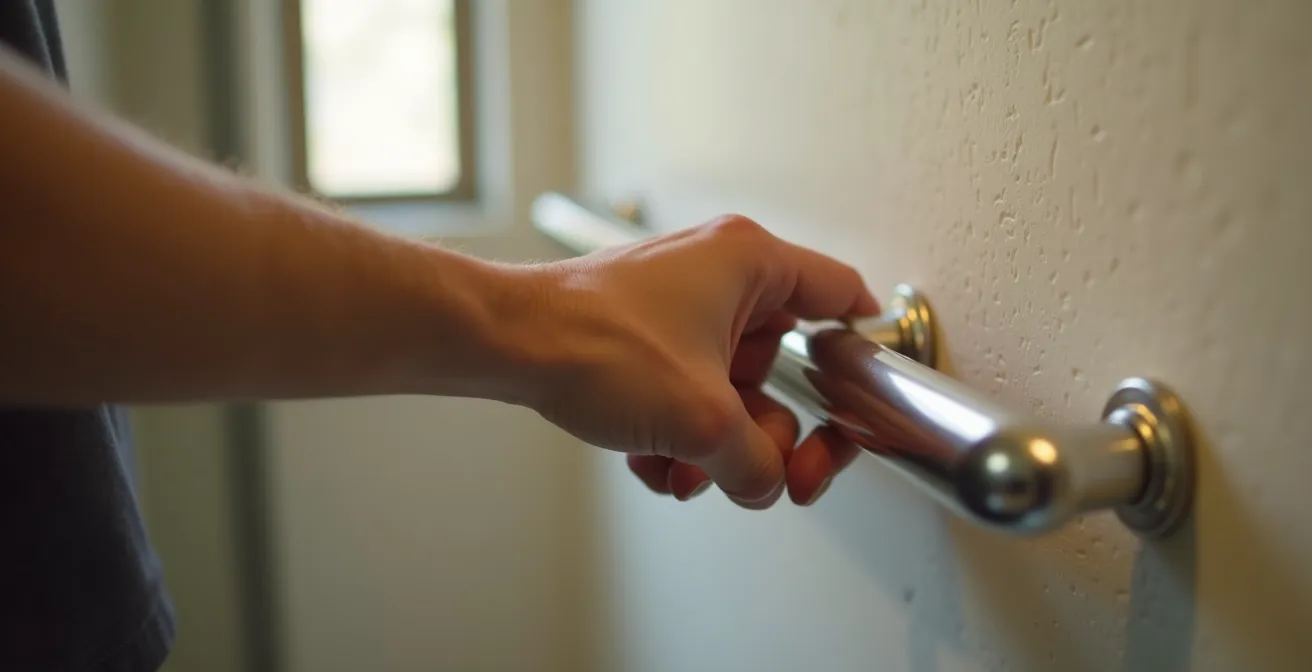
Beyond secure mounting, two other “compliance traps” frequently emerge: incorrect clearance and height. According to Canadian standards, there must be a specific amount of space between the bar and the wall to allow for a secure grip. Similarly, the height from the floor is precisely defined. Getting these measurements wrong by even a few centimetres can render the installation non-compliant and unhelpful to the user. A proper installation feels intuitive and provides confident support, as the user in this image experiences.
To avoid these pitfalls, you must adhere strictly to the specifications outlined in accessibility standards like the CSA B651. For instance, grab bars must be able to support a minimum load of 1.3 kN (approximately 290 lbs) applied from any direction, a requirement that highlights the need for robust structural anchoring. The clearance between the grab bar and the wall must be between 35-45mm (about 1.5 inches), and horizontal bars should be mounted 750-850mm (about 30-33 inches) from the finished floor. These aren’t suggestions; they are precise engineering requirements for safety and usability.
How to Audit Your Wayfinding Signage for Visual Impairment Compliance?
Effective wayfinding signage is a critical component of a holistically accessible space, guiding everyone safely and efficiently. For individuals with visual impairments, clear and compliant signage is not a convenience—it’s essential. In Quebec, this goes beyond simple text and symbols; it involves specific rules on contrast, tactile elements, and language. A common oversight is failing to meet the minimum 70% luminance contrast between the text and its background, which is necessary for readability for people with low vision. Another is forgetting that in Canada, accessibility standards strongly emphasize bilingual signage and the use of international symbols, a crucial consideration given Montreal’s context.
The solution is to perform a systematic audit of your existing and planned signage using the correct standards as your guide. In this context, the CSA B651-18 standard is your primary reference. The materials you choose can also play a role in both compliance and aesthetics. For a heritage setting, you can move beyond plastic. Materials like etched brass or routed wood can provide the necessary tactile feedback (raised characters and Braille) while respecting and enhancing the historical character of your building. This is another example of “heritage integration” at work.
To help you begin, here is a practical checklist based on the key requirements of the CSA B651-18 standard, contextualized for a business in Montreal. Use this to walk through your space and identify areas for improvement.
Your Essential Signage Compliance Checklist: Key Points to Verify
- Verify minimum 70% luminance contrast between text and background.
- Ensure tactile characters are raised 0.8mm to 1.5mm from the surface.
- Check that Grade 2 Braille is correctly positioned directly below the tactile text.
- Confirm sign mounting height is between 1200mm and 1500mm from the floor to the centreline of the sign.
- Validate that both French and English text comply with Quebec’s Charter of the French Language requirements.
How to Retrofit Historic Old Montreal Facades with Modern Security Frames?
For a ground-floor retail business, security is as important as accessibility. The challenge in Old Montreal is integrating modern security features, like robust door and window frames, without compromising the building’s priceless heritage facade. The key is to think of security and accessibility not as separate projects, but as a single, integrated upgrade. A new, secure door frame is the perfect opportunity to also install an automatic door opener. A redesigned entryway can improve both surveillance sightlines and barrier-free access.
Heritage authorities in Montreal are not against security; they are against incongruous and damaging alterations. Successful retrofits use high-quality materials that mimic historical profiles while incorporating modern technology. For example, slim-profile steel frames can offer superior strength to bulky aluminum while being less visually intrusive. The approval process hinges on demonstrating that your proposed solution is respectful of the building’s character. Often, this means concealing hardware or choosing finishes that are appropriate for the period. As the city-wide push to retrofit older infrastructure like the STM network shows, there is a recognized need to modernize, but it must be done thoughtfully.
It’s also important to understand the financial context of this work. Any significant restoration work on a heritage building is an investment. The City of Montreal’s support programs often have thresholds to qualify for subsidies. For instance, under the restoration program for heritage buildings, the total cost of restoration work must be at least $5,000 to be eligible for aid. This encourages owners to bundle smaller projects into a more comprehensive—and ultimately more coherent—renovation. Combining your security and accessibility upgrades can help you meet these thresholds and access financial support for the entire project.
How to Adjust a Kitchen Chair for 8 Hours of Work Without Back Pain?
A truly accessible business thinks about everyone, including the people who make it run: your employees. While customer-facing accessibility is crucial, creating a safe and comfortable environment “back-of-house” is equally important for inclusivity, morale, and productivity. An employee struggling with back pain from an unsuitable chair or navigating a cluttered stockroom is not able to perform at their best. This is not just an ergonomic issue; it’s an accessibility issue. A holistic approach means ensuring your staff areas are as thoughtfully designed as your sales floor.
This starts with the basics. For an employee working at a cash wrap, a packing station, or a small office, proper seating is paramount. A simple kitchen chair is not designed for prolonged use and can lead to chronic pain. An adjustable ergonomic chair with proper lumbar support is a small investment that pays dividends in employee well-being and reduced absenteeism. The principle extends beyond seating. Are your stockroom pathways wide enough for easy movement? Are prep surfaces at a comfortable, adjustable height? Is the staff washroom equipped with the same accessibility features as the public one?
Auditing your staff-only areas for accessibility is a proactive step that demonstrates your commitment as an employer. Key things to look for include ensuring clear pathways of at least 920mm (36 inches) in width, providing varied and accessible seating options in break areas, and making sure any workstations can be adapted to different body types and needs. By creating an environment where your team feels safe and supported, you foster a more positive and loyal workforce, which ultimately translates to better customer service.
Key Takeaways
- Accessibility is a business driver, not just a cost, with proven links to increased foot traffic and customer loyalty.
- Montreal offers specific financial aid (like the PAAC program) to help heritage property owners fund accessibility retrofits.
- True compliance goes beyond ramps, including details like grab bar mounting, signage contrast, and winter-proof door openers.
Key Municipal Standards: 3 Compliance Traps for Montreal Property Managers
Navigating the web of accessibility standards can be daunting because you are accountable to multiple levels of government. For an Old Montreal business, there are three primary jurisdictions to consider: municipal bylaws, the Quebec Building Code, and federal standards (like the Accessible Canada Act). The first compliance trap is assuming one standard covers all. They don’t. Each has different triggers and requirements, and you generally must meet the strictest of the applicable rules. For example, a renovation might trigger a municipal requirement that is more stringent than the provincial code for that specific element.
The second trap is misunderstanding the “trigger” for compliance. A common misconception is that accessibility rules only apply to new construction or massive renovations. In Montreal, often any renovation permit can trigger a requirement to upgrade accessibility features, even if the work itself seems unrelated. This is a critical point: your planned aesthetic refresh could legally require you to also upgrade your entrance or washroom. Knowing this in advance allows you to budget and plan accordingly, avoiding costly surprises and delays.
The third and most specific trap for Old Montreal is the sequence of approvals. You must always secure heritage approval before finalizing your accessibility design. Presenting a fully-formed plan that meets the building code but ignores heritage aesthetics will almost certainly be rejected, forcing you back to the drawing board. The process must be collaborative, involving heritage consultants from the very beginning. To clarify this complex landscape, the following table outlines the key differences in jurisdiction.
This table compares the triggers and standards across municipal, provincial, and federal levels, helping you understand which rules apply to your project.
| Requirement | Montreal (Municipal) | Quebec (Provincial) | Federal |
|---|---|---|---|
| Heritage Approval | Required first | N/A | N/A |
| Accessibility Trigger | Any renovation | Major renovation (>50% value) | 2040 deadline |
| Standards Applied | Local bylaws | Quebec Building Code | CSA B651 |
| Language Requirements | French priority | French mandatory | Bilingual |
By viewing accessibility as a proactive investment in your business and community, you can transform a perceived obligation into a powerful tool for growth. The next logical step is to begin your own accessibility audit with these principles in mind.
Frequently Asked Questions on Accessibility Compliance
What is the required load-bearing capacity for grab bars?
According to CSA standards, grab bars must be securely anchored to support a minimum of 1.3 kN (which is approximately 290 lbs or 132 kg) applied in any direction. This is why mounting into structural blocking is essential.
What clearance is needed between the grab bar and the wall?
A clear space of 35mm to 45mm (about 1.5 to 1.75 inches) must be maintained between the grab bar and the wall surface. This ensures a person can get a full, secure grip around the bar.
How high should horizontal grab bars be mounted?
Horizontal grab bars, such as those next to a toilet, should be mounted so that their height is between 750mm and 850mm (about 29.5 to 33.5 inches) from the finished floor to the top of the bar.