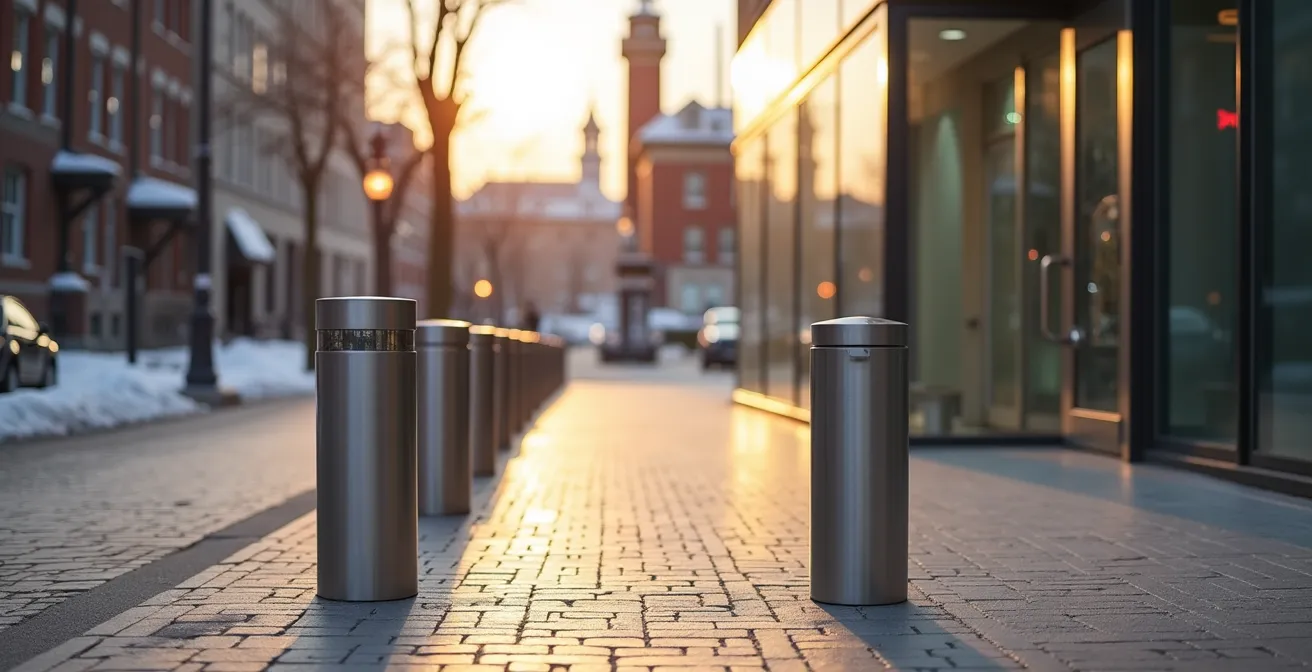
For Montreal landscape architects, selecting an anti-ram bollard is not a choice between safety and style, but a technical exercise in fusing them.
- Success requires understanding the physics of K-ratings versus real-world site constraints and threat levels.
- Engineers must plan for Montreal’s specific environment, from navigating subterranean utility mazes to specifying materials that resist corrosive road salt.
Recommendation: Prioritize a site-specific audit that balances crash-ratings, accessibility needs, and a long-term maintenance strategy against corrosion before any specification is finalized.
As a landscape architect in Montreal, your canvas is the urban fabric itself. You envision public plazas, corporate frontages, and pedestrian zones not just as spaces, but as experiences. The challenge arises when the need for perimeter security—specifically anti-ram bollards—enters the design brief. The default solution often conjures images of brutalist concrete blocks or purely functional steel posts that disrupt the aesthetic flow you so carefully curated. This creates a professional tension: how do you protect a space from a vehicle-borne threat without turning it into a fortress?
The conventional approach frames this as a simple trade-off between security and beauty. However, this perspective is fundamentally limited. The most successful and resilient public spaces in Montreal treat security not as an add-on, but as an integrated design element. The key is to move beyond the platitudes of “stopping cars” and “looking good” and embrace a more sophisticated viewpoint. This involves a deep understanding of the engineering realities, the specific environmental challenges of our city, and a holistic design philosophy.
The true task lies in a form of urban acupuncture: the precise, strategic placement of security elements that protect the vitality of a space without harming its character. It’s about mastering the aesthetic-security paradox. This requires balancing the unyielding physics of a crash-rated bollard with the fluid, human-centric design of a public square, all while navigating Montreal’s unique subterranean and climatic landscape.
This guide provides a structural and aesthetic framework for making these critical decisions. We will dissect the key engineering considerations and design principles, moving from the foundational science of crash ratings to the practicalities of installation, maintenance, and the holistic application of urban security protocols. The goal is to equip you with the knowledge to specify solutions that are not only effective but also elegantly integrated into Montreal’s unique identity.
Summary: A Landscape Architect’s Guide to Bollard Specification in Montreal
- K4 vs K12 Ratings: Which Bollard Stops a Moving Truck?
- How to Install Deep-Mount Bollards Without Hitting Downtown Utility Lines?
- Fixed vs Retractable Bollards: Which Is Best for Emergency Vehicle Access?
- The Maintenance Step That Saves Steel Bollards from Road Salt Corrosion
- How to Space Bollards to Stop Cars but Allow Strollers and Wheelchairs?
- Bicycle Rack vs Concrete Jersey: Which Barrier Stops Vehicle Attacks?
- When to Inspect Security Anchors: A Seasonal Maintenance Timeline
- Applying CPTED Principles to Montreal’s Urban Prevention Protocols
K4 vs K12 Ratings: Which Bollard Stops a Moving Truck?
The first and most critical decision in specifying a bollard is understanding its crash rating. This is not an aesthetic choice but a matter of physics. The “K-rating” system, now part of the broader ASTM F2656 standard, defines a barrier’s ability to stop a vehicle of a specific weight at a specific speed. A common misconception is that all bollards are created equal; in reality, the difference between a K4 and a K12 rating is immense. A K4 (or M30) rated bollard is certified to stop a 15,000-pound (6,800 kg) medium-duty truck traveling at 30 mph (48 km/h).
In contrast, a K12 (or M50) rated bollard must stop the same 15,000-pound truck moving at 50 mph (80 km/h). The kinetic energy at 50 mph is nearly three times greater than at 30 mph, demanding a significantly more robust foundation and bollard structure. For context, high-security specifications confirm that a K12 system can arrest a 15,000 lb vehicle at 50 mph with less than 1.2m of penetration. This is the level of protection required for critical infrastructure and high-threat government buildings.
For a landscape architect in Montreal, the choice is determined by a site-specific threat assessment. Is the goal to prevent accidental low-speed incursions in a pedestrian zone, or to defend a high-profile landmark against a determined hostile attack? The context dictates the engineering.
This table illustrates how different ratings apply to familiar Montreal locations, providing a clear framework for matching the level of protection to the site’s function and risk profile.
| Rating | Vehicle Weight | Impact Speed | Penetration | Montreal Application |
|---|---|---|---|---|
| K4/M30 | 15,000 lbs | 30 mph | <3 feet | Rue Prince-Arthur pedestrian zones |
| K8/M40 | 15,000 lbs | 40 mph | <3 feet | Commercial districts |
| K12/M50 | 15,000 lbs | 50 mph | <3 feet | Palais des Congrès, federal buildings |
Ultimately, specifying a K12 bollard where a K4 would suffice leads to unnecessary cost and construction complexity, while under-specifying creates a dangerous illusion of security. The architect’s role is to mediate this decision with precision.
How to Install Deep-Mount Bollards Without Hitting Downtown Utility Lines?
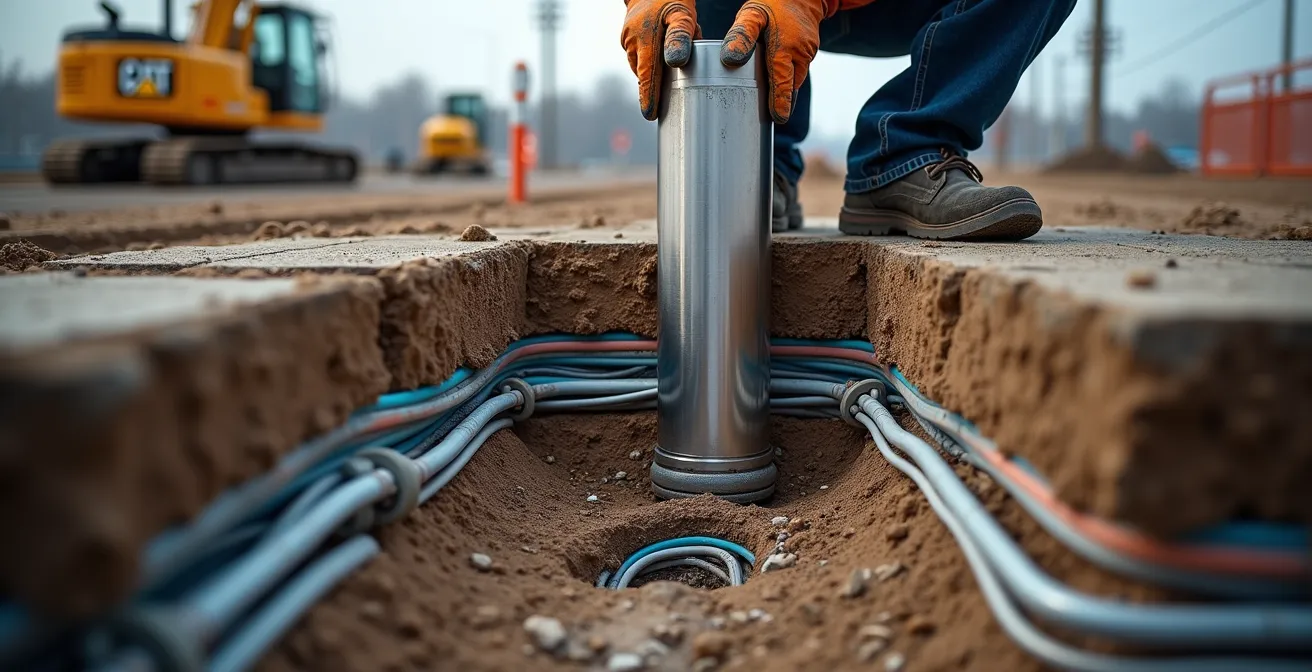
Once the crash rating is determined, the focus shifts from the physics above ground to the complex world below. The effectiveness of a deep-mount bollard is entirely dependent on its foundation, which can require excavation several feet deep. In a city as old and dense as Montreal, this presents a significant challenge: a subterranean maze of gas lines, water mains, fibre optic cables, and electrical conduits. Striking a utility line is not just an expensive mistake; it can be a catastrophic event. This is where the concept of subterranean cartography becomes a critical part of the design process.
Before a single shovel breaks ground, a thorough utility survey is non-negotiable. The first step, mandated by law in Quebec, is to contact Info-Excavation Quebec at least 72 hours before any digging. This service coordinates with various utility owners to mark the location of their underground infrastructure. However, these markings are often approximate. For the precision required in landscape architecture, Ground Penetrating Radar (GPR) surveys are often employed to create a more detailed 3D map of the subsurface, allowing for strategic placement of bollard foundations to avoid conflicts.
This cross-section view illustrates the challenge: a precise installation requires navigating a complex and often poorly documented underground environment. The foundation must be deep enough to provide the necessary resistance without compromising the city’s vital infrastructure.
The architect’s plans must account for this underground reality. It may be necessary to adjust bollard spacing or even select a different mounting type (such as shallow-mount systems) if the utility congestion is too severe. The design’s elegance is therefore contingent on a deep, technical understanding of what lies beneath the surface. It is a hidden constraint that has a powerful influence on the final visual outcome.
Ignoring this phase of due diligence introduces unacceptable risk to the project timeline, budget, and public safety. A truly resilient design is one that respects the city’s infrastructure both above and below ground.
Fixed vs Retractable Bollards: Which Is Best for Emergency Vehicle Access?
The next critical design decision addresses the operational needs of the site: should the perimeter be permanent or adaptable? The choice between fixed and retractable bollards hinges on the need for authorized vehicle access. For areas that must be permanently closed to traffic, fixed bollards offer the most robust, cost-effective, and low-maintenance solution. They are the silent sentinels of pedestrian-only zones.
However, many public spaces in Montreal require conditional access. Festival grounds, market streets, and building entrances need to allow passage for emergency services, delivery trucks, or maintenance vehicles. In these scenarios, retractable (or operable) bollards are essential. These systems can be lowered into the ground, clearing a path in seconds. High-performance automated systems can achieve an Emergency Fast Operation (EFO) in as little as 2 seconds, a critical feature when every moment counts for first responders.
A common concern for Montreal projects is the performance of mechanical systems during our harsh winters. The combination of extreme cold, snow, and ice can be a significant challenge for any operable equipment. However, modern retractable bollards are engineered for this reality. Canadian installations demonstrate that systems rated to -40°C, equipped with internal heating elements and installed over deep gravel drainage beds to prevent frost heave, can perform reliably. Indeed, successful Canadian installations have demonstrated over 10+ years of successful operation through the toughest winter conditions, proving their viability in the Quebec climate.
As the architect, your role is to analyze the flow and function of the space. Mapping the required access points for emergency and service vehicles will determine where an adaptable perimeter is not just a benefit, but a necessity. This ensures that in protecting the public, you are not inadvertently hindering those who serve it.
The Maintenance Step That Saves Steel Bollards from Road Salt Corrosion
A bollard’s life is not measured solely by its ability to withstand a single impact, but by its resilience over decades of environmental exposure. In Montreal, the single greatest threat to a steel bollard’s structural integrity is not a vehicle, but road salt. Canada uses a staggering five million tonnes of road salt every year, and this has a severe corrosive effect on steel infrastructure. Quebec studies estimate that de-icing salt causes between $469 and $1,450 per ton in infrastructure damage, a testament to its destructive power.
The cautionary tale of Montreal’s original Champlain Bridge, whose 57-year lifespan was significantly shortened by relentless salt-induced corrosion, serves as a powerful reminder for any infrastructure project in our climate. For a security bollard, corrosion is not merely a cosmetic issue; it’s a structural failure in the making. A heavily corroded bollard, or its anchor system, will not perform to its certified crash rating. Therefore, specifying the right material and a proactive maintenance plan is a non-negotiable aspect of the design.
The first line of defense is material selection. 316-grade stainless steel offers superior corrosion resistance compared to standard steel due to its molybdenum content. For carbon steel bollards, hot-dip galvanizing followed by a durable powder coat or paint system is essential. But even the best materials require care. The key is a disciplined, year-round maintenance protocol designed to combat the effects of chloride-induced corrosion from road salt. A proactive plan is the only way to ensure the bollard’s longevity and security function.
Action Plan: A Seasonal Bollard Maintenance Protocol
- Fall (Pre-Salt): Inspect and apply protective coatings and waxes to the bollard surface and base before the first salt application.
- Winter (Peak Salt): Conduct monthly visual inspections, focusing on the base where salt and slush accumulate, and rinse when possible during thaws.
- Early Spring (Post-Thaw): Perform a thorough pressure washing to remove all salt deposits from the bollard, its base, and the surrounding pavement.
- Late Spring (Structural Check): After the freeze-thaw cycles have ended, conduct a full structural inspection, checking for any tilting, cracks at the base, or loose anchors.
- Summer (Repair & Recoat): Address any surface corrosion or coating damage immediately with touch-up applications to prevent the corrosion from spreading.
By integrating a maintenance strategy into the initial design and specification, the landscape architect ensures the security investment remains effective for its entire intended lifecycle, preventing premature failure and preserving both safety and aesthetics.
How to Space Bollards to Stop Cars but Allow Strollers and Wheelchairs?
Effective perimeter security is a balancing act. The goal is to create a barrier that is impermeable to vehicles but remains completely permeable to people. This is the essence of the permeability vs. perimeter paradox. The spacing of bollards is therefore not an arbitrary decision but a carefully calculated dimension that defines the functionality of the public space. Placed too far apart, they fail to stop smaller vehicles. Placed too close together, they create an impassable barrier for people using wheelchairs, strollers, or delivery carts, violating accessibility laws and hindering the life of the plaza.
The standard guideline for spacing is typically between 3 and 5 feet (900mm to 1500mm) on center. However, the optimal distance is dictated by local context and regulations. As a designer in Montreal, you must account for the specific needs of the city’s inhabitants and infrastructure. This includes ensuring compliance with Quebec’s accessibility laws, which mandate clear passage for mobility devices, as well as considering the width of common urban tools like BIXI bikes and small sidewalk snow removal equipment.
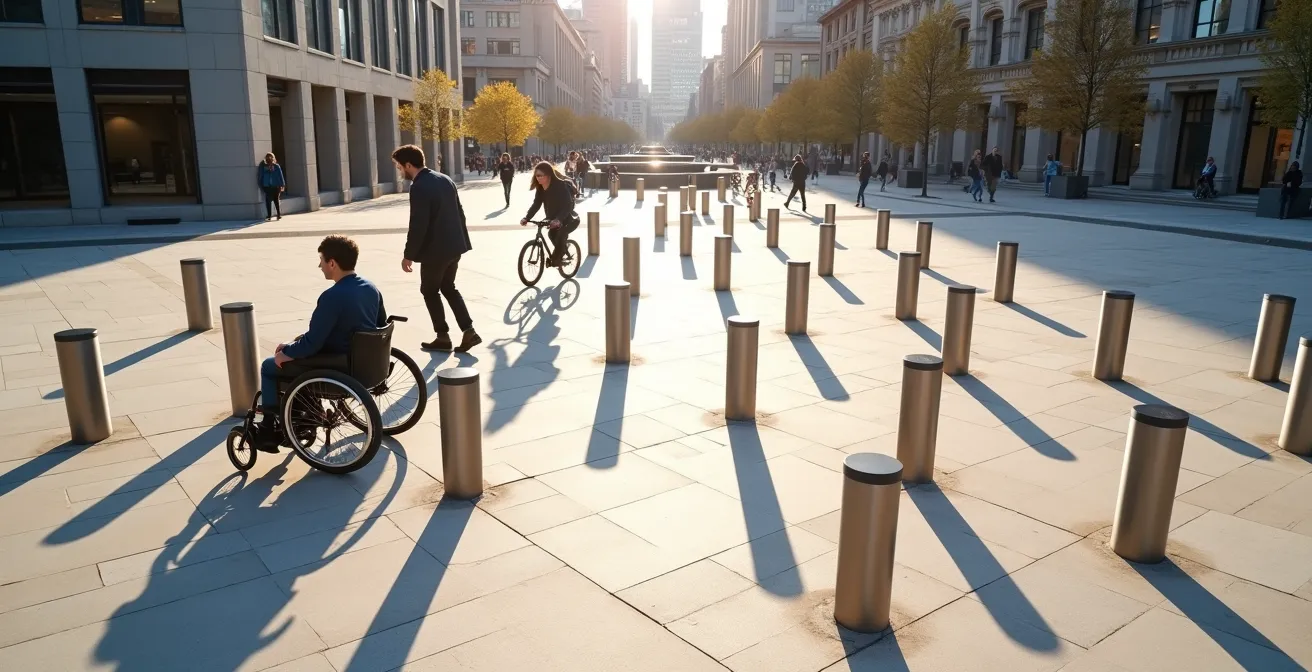
This overhead view of a well-designed plaza demonstrates how optimal spacing creates a safe zone that feels open and accessible, allowing for the free flow of pedestrians, cyclists, and wheelchair users while maintaining a secure perimeter.
The following table breaks down the specific width requirements that should inform bollard spacing decisions in a typical Montreal context. This data-driven approach ensures the design is both safe and truly inclusive.
| Vehicle Type | Width Requirement | Recommended Spacing | Montreal Context |
|---|---|---|---|
| Wheelchair | 32 inches | 36-48 inches | Quebec accessibility law compliance |
| BIXI Bike | 24 inches | 36 inches min | Bike-share station access |
| Snow removal equipment | 48 inches | 54-60 inches | Small sidewalk plows |
| Delivery cart | 30 inches | 36-42 inches | Jean-Talon Market vendors |
By meticulously planning the spacing, the landscape architect transforms a simple row of posts into a sophisticated system that protects, includes, and enhances the public realm. It is in this detail that a security measure becomes a feature of great urban design.
Bicycle Rack vs Concrete Jersey: Which Barrier Stops Vehicle Attacks?
The conversation about vehicle barriers often extends beyond permanent bollards, especially in a city like Montreal, renowned for its year-round festivals and events. The need for temporary, adaptable, and aesthetically pleasing security is constant. The default solution has long been the concrete Jersey barrier—a brutalist, visually intrusive element that creates a hostile environment. While they may seem formidable, most Jersey barriers are not crash-rated and can be displaced or breached by a determined vehicle. The landscape architect’s challenge is to find alternatives that provide certified protection without sacrificing the welcoming atmosphere of a public gathering.
The market now includes a range of Hostile Vehicle Mitigation (HVM) rental barriers. These engineered systems are crash-rated (often to K4/M30 standards) and can be deployed much faster than concrete blocks. While their appearance is often industrial, they represent a significant step up in reliable, temporary protection. An even more elegant solution lies in integrating security into multi-functional urban furniture. While a standard BIXI station is not crash-rated, the concept of a dual-purpose element is powerful. Decorative planters, reinforced benches, and even custom-designed bicycle racks can be engineered to serve as discreet, aesthetically pleasing vehicle barriers, blending security seamlessly into the landscape.
This approach is particularly relevant for temporary events, where the visual impact of security measures is a major concern for organizers and attendees. The choice of barrier involves a trade-off between deployment speed, crash rating, visual appeal, and cost.
The following table compares common temporary barrier options for a typical Montreal festival context, highlighting the variables a designer must weigh.
| Barrier Type | Deployment Time | Crash Rating | Visual Impact | Cost/Day |
|---|---|---|---|---|
| Concrete Jersey | 4 hours | Unrated | Brutalist/Poor | $50-100 |
| HVM Rental Barriers | 2 hours | K4/M30 | Industrial | $200-400 |
| Decorative Planters | 3 hours | Site-specific | Aesthetic | $150-300 |
By moving beyond the default Jersey barrier and exploring integrated or aesthetically superior HVM solutions, the architect can provide certified protection that enhances, rather than detracts from, the public experience. It is a key strategy for maintaining Montreal’s vibrant and open cultural life securely.
When to Inspect Security Anchors: A Seasonal Maintenance Timeline
The visible bollard is only half the story. The true strength of a deep-mount, crash-rated system lies in its foundation—the massive concrete footing and the security anchors that bind the bollard to it. In Quebec’s climate, this unseen foundation is under constant assault from freeze-thaw cycles. Water seeps into microscopic cracks in the concrete and surrounding pavement. As it freezes, it expands with incredible force, slowly deteriorating the foundation and potentially loosening the anchor bolts over time. A K12-rated bollard with a compromised anchor system is nothing more than a decorative post waiting to fail under impact.
For this reason, a disciplined and documented inspection timeline is not an optional extra; it is a fundamental requirement for ensuring the system’s long-term performance and mitigating liability. A visual check is insufficient. The inspection protocol must be structural, seasonal, and thorough. The period immediately following the winter thaw is the most critical time for a detailed inspection, as this is when the cumulative damage from the freeze-thaw cycles becomes apparent.
A professional inspection should go beyond a simple visual check. It should include torque testing of anchor bolts to ensure they meet the manufacturer’s specifications and, for critical infrastructure, may even involve non-destructive methods like ultrasonic testing to assess the integrity of the concrete foundation itself. Maintaining a dated log of these inspections is a crucial step, providing a clear record of due diligence that can be vital for liability defense in the event of an incident. The protocol must be adapted to our specific climate to be effective.
By specifying a rigorous, season-specific inspection protocol from the outset, the landscape architect ensures that the security system remains as robust on its tenth anniversary as it was on the day of installation. It is the professional’s duty to plan for the entire lifecycle of the security measure, not just its initial implementation.
Key Takeaways
- Match the Bollard to the Threat: A K4 rating is for low-speed control; a K12 rating is for high-speed, high-threat environments. Mis-specifying is either wasteful or dangerous.
- Plan for the Unseen: The success of an installation in downtown Montreal depends as much on mapping subterranean utilities as it does on the design above ground.
- Engineer for a Montreal Winter: Specify materials (like 316-grade steel) and maintenance protocols that are designed to resist decades of road salt and freeze-thaw cycles.
Applying CPTED Principles to Montreal’s Urban Prevention Protocols
After dissecting the technical components of bollard specification—crash ratings, foundations, materials, and spacing—the final step is to elevate the perspective. A landscape architect’s greatest value lies in synthesizing these individual elements into a coherent, holistic security strategy. This is achieved by applying the principles of Crime Prevention Through Environmental Design (CPTED). CPTED is a design philosophy that aims to discourage illicit activity and reduce fear by creating environments that feel safe, vibrant, and well-maintained.
Bollards, when viewed through the CPTED lens, are not just physical barriers. They are tools that help define and reinforce the core CPTED principles. Natural Surveillance: Bollards can be used to channel pedestrian flow into areas that are well-lit and easily observed from surrounding buildings, discouraging potential attackers who prefer anonymity. Territorial Reinforcement: A clear, aesthetically pleasing line of bollards or integrated planters creates a psychological boundary. It signals that a space is cared for and has a clear distinction between public, semi-private, and private areas. Access Control: This is the most obvious function. Bollards are used to control or deny vehicle access, directing traffic to legitimate entry points and protecting vulnerable pedestrian zones.
Montreal’s own Place des Festivals is a masterclass in applied CPTED. The strategic placement of bollards, benches, and lighting fixtures works in concert to create a space that feels both open and secure. The barriers are part of a larger design language that encourages positive use of the space while subtly discouraging negative behavior. The bollards don’t just stop cars; they help frame sightlines, define walkways, and support the overall sense of place. This is the ultimate goal: security that is so well-integrated it becomes an invisible, yet essential, part of the urban experience.
For the landscape architect, this means the final design presentation should not just be about the bollards themselves, but about how they contribute to a safer, more resilient, and more beautiful public realm. To put these principles into practice for your specific project, the next logical step is to conduct a formal site-specific security assessment that will inform your design and specification process.