The constant flow of deliveries in Montreal condos creates a major security vulnerability that simple buzzers can’t solve, leaving buildings exposed to theft and unauthorized access.
- Static, shared codes are a primary risk, often written down or easily guessed, undermining the entire security system.
- Modern solutions focus on managing the “credential lifecycle”—creating temporary, unique, and auditable codes for each courier or guest.
Recommendation: Shift from a hardware-focused mindset to a systems-based approach that prioritizes auditable logs, resident policies, and layered security to manage temporary access effectively.
As a condo board president in Montreal, you’ve seen it: a pile of Amazon packages left in the lobby, a frustrated courier unable to get in, or worse, a resident reporting a stolen delivery. The default solution for decades has been a simple four-digit code or a buzzer linked to a resident’s phone. Yet, as our buildings become denser and e-commerce deliveries surge, this outdated method is no longer just inconvenient; it’s a gaping hole in our collective security. The convenience of getting food or packages delivered is clashing directly with the need for a safe, secure home.
Many boards react by considering more cameras or stricter rules, but these are often superficial fixes. They fail to address the core of the problem: the management of temporary, high-frequency access for a stream of non-residents. The real challenge isn’t about building a higher wall, but about creating smarter doors. It requires a fundamental shift in thinking away from static, permanent codes and towards dynamic, traceable credentials.
But what if the key to solving this wasn’t in buying the most expensive intercom, but in designing a resilient system that accounts for the real-world behaviours of couriers, guests, and even our own residents? This guide moves beyond generic advice to provide a practical framework for Montreal condo boards. We’ll explore why simple codes fail, how to implement secure temporary access, and how to build a layered security strategy that protects your community without sacrificing modern convenience. This is about establishing strong “access hygiene” for your entire building.
To address this complex issue, we will break down the problem and its solutions. This article will guide you through the weaknesses of common security practices and introduce robust, modern alternatives designed for the unique challenges of a Montreal residential tower.
Summary: A Guide to Modern Access Control for Montreal Condos
- Why “1234” Is Likely the Entry Code for Half the Buildings on Your Street?
- How to Configure One-Time Access Codes for Uber Eats and Couriers?
- Virtual Keys vs Pin Codes: Which Is More Secure for Airbnb Guests?
- The Code-Sharing Risk That Lets Unauthorized Strangers Roam Your Hallways
- How to Review Intercom Logs to Catch a Package Thief?
- Why Mobile Credentials Are Safer Than Key Cards for High-Turnover Offices?
- Why High Camera Density Doesn’t Always Equal Better Security in Downtown Montreal?
- Designing Mantrap Vestibules for High-Security Zones in Montreal Offices
Why “1234” Is Likely the Entry Code for Half the Buildings on Your Street?
The greatest vulnerability in many Montreal residential buildings isn’t a sophisticated hacker; it’s a simple, memorable, and widely shared access code. Codes like “1234” or the building’s street number are shockingly common because they prioritize convenience over security. This single, static code, given to every resident, cleaner, and contractor, quickly loses its integrity. It becomes public knowledge, effectively turning a secure entrance into a public doorway. With property crime being a persistent issue, relying on such a weak first line of defense is a significant gamble. In fact, a recent security analysis showed that vandalism and theft have a combined rate of 40.69% in Montreal’s commercial and residential sectors, highlighting the tangible threat.
The problem is systemic. A single code for everyone creates a “tragedy of the commons” scenario: no one feels individual responsibility for its security. Residents might casually share it with a friend or a food delivery driver, not realizing the cumulative risk. This weak access hygiene is the root cause of many security breaches. Once a code is compromised, changing it is a logistical nightmare that involves informing hundreds of residents, making it a rare event. As a result, old codes persist for years, known to countless past residents and service providers.
Transitioning away from this flawed model requires moving from a single, shared secret to a system of unique, accountable credentials. The goal is to ensure that every entry is tied to an individual, or at least to a specific, limited-use purpose. This doesn’t necessarily mean a massive, expensive overhaul. It starts with a strategic audit of your current practices and a commitment to phasing out the “one code to rule them all” approach in favor of more robust, modern alternatives.
How to Configure One-Time Access Codes for Uber Eats and Couriers?
The constant parade of delivery couriers is a defining feature of modern condo living, but it also presents a significant security challenge. How do you grant access for a legitimate 30-second delivery without leaving the door open for opportunists? The solution lies in managing the credential lifecycle of temporary access. Instead of a permanent code, modern intercom systems allow residents or property managers to generate secure, one-time-use PINs for each specific delivery.
This approach transforms building access. When a resident orders from Uber Eats, they can generate a PIN through a mobile app that is valid only for a short window, such as the next 30 minutes. This code can be automatically sent to the courier. Once used, the PIN expires and becomes useless. This eliminates the risk of a code being saved and reused later. For example, a real-world system implemented in Canadian buildings by ButterflyMX provides major couriers with unique, trackable PINs. This ensures deliveries are completed successfully while creating a forensic audit trail for every entry, linking the specific courier company to a time-stamped event.
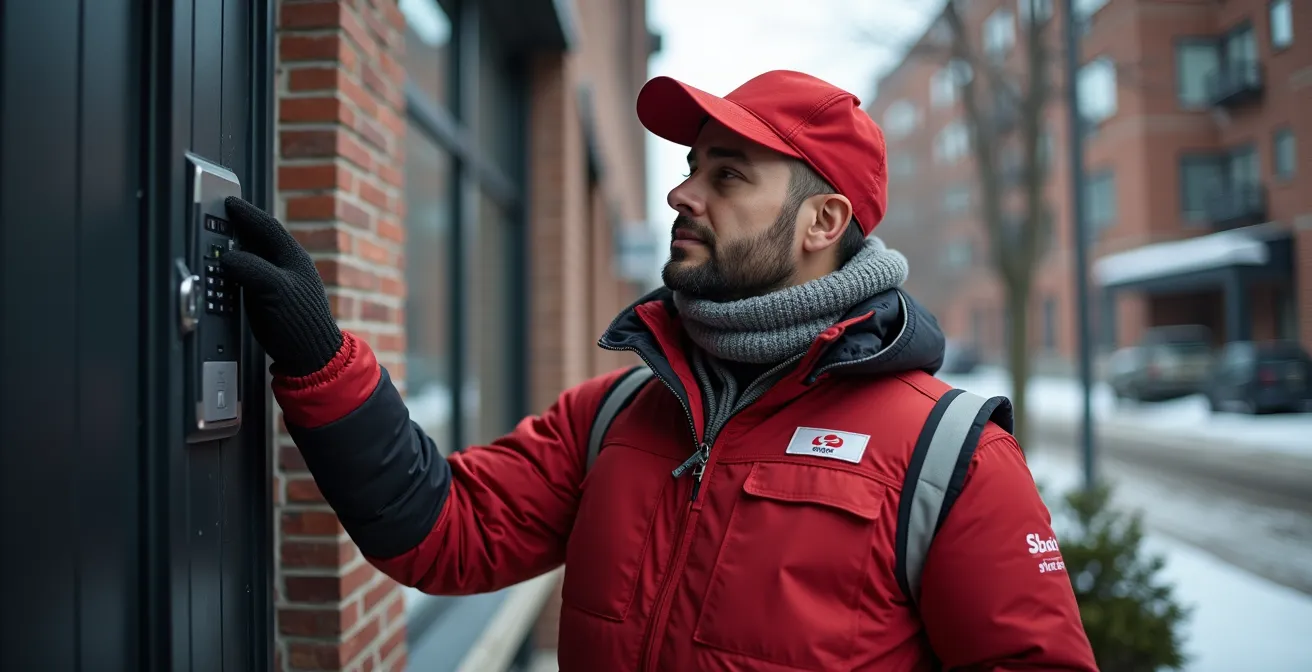
Different methods offer varying levels of security and convenience. One-time PINs are excellent for single, ad-hoc deliveries. For more regular services, time-limited QR codes can be issued to specific courier companies, which are valid only during business hours. In situations where a resident is home, many systems also allow for remote unlocking via a smartphone app, providing real-time verification through video. By adopting a system that provides these flexible options, a condo board can solve the delivery dilemma, balancing the convenience residents demand with the security the community needs.
Virtual Keys vs Pin Codes: Which Is More Secure for Airbnb Guests?
The rise of short-term rentals in Montreal condos introduces another layer of complexity to access management. For Airbnb guests, you need a solution that is both secure and user-friendly, and capable of being managed remotely. While PIN codes are a common choice, they come with inherent risks. A simple PIN can be observed, shared, or forgotten. A more robust and increasingly popular alternative is the virtual key, often in the form of a dynamic QR code or a Bluetooth-based credential on a smartphone.
The preference for keyless solutions is clear; one industry report found that 67% of renters want keyless smart locks in their buildings, a sentiment that extends to short-term guests who value seamless entry. A virtual key, tied to a guest’s smartphone, is harder to share than a simple number sequence. More advanced systems use dynamic QR codes, which offer a significant security advantage. As the Axis Communications Security Team notes:
Dynamic QR codes can be updated and changed even after being created and distributed, while at the same time keeping all the aforementioned benefits of a QR code-based access control solution.
– Axis Communications Security Team, QR codes for smart, cost-effective access control
This dynamism is crucial. You can issue a QR code that is only activated at the precise check-in time and is automatically revoked at check-out. This complete control over the credential lifecycle prevents past guests from ever attempting to re-enter the property. While a PIN code system is better than a physical key, it still relies on a static piece of information. A virtual key, especially a dynamic one, ties access to a specific device and a specific time frame, making it the superior choice for the high-turnover environment of short-term rentals.
The Code-Sharing Risk That Lets Unauthorized Strangers Roam Your Hallways
The most sophisticated access control system can be defeated by its greatest vulnerability: human nature. The convenience-security paradox is most evident in the widespread practice of code sharing. A resident, wanting to be helpful, gives the code to a cleaner. A courier, frustrated by a lack of access, finds a way in and shares the method with colleagues. This informal network of shared secrets is how unauthorized individuals gain entry to seemingly secure buildings.
This isn’t theoretical; it’s a daily reality in Montreal. One observer on a tech forum described a common scenario perfectly, which serves as a powerful real-world testimony:
A frustrated delivery driver who gets the code will write it on the side of the access panel to help everyone out. So many people in gated communities and apartment complexes order things from Amazon, and other delivery services, and want front door delivery but don’t give them any way to get in.
– Montreal Building Access Vulnerability Discovery
This single act, born of frustration, completely bypasses millions of dollars in security infrastructure. It highlights that technology alone is not enough. A robust security posture requires clear policies and good access hygiene from residents. The board must establish and communicate clear rules about code sharing, outlining the risks and potential consequences. Furthermore, the system itself should be designed to mitigate this risk by making unique, temporary codes so easy to generate that residents are never tempted to share their personal, long-term credentials.
Combating this requires a multi-pronged approach. First, implement systems that allow for tenant-managed temporary codes. Second, conduct regular audits of access logs to spot unusual patterns, like a single code being used dozens of times in a day. Finally, foster a community culture of security, reminding residents that protecting the building’s access is a shared responsibility. Without addressing the human element, even the most advanced lock is just a suggestion.
How to Review Intercom Logs to Catch a Package Thief?
Preventing unauthorized access is the primary goal, but when an incident like package theft occurs, your security system must provide the tools to investigate. The loss is not trivial; it’s estimated that in North America, $5.4 billion worth of packages were stolen in 2020 alone. This is where a modern intercom’s forensic audit trail becomes invaluable. Unlike old systems that provide no data, today’s video intercoms create a detailed, time-stamped log of every single access event, whether successful or failed.
These logs are more than just a list of entries. A comprehensive audit trail should include:
- Timestamp: The exact date and time of the access attempt.
- User/Credential: Which PIN, mobile credential, or key fob was used.
– Entry Point: Which door or gate was accessed. – Photo/Video: A snapshot or short video clip of the person at the entry point.
When a package goes missing from the lobby, the property manager or a designated board member can cross-reference the time of delivery with the access logs. Did an unfamiliar face use a resident’s code shortly after the delivery? Was there a series of failed access attempts before a door was forced open? This data provides concrete evidence for both internal investigation and, if necessary, for a police report.
The most powerful application is the integration of access logs with the building’s video surveillance system. As one case study on apartment security highlights, connecting these systems enables security teams to analyze user behavior and investigate suspicious activities with time-stamped photos stored for up to a year. This allows you to instantly pull up the video footage associated with a specific access event, creating an unbroken chain of evidence. Instead of scrubbing through hours of video, you can pinpoint the exact moment of entry and see who was there, transforming your security system from a passive deterrent into an active investigative tool.
Why Mobile Credentials Are Safer Than Key Cards for High-Turnover Offices?
While our focus is residential, the principles of managing high-turnover access are perfected in commercial office spaces and are directly applicable to the residents of a condo building. Traditional plastic key cards or fobs, long the standard, are fundamentally flawed. They can be lost, stolen, or cloned. When an employee leaves a company—or a resident moves out of a condo—the physical retrieval of that fob is often missed, leaving a permanent security risk. Mobile credentials, which turn a resident’s smartphone into their key, offer a vastly more secure and manageable alternative.
The security advantage of mobile credentials lies in several layers of protection that fobs lack. First, they are protected by the phone’s own biometrics, such as Face ID or a fingerprint sensor. Second, they are device-locked, making them far more difficult to share or clone than a simple plastic card. Most importantly, their credential lifecycle can be managed remotely and instantly. When a resident moves out, their access can be revoked with a single click in a central dashboard, no physical retrieval necessary. As Swiftlane Security Systems points out, this scalability is a game-changer:
With systems that use PIN codes, mobile apps, facial integration and the like, they can scale to thousands of unique users who each get their own unique access. You can seamlessly revoke singular access when tenants move out, without forcing everyone to change their key.
– Swiftlane Security Systems, Keyless Entry Systems for Apartments – Essential Buying Tips
For a condo board, this means better security and drastically reduced administrative overhead. No more reprogramming locks or worrying about unreturned fobs. The comparison is stark when laid out clearly.
| Feature | Mobile Credentials | Key Cards/Fobs |
|---|---|---|
| Biometric Protection | Face ID/Fingerprint | None |
| Remote Management | Instant revocation | Physical retrieval needed |
| Sharing Risk | Device-locked | Can be copied |
| Audit Trail | Detailed with timestamps | Basic logging only |
| Cost per User | $0 (uses existing phone) | $5-15 per card |
By adopting mobile credentials, a building improves its overall access hygiene, making security both stronger and simpler to manage for everyone.
Why High Camera Density Doesn’t Always Equal Better Security in Downtown Montreal?
A common reaction to a security incident in a downtown Montreal condo is to propose installing more cameras. While well-intentioned, this “more is better” approach often leads to a false sense of security and a mountain of useless data. The reality is that camera quantity is less important than strategic placement and, most crucially, integration with your access control system. A dozen cameras recording empty hallways 24/7 are far less effective than a single camera that intelligently records an event triggered by an access attempt.
The truly effective model is event-based surveillance. This is a core component of a layered security funnel, where different security tools work together. By integrating your access control system with your cameras, you create a smart, responsive network. When someone uses a PIN code at the front door, the system can automatically trigger the lobby camera to record a short clip and link it to that specific access event in the log. This approach was successfully used in Montreal properties to “video verify” all access events, creating invaluable forensic capabilities by matching identity data to visual images for every entry point.

This integrated strategy is more efficient, respects privacy by not recording constantly, and makes investigations exponentially faster. Instead of having a security guard (or a volunteer board member) sift through hours of footage, you can simply click on an access event—”Front Door, 2:15 AM, PIN 8675″—and immediately see the corresponding video. This shifts the role of cameras from passive observers to active participants in your security ecosystem. True security isn’t about having the most eyes; it’s about having the smartest ones.
Action Plan: Optimizing Security Beyond Camera Quantity
- Focus on strategic camera placement at all access control points (entrances, package rooms, garages) rather than simply aiming for full coverage.
- Integrate access control logs with your camera system to enable event-based recording for every entry attempt.
- Implement smart video analytics to automatically detect and flag unusual patterns, such as tailgating or loitering near an entrance.
- Configure your system to use access control data to trigger camera recording only when an event occurs, saving storage and simplifying review.
- Build a layered security strategy that combines video evidence, access control data, and detailed audit trails for a comprehensive forensic capability.
Key takeaways
- Static, shared access codes are the single biggest point of failure in most residential security systems.
- Effective security relies on managing the entire “credential lifecycle”—creating, monitoring, and revoking unique access codes for residents, guests, and deliveries.
- Integrating access control logs with video surveillance creates a powerful forensic tool that is far more effective than simply adding more cameras.
Designing Mantrap Vestibules for High-Security Zones in Montreal Offices
For the most sensitive areas of a building—like a package room overflowing with valuable deliveries—a single locked door may not be enough. This is where concepts from high-security office design, such as mantrap vestibules, can be adapted for residential use. A mantrap is a small, secured space with two interlocking doors; the second door cannot be opened until the first one has closed and, in some cases, an additional verification step is completed. This creates a layered security funnel that effectively prevents tailgating, where an unauthorized person follows a legitimate user through an open door.
In a residential context, this can be implemented as a “virtual mantrap” for a package room. A courier uses a one-time PIN to open the first door into a small vestibule. To unlock the inner door to the main package room, they must perform a second action, such as scanning the barcode of a package they are delivering. This two-stage process creates a complete chain of custody. The system captures a time-stamped photo or video at each stage, making it virtually impossible for someone to sneak in or for a thief to enter and claim they were making a legitimate delivery.
Implementing such a system might sound complex, but modern access control technology makes it highly feasible, even for retrofitting existing buildings. These systems can integrate with current electronic locks without requiring major construction. The reliability of large-scale smart lock deployments has been proven; for instance, the M City condo development in Ontario successfully deployed 4,000 smart locks across four towers with minimal failure rates and predictable maintenance schedules. By creating a high-security zone for packages, you protect the building’s most targeted assets and provide residents with true peace of mind, knowing their deliveries are secured in a purpose-built space.
To secure your Montreal condo building effectively, the crucial first step is to audit your current access system not as a collection of hardware, but as a complete ecosystem of policies, user behaviours, and technology. Assess your vulnerabilities, from shared codes to unmonitored entry points, and build a strategy that prioritizes temporary, auditable credentials for all non-residents. This proactive, systems-based approach is the only sustainable way to protect your community in the age of on-demand everything.
Frequently Asked Questions on Managing Temporary Access
What is a virtual mantrap for package rooms?
A two-stage verification system where couriers use a one-time code for the vestibule, then must perform a second action like scanning a package barcode to unlock the inner door.
How does this prevent package theft?
It creates a complete chain of custody with time-stamped photos at each entry point, making it virtually impossible for unauthorized persons to access the package room.
Can this system work with existing infrastructure?
Yes, modern access control systems can retrofit existing doors and integrate with current electronic locks without major construction.