
Most businesses treat physical security as an unquantifiable expense; the reality is that every component, from guards to cameras, has a measurable financial performance.
- Ineffective security measures, like dummy cameras, create massive liability exposure and can void insurance coverage in the event of a breach.
- Integrating systems like alarms and access control yields direct ROI by eliminating operational costs, such as the recurring false alarm fees charged by the SPVM.
Recommendation: Shift the conversation from “how much does security cost?” to “what is the risk-adjusted return of our security strategy?”
For any Montreal business owner or CFO, the security budget often appears as a significant and stubborn line item—a cost centre accepted as a “necessary evil.” You approve expenses for guards, cameras, and alarms, but the return on that investment remains frustratingly vague. Standard advice revolves around generic concepts like “deterrence” and “peace of mind,” which don’t hold up in a financial review. You’re left asking the critical question: “Are we spending too much, too little, or just spending it wrong?”
The conventional approach of simply adding more cameras or increasing guard hours without a strategic framework is a recipe for inefficiency. It fails to account for the specific threat landscape of Montreal, from organized retail crime in downtown corridors to the stringent data protection requirements of Quebec’s Bill 25. This method treats security as a passive expense rather than an active, dynamic business function that can be optimized for performance.
But what if you could shift the entire paradigm? The true key to mastering your security budget isn’t just about cutting costs; it’s about re-framing security as a portfolio of assets and services whose financial performance can be rigorously measured. It’s about calculating its direct impact on risk mitigation, operational efficiency, and liability reduction. This isn’t about guesswork; it’s about applying a financial framework to every security decision.
This guide provides that framework. We will move beyond abstract benefits and provide you with the concrete metrics, formulas, and strategic considerations needed to analyze, justify, and optimize your security spending. You will learn how to calculate the potential cost of an incident before it happens, measure the true value of your security personnel, and make informed decisions on technology investments that directly benefit your bottom line.
This article provides a comprehensive financial framework for evaluating your security investments. The following sections break down how to calculate ROI for each major component of your security strategy, tailored specifically for the Montreal business environment.
Summary: A Financial Framework for Measuring Physical Security ROI
- How to Calculate the Cost of a Break-In Before It Happens?
- KPIs for Guards: How to Measure Value Beyond Just “Being There”?
- Leasing Security Equipment vs Buying Capital Assets: Which is Better for Cash Flow?
- The “Fake Camera” Strategy That Exposes You to Massive Liability
- How to Integrate Alarms and Access Control to Reduce Management Time?
- Mirror on a Stick vs Automated Scanners: Is the Upgrade Worth the Cost?
- Why New R-Value Standards Will Increase Your Renovation Budget by 15%?
- Which Proactive Threat Prevention Measures Best Secure Downtown Montreal Retailers?
How to Calculate the Cost of a Break-In Before It Happens?
To measure security ROI, you must first quantify the risk. A break-in is not just the value of stolen goods; it’s a cascade of direct and indirect costs that can cripple a business. A true risk-adjusted ROI calculation begins by modeling this total potential cost. Direct costs include replacing stolen inventory, repairing physical damage, and the immediate loss of cash. However, the indirect costs are often far greater and must be factored into your financial model.
These indirect costs include business interruption, forensic analysis to determine the scope of a data breach, and reputational damage that erodes customer trust. For Montreal businesses, the most significant financial threat comes from regulatory penalties. Under Quebec’s Bill 25, failure to protect personal information can lead to catastrophic fines. As highlighted in a report from the Communications Security Establishment, post-breach recovery costs are substantial, with total recovery costs in 2023 reaching approximately $1.2 billion across Canada.
To make this tangible, consider the financial impact of a single incident. While physical and cyber breaches have different vectors, the financial fallout model is analogous. A recent Canadian study found that Business Email Compromise incidents, a form of cyber breach, had an average cost of approximately $201,000 CAD per incident. By calculating this Total Potential Incident Cost (Direct Costs + Indirect Costs + Regulatory Fines), you establish a clear financial justification for proactive security spending. Every dollar spent on effective prevention directly reduces this massive potential liability.
This calculation transforms security from an ambiguous expense into a clear-cut insurance policy with a quantifiable value.
KPIs for Guards: How to Measure Value Beyond Just “Being There”?
One of the largest security expenses is often personnel, yet their value is typically the hardest to quantify. The traditional view of a guard as a “visible deterrent” is insufficient for a CFO. To measure their ROI, you must move beyond presence and establish clear Key Performance Indicators (KPIs) that connect their actions to business outcomes. The goal is to measure a guard’s contribution to risk reduction, operational efficiency, and customer experience.

As the image suggests, modern security management is a data-driven practice. A robust KPI framework for guards in Montreal should include metrics such as the incident response time, the de-escalation success rate (situations resolved without police intervention), and the number of proactive intelligence reports submitted (e.g., identifying suspicious patterns). Ensuring 100% compliance with Bureau de la sécurité privée (BSP) licensing is a foundational, non-negotiable metric.
Furthermore, guards can provide value beyond security. Tracking positive customer interactions—such as providing directions or assistance—quantifies their role in enhancing the customer experience. A well-trained security professional is part of a broader security awareness program that generates significant returns. Their ability to educate staff and embody security best practices contributes directly to a culture of safety. This holistic approach allows you to measure their impact not just as a cost, but as a multi-faceted asset contributing to a safer and more efficient business environment.
By implementing these KPIs, you can shift the conversation from headcount to performance, justifying personnel costs with hard data.
Leasing Security Equipment vs Buying Capital Assets: Which is Better for Cash Flow?
The decision to purchase security equipment (CapEx) versus leasing it (OpEx) has significant implications for a company’s cash flow and tax strategy. For a CFO, this isn’t just a technology choice; it’s a financial one. Buying equipment outright requires a large upfront capital investment, which is then depreciated over time using the Capital Cost Allowance (CCA) system in Canada. Security systems generally fall under Class 8, with a specific depreciation rate.
Leasing, on the other hand, transforms this into a predictable, manageable monthly operating expense. The entire lease payment is typically tax-deductible in the year it’s paid, offering a more immediate and straightforward tax benefit compared to the multi-year depreciation of a purchased asset. This OpEx model preserves capital for other core business investments and avoids tying up funds in rapidly depreciating technology. The following table, based on guidance from the Canada Revenue Agency, breaks down the key financial differences.
| Financial Aspect | Purchase (CCA) | Lease |
|---|---|---|
| First Year Deduction | Class 8: 20% depreciation rate (security systems) | 100% of lease payments |
| Tax Treatment | Capital Cost Allowance over multiple years | Full expense deduction annually |
| Technology Updates | Locked into owned equipment | Regular upgrades included |
| Cash Flow Impact | Large upfront capital requirement | Predictable monthly expense |
| Bill 25 Compliance | Owner responsible for updates | Provider ensures compliance |
The trend towards service-based models is accelerating, particularly in the tech-heavy security industry. As Montreal-based industry leader Genetec Inc. noted in its recent predictions, this shift is driven by the desire for better ROI. In their “2026 Physical Security Industry Predictions,” they state:
Access control will remain a top priority as organizations modernize legacy systems and focus on maximizing ROI. The value of access control is expanding well beyond locking and unlocking doors to deliver measurable business outcomes… Access Control as a Service (ACaaS) adoption will accelerate.
– Genetec Inc., 2026 Physical Security Industry Predictions
For many Montreal businesses, the flexibility, predictable costs, and built-in technology refreshes of leasing present a superior value proposition and a healthier approach to cash flow management.
The “Fake Camera” Strategy That Exposes You to Massive Liability
In a quest to cut costs, some businesses resort to installing dummy or non-functional security cameras. The perceived logic is simple: achieve a visual deterrent for a fraction of the price. However, from a financial and legal standpoint, this strategy is not a saving; it is an active creation of catastrophic liability exposure. The potential downside vastly outweighs the minimal upfront cost savings.
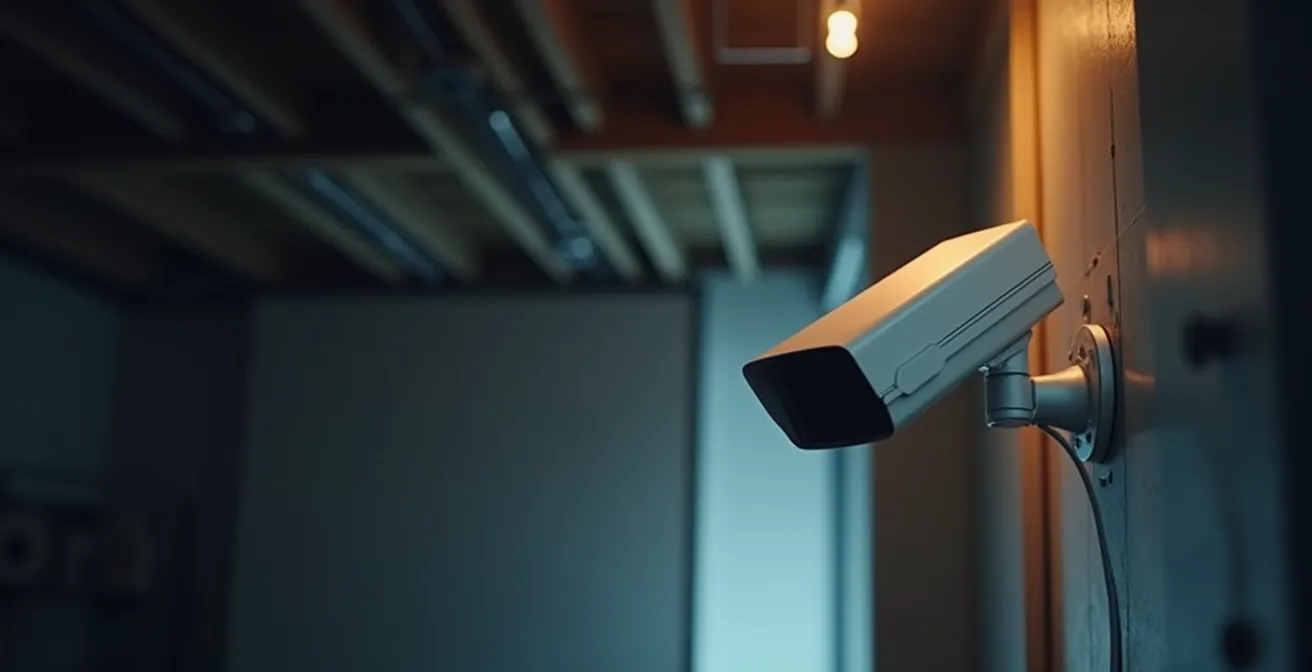
The primary risk lies with insurance. A security system is part of the implicit contract with your insurer. By installing fake cameras, you are misrepresenting your security posture. In the event of a significant incident like a major theft or a data breach, your insurance provider has grounds to deny your claim entirely. What was a perceived saving becomes a multi-hundred-thousand-dollar liability. The scale of this risk is enormous; a Canadian cyber claims study revealed that the average five-year total incident cost stood at about $782.56K CAD per incident.
Furthermore, fake cameras create a false sense of security for employees and customers, which can have legal repercussions. If an incident occurs and it’s discovered that the promised surveillance was non-existent, your business could face lawsuits for negligence. The ROI of a fake camera is deeply negative. It offers a minimal, unproven deterrent while exposing the organization to claim denials, lawsuits, and regulatory scrutiny—turning a cost-cutting tactic into a significant financial and reputational threat.
Investing in a functional, albeit smaller, system is infinitely wiser than creating a facade that will crumble under the first real test.
How to Integrate Alarms and Access Control to Reduce Management Time?
Beyond preventing break-ins, a well-designed security system should reduce operational drag—the hidden costs associated with inefficient day-to-day management. One of the most significant sources of this drag for Montreal businesses is false alarms. Each time a false alarm is triggered, it consumes employee time and, more importantly, incurs direct costs. The Service de police de la Ville de Montréal (SPVM) has a clear fee structure for this inefficiency.
According to the official schedule, while the first commercial burglary false alarm is a warning, subsequent calls come with escalating financial penalties. An analysis of the SPVM’s official fee schedule shows commercial burglary false alarms cost $183 for a second call, rising to $274 for a third, and $364 for every call thereafter. These are direct, quantifiable costs that can be almost entirely eliminated through smart system integration.
By integrating your alarm system with your access control system, you create an intelligent ecosystem. For example, the alarm system can be programmed to automatically disarm when an authorized user presents a valid credential at the door, eliminating the common user error of forgetting to punch in a code. This integration also provides an audit trail, showing exactly who accessed which area and when, which is invaluable for both security and compliance with standards from organizations like the CNESST.
Action Plan: Calculating Your Integration ROI
- False Alarm Reduction: Calculate annual savings by integrating card access with your alarm system. Multiply your historical number of user-error false alarms by the average SPVM fee ($183-$364) to find your direct ROI.
- Time Savings Quantification: Estimate time saved from automated opening/closing procedures. 15 minutes saved daily per location translates to over 5 hours per month, a direct payroll saving.
- Instant Access Revocation: Document the security and administrative benefits of instantly deactivating credentials for terminated employees, eliminating the need to re-key locks and mitigating insider threats.
- CNESST Compliance Documentation: Leverage the integrated network of sensors and real-time notifications to demonstrate an additional layer of security in high-risk areas, strengthening your compliance posture.
- Occupancy Management Value: Analyze access control data to optimize HVAC and lighting based on actual building usage, creating additional ROI through energy savings.
This approach shifts the function of security from a reactive cost centre to a proactive tool for improving overall business efficiency.
Mirror on a Stick vs Automated Scanners: Is the Upgrade Worth the Cost?
Evaluating a technology upgrade, such as moving from manual under-vehicle inspection mirrors to automated scanners, requires a context-specific ROI analysis. The answer is not universal; it depends entirely on your business type, location, and threat profile in Montreal. For a low-traffic office in Westmount, a simple mirror may be sufficient. For a high-volume logistics facility near the YUL airport or the Port of Montreal, the “mirror on a stick” is an obsolete tool that introduces significant liability and inefficiency.
Automated Under-Vehicle Inspection Systems (UVIS) provide a high-resolution digital record of every vehicle’s undercarriage, creating an auditable data trail. This is crucial for investigations and liability protection. As security experts at LVT highlight, video evidence is invaluable because it can “disprove false accounts, eliminate conflicting testimonies, and provide an accurate eyewitness account.” An automated scanner accomplishes this systematically, while a manual mirror inspection leaves no record and is highly prone to human error.
The ROI calculation depends on the location’s specific needs. For a downtown corporate headquarters, the professional image and enhanced tenant security provided by an automated scanner can be a key differentiator in a competitive real estate market. The decision matrix below illustrates how the ROI changes based on the Montreal-specific context.
| Location Type | Manual Mirror ROI | Automated Scanner ROI | Key Decision Factor |
|---|---|---|---|
| Logistics near YUL/Port | Negative (high liability) | Positive (high volume) | Volume & security requirements |
| Small Westmount Office | Adequate | Negative (low traffic) | Limited vehicle traffic |
| Downtown Corporate HQ | Poor (image issue) | Strong (deterrence value) | Professional image & tenant attraction |
| Event Venues | Inadequate | Essential | Data trail for investigations |
Ultimately, the upgrade is justified when the volume of traffic, the need for a digital audit trail, and the value of deterrence outweigh the capital cost of the system.
Why New R-Value Standards Will Increase Your Renovation Budget by 15%?
At first glance, new building code mandates for higher R-values (insulation standards) seem like just another construction cost. However, a strategic CFO sees this mandatory renovation not as a burden, but as a golden opportunity for security investment. When walls, ceilings, and floors are already being opened up for insulation upgrades, the marginal cost of installing a comprehensive, wired security infrastructure plummets. This is the single most cost-effective moment to future-proof your building’s security.
Running cabling for cameras, access control readers, and integrated sensors in a finished building is disruptive and expensive. Bundling this work into a planned renovation leverages existing labour and site preparation, dramatically lowering installation costs. Furthermore, this capital expenditure can be optimized for tax purposes. These new security assets qualify for the Capital Cost Allowance (CCA), allowing you to depreciate the investment over time and reduce your taxable income.
Moreover, the technology installed can deliver ROI beyond traditional security. For instance, integrating a network of environmental sensors during the renovation can prevent costly damage. A business that installed these systems during a mandatory refit was able to prevent an average of $15,000 in annual water damage and reduce HVAC costs by 30% through smarter occupancy monitoring. This turns a portion of the “security” budget into an operational savings and risk mitigation tool, generating a powerful, multi-layered return on an investment you were already forced to make.
Instead of viewing new regulations as a pure cost, you can leverage them to make strategic upgrades that pay for themselves in both security and operational efficiency.
Key Takeaways
- Quantify risk by modeling the total potential cost of an incident, including direct losses, business interruption, and regulatory fines under Quebec’s Bill 25.
- Measure the value of security personnel with concrete KPIs like de-escalation rates and proactive intelligence reports, not just physical presence.
- Leverage mandatory renovations (like those for new R-Value standards) as a cost-effective opportunity to install integrated security infrastructure and claim Capital Cost Allowance.
Which Proactive Threat Prevention Measures Best Secure Downtown Montreal Retailers?
For downtown Montreal retailers, security cannot be a passive, reactive function. The specific urban threat landscape requires a proactive and integrated prevention strategy. With vandalism and theft having a combined rate of 40.69% in Montreal, these crimes represent a primary and consistent drain on profitability. A generic security plan is insufficient; a successful strategy must be tailored to the realities of a dense, high-traffic commercial environment like the Sainte-Catherine Street corridor.

An effective framework combines technology, personnel, and community partnerships. This approach moves beyond simply installing cameras and focuses on creating an intelligent security ecosystem. Key measures for a downtown retailer include:
- Community Intelligence Sharing: Actively participating in local business development corporations (SDCs) like Montréal Centre-Ville provides access to shared intelligence on organized retail crime patterns and coordinated response strategies.
- Specialized Personnel: Deploying bilingual, customer-service-trained security staff is essential. Staff should have certifications in incident de-escalation, first aid (OFA), and Naloxone training to manage the complex social and safety issues present in urban centers compassionately and effectively.
- Targeted AI Analytics: Implementing modern video analytics can proactively identify and flag problematic behavior, such as loitering patterns near metro entrances or suspicious activity in stock rooms, allowing for early intervention.
- Access Control on Facilities: Installing robust access control on public-facing facilities like restrooms is a simple but highly effective measure to reduce vandalism, loitering, and associated cleaning and repair costs.
- Coordinated SPVM Response: Utilizing the established communication channels provided by SDCs ensures a faster and more efficient response from the SPVM during an active incident.
By shifting from a passive to a proactive and localized strategy, Montreal retailers can transform their security posture from a simple defense into a strategic advantage that protects assets, enhances the customer experience, and directly improves the bottom line. To apply these principles effectively, the next logical step is to conduct a comprehensive audit of your current security posture against these financial and operational metrics.