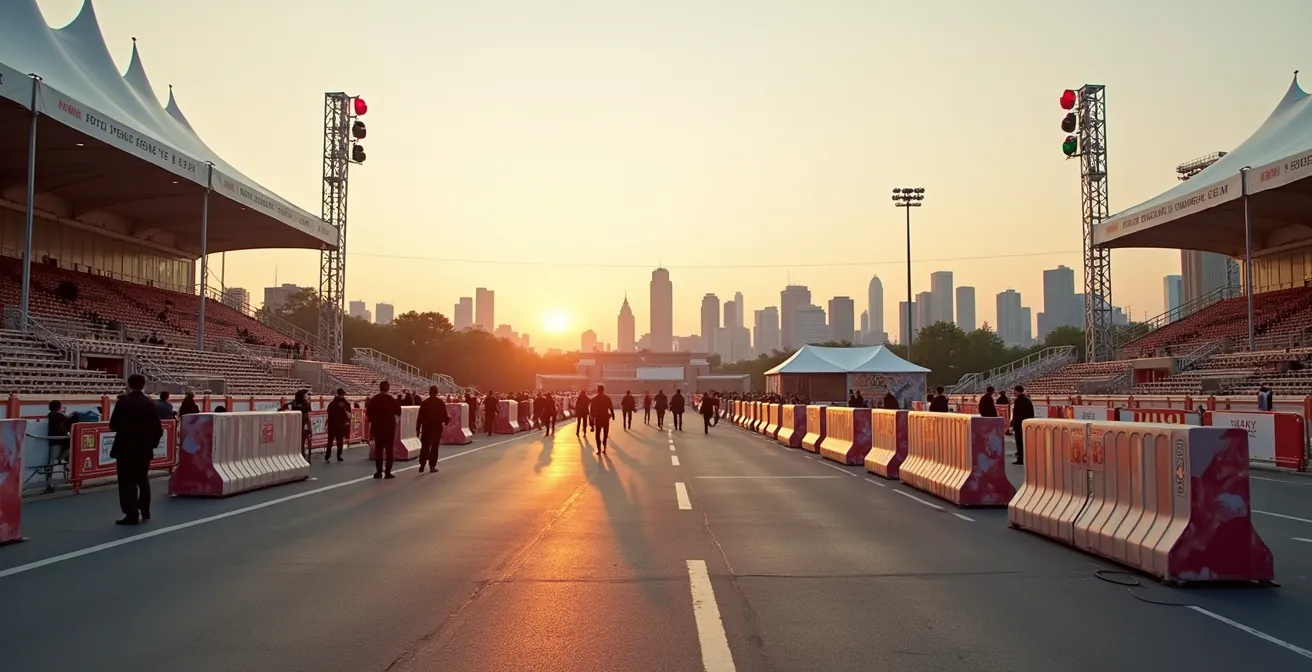
Successfully navigating Montreal’s event safety regulations is not about checking boxes, but mastering the operational logic behind them to proactively mitigate risk.
- Theoretical site capacity is irrelevant; effective capacity is dictated by the precise, calculated flow rate of your emergency exits.
- Barrier selection is a critical decision: bicycle racks offer crowd guidance, while only engineered solutions like Jersey barriers provide true hostile vehicle mitigation.
Recommendation: Shift your planning from reactive compliance to proactive risk analysis, focusing on how crowds, vehicles, and structures will behave in your specific venue.
As an event producer in Montreal, you know the exhilarating moment when a public square transforms into a vibrant festival. But beneath the surface of music and celebration lies a complex framework of municipal safety standards. Many producers focus on the obvious task of securing a permit from the borough. They believe compliance is a checklist: fire extinguishers, security guards, and a basic site map. This approach is not only inefficient; it’s dangerous.
The core challenge isn’t simply following rules, but understanding the operational physics they represent. The Service de sécurité incendie de Montréal (SIM) and the Service de police de la Ville de Montréal (SPVM) don’t just want to see a plan; they want to see that you have anticipated and solved the logistical problems of crowd dynamics, structural integrity, and threat mitigation before they can occur. They are evaluating your grasp of how thousands of people will move, how temporary structures will bear stress, and how your perimeter will hold up against external threats.
This guide abandons the compliance-as-checklist mindset. Instead, it provides an authoritative, logistical framework for event producers. We will dissect the critical, often misunderstood, safety requirements for large outdoor events in Montreal. The goal is to move beyond what the regulations say, and into why they exist and how to implement them effectively on the ground. By mastering the regulatory logic, you can design an event that is not only approved but fundamentally safer for every attendee, artist, and staff member.
This article breaks down the most critical and often overlooked aspects of event safety planning in Montreal. The following sections provide logistical guidance on everything from calculating true crowd capacity to navigating the specific submission timelines required by city authorities.
Summary: A Logistical Framework for Montreal Event Safety Compliance
- Why Your Event Capacity Is Lower Than You Think Due to Emergency Exits?
- How to Anchor Tents on Asphalt Without Damaging Public Property?
- Bicycle Rack vs Concrete Jersey: Which Barrier Stops Vehicle Attacks?
- The Site Design Error That Creates Dangerous Crowd Crushes at Exits
- When to Submit Your Emergency Plan to the SPVM and SIM?
- How to Screen Delivery Trucks Thoroughly Without Creating a Traffic Jam?
- The Stairwell Behavior That Slows Down High-Rise Evacuations
- Navigating Provincial Security Regulations for Private-Public Partnerships
Why Your Event Capacity Is Lower Than You Think Due to Emergency Exits?
The most common miscalculation in event planning is assuming capacity is based on the square footage of your site. For Montreal authorities, and specifically the SIM, this is incorrect. Your event’s legal maximum capacity is a direct function of its egress capabilities. The total number of people who can safely exit the venue within a specific timeframe determines the total number of people who are allowed in. This is not a guideline; it is a hard calculation.
The foundational principle, according to Montreal’s fire safety regulations, is that the width of exit doors, hallways, and stairwells are the main criteria determining maximum capacity. Every temporary obstruction, from a misplaced garbage bin to a sponsor’s sign, can reduce the “effective width” of an exit path, thereby legally reducing your site’s capacity. You must calculate capacity based on the narrowest point of each egress route.
Furthermore, crowd psychology is a critical factor. In low-light conditions, with confusing signage, or in the presence of smoke, the flow rate of people through an exit can decrease significantly. Prudent planning accounts for this by applying a reduction factor—sometimes as much as 25%—to the theoretical flow rate. This shift from theoretical to effective capacity is what safety inspectors will assess. Overlooking this distinction is the fastest way to have your capacity slashed by an inspector on opening day.
Ultimately, your capacity is not what you can fit, but what you can evacuate. Grounding your plan in this regulatory logic from the outset is non-negotiable for a safe and successful event.
How to Anchor Tents on Asphalt Without Damaging Public Property?
Setting up large tents for a festival or market on a public asphalt surface like Place des Festivals presents a significant logistical challenge: how to achieve the required anchoring force without driving stakes into the ground and damaging municipal property. Drilling into city asphalt is strictly prohibited and will result in significant fines and repair costs. The only viable solution is to use surface-based weighting, or ballasting.
Historically, this was done with crude methods like 55-gallon drums filled with water or cumbersome concrete blocks. These methods are now considered unprofessional and often insufficient. A 55-gallon barrel only provides approximately 220 pounds of anchoring strength, which may not meet the wind-load specifications for large structures. Concrete blocks are effective but present major logistical hurdles in transport and placement, increasing labor costs and site damage risk.
The industry standard is now engineered water ballast systems. These are purpose-built containers that, when filled with water, can provide immense and calculable weight. For instance, advanced systems offer over 660 pounds of anchoring strength per unit, triple that of a standard water barrel. They are designed for easy filling and draining, dramatically reducing setup and teardown times.
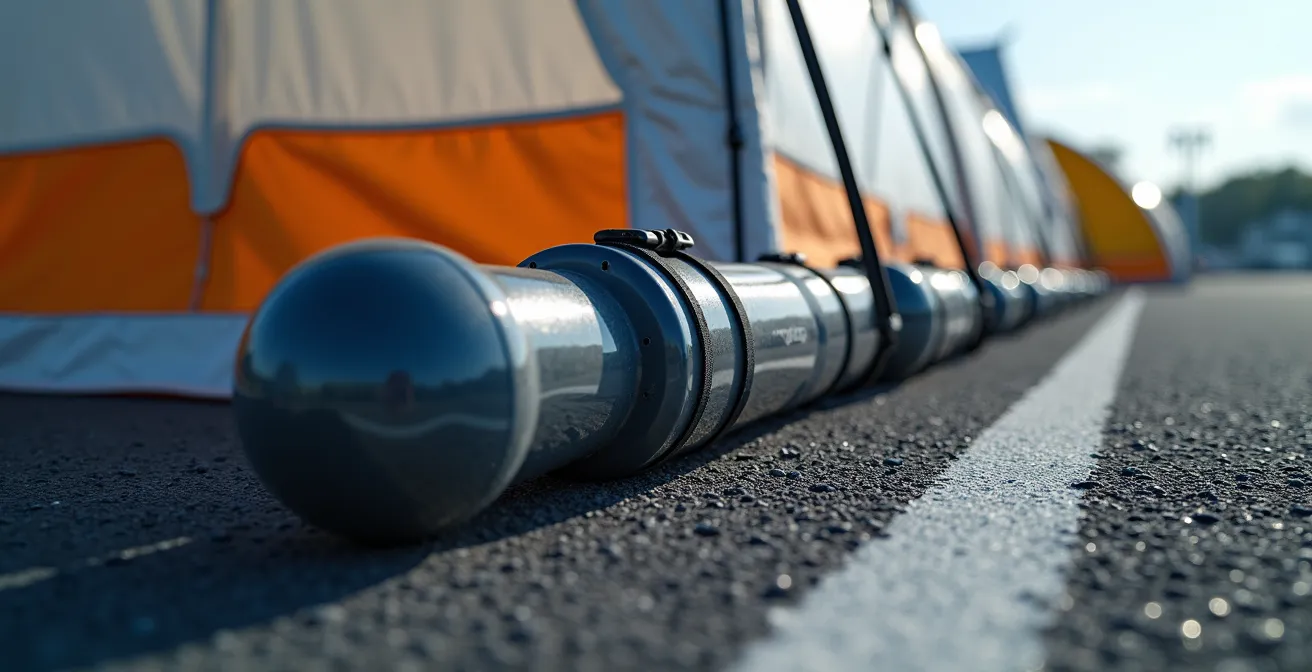
The following table, based on data from an analysis of common ballasting methods, provides a clear comparison for planning purposes. It highlights why engineered ballasts are the superior choice for professional events on sensitive surfaces.
| Anchoring Method | Weight Capacity | Surface Impact | Setup Complexity |
|---|---|---|---|
| Water Ballasts | 660 lbs per unit | No damage | Easy fill/drain |
| Concrete Blocks | Variable | No damage | Difficult transport |
| 55-gallon Drums | 220 lbs | No damage | Not recommended |
| Asphalt Stakes | High | Requires plugs | Professional installation |
For any Montreal event on public property, investing in professional-grade water ballasts is not an upgrade; it is a fundamental requirement for ensuring site integrity and structural safety.
Bicycle Rack vs Concrete Jersey: Which Barrier Stops Vehicle Attacks?
A frequent and dangerous point of confusion for event producers is the selection of perimeter barriers. The assumption that any physical barrier is sufficient for security is flawed. It’s crucial to distinguish between equipment for crowd guidance and solutions for vehicle attack prevention. The choice of barrier must match the specific threat you are mitigating.
Standard metal bicycle racks or interlocking barriers are effective for crowd delineation. Their purpose is to define spaces, guide foot traffic, and prevent attendees from wandering into restricted areas. They create a visual and psychological perimeter but offer virtually no resistance to vehicle impact. They are appropriate for low-risk street fairs or local markets where the primary concern is crowd management, not hostile vehicle threats.
For high-profile events that could be targets—such as the Grand Prix, major music festivals, or international summits—the SPVM requires a strategy for Hostile Vehicle Mitigation (HVM). This involves using barriers specifically engineered and rated to stop a moving vehicle. The most common solution is the concrete Jersey barrier. The official guidance is clear, as noted in the SPVM Event Planning Guidelines:
Bicycle racks are for ‘crowd delineation’ while concrete Jersey barriers are for ‘hostile vehicle mitigation’ (HVM) required for high-profile events.
– Montreal Event Security Assessment, SPVM Event Planning Guidelines
Using bicycle racks where Jersey barriers are required is a critical failure in your security plan. It demonstrates a misunderstanding of threat vectors and will be immediately flagged by SPVM assessors. While Jersey barriers create challenges for emergency vehicle access, these must be addressed through planned, defensible gaps in the perimeter, not by using inadequate equipment.
Your barrier plan must explicitly state the identified threats and justify the selection of equipment based on its intended security function—delineation or mitigation.
The Site Design Error That Creates Dangerous Crowd Crushes at Exits
Dangerous crowd crushes are rarely spontaneous events; they are typically the result of predictable failures in site design. The single most critical error is the creation of “unmanaged funnels,” where a wide area of crowd movement is forced into a narrow egress point, dramatically increasing density and pressure. This often happens unintentionally at the end of an event, as large numbers of people head toward a single public transit entrance or parking lot exit.
The core of the problem lies in a misunderstanding of crowd physics. A crowd moving through an open space has a low density. As they approach a narrow exit, their speed slows, but the people behind them continue to press forward, unaware of the bottleneck. This compression can quickly escalate to dangerous levels, where individuals are lifted off their feet and moved by the force of the crowd, leading to crushing injuries or asphyxiation. It is essential to understand that density and capacity are not the same. A space may have the capacity for 10,000 people, but if they all try to exit through one small gate, the density at that point will become lethal.
To prevent this, your site plan must be designed for dispersal. Instead of allowing natural funnels to form, you must actively manage the flow. This can be achieved through several strategies: implementing staggered closing times for different stages or attractions to distribute the exit flow over time; creating secondary “cool-down” zones near major exits with food, water, or light entertainment to encourage people to linger; and using barrier systems not just for the perimeter, but to create wide, clear channels leading directly to exits, preventing cross-flows and blockages.

Your event layout must be modeled to identify and eliminate these dangerous choke points before a single attendee enters the site. This proactive approach to crowd flow management is a hallmark of a professional and safe event operation.
When to Submit Your Emergency Plan to the SPVM and SIM?
Submitting your emergency and security plans to Montreal’s authorities is not a last-minute task. It is a structured process with firm deadlines that are tied to the scale and risk profile of your event. Failure to adhere to this timeline is a common reason for permits being delayed or denied. The process requires proactive engagement, not reactive submission.
For large-scale new events, initial contact with your borough’s permit officer should begin more than 180 days out. This officer is your primary coordinator, facilitating communication with the SPVM and SIM. The first formal submission of a preliminary plan should occur around the 90-day mark before the event. This gives both services adequate time to review your core strategy, identify major issues, and provide feedback. A final, detailed operational plan, incorporating all requested changes and including all necessary documentation (supplier contracts, security agent licenses, site plans), is typically due 30 days before the event.
However, be aware of the absolute final deadline. The SIM requires that special event applications and safety notices be received at least 10 working days before the event. This is a hard stop; missing this window virtually guarantees your event will not be approved. To avoid last-minute crises, a highly effective strategy is to request an informal consultation meeting with SPVM and SIM representatives well before drafting your formal plan. This allows you to understand their specific concerns for your venue and event type, enabling you to build a plan that addresses their questions from the start.
Your 5-Point Pre-Submission Audit
- Points of contact: Identify and document the specific individuals at the SIM, SPVM, and your local borough who are responsible for your event file.
- Collecte: Inventory all existing documents, including architectural site plans, supplier insurance certificates, security company licenses, and past event incident reports.
- Cohérence: Cross-reference every element of your site plan and emergency procedures against the requirements of the Quebec Safety Code, Chapter VIII, Building.
- Mémorabilité/émotion: Assess all emergency signage, public address announcements, and staff communication scripts for clarity. Do they convey authority and calm, guiding action rather than causing panic?
- Plan d’intégration: Develop a prioritized action plan with clear deadlines to address any gaps identified between your plan and regulatory requirements before formal submission.
The timeline is not arbitrary; it is designed to allow for a thorough, collaborative review process that ensures public safety. Respecting it demonstrates your professionalism and competence as an event producer.
How to Screen Delivery Trucks Thoroughly Without Creating a Traffic Jam?
For any large-scale outdoor event, managing the flow of delivery and production trucks is a major security and logistical challenge. On-site vehicle screening during setup hours can create massive traffic congestion on public streets, frustrating suppliers and attracting unwanted attention. More importantly, it brings unscreened vehicles—a potential threat vector—directly to your event’s perimeter. A professional security operation externalizes and centralizes this process.
The most effective strategy is to establish a remote marshalling yard. This is an off-site location, typically in a nearby industrial area like Pointe-Saint-Charles, that serves as the single point of entry for all event-related vehicles. Instead of arriving directly at the venue, all trucks are directed to this controlled yard first. This approach offers several critical advantages.
First, it allows for thorough, unhurried security screening. Away from the pressure of the main site, security teams can conduct full inspections of the cabin and cargo. Second, it facilitates pre-verification. By requiring suppliers to submit all vehicle and driver information to the SPVM a week in advance for background checks, you can clear most personnel before they even arrive. Once a vehicle is inspected and cleared at the marshalling yard, it can be sealed and dispatched to the event site on a “just-in-time” basis. On-site verification is then reduced to a quick check of the seal and a QR code scan, eliminating bottlenecks at the gate.
This system also allows for better logistical planning. By coordinating with the city for noise bylaw exemptions, deliveries can be scheduled for overnight hours (e.g., 2 AM – 6 AM), further reducing impact on public traffic. This level of coordination requires careful planning, including factoring in union requirements for driver schedules, but it transforms vehicle access from a chaotic risk to a controlled, efficient process.
It fundamentally enhances your event’s security posture by moving the screening perimeter far away from your attendees and assets.
The Stairwell Behavior That Slows Down High-Rise Evacuations
While most outdoor events focus on horizontal crowd movement, those incorporating vertical structures like multi-level VIP areas or grandstands (such as at the Circuit Gilles-Villeneuve) must consider the unique physics of stairwell evacuations. During an emergency, a stairwell’s capacity can be drastically reduced by specific, predictable human behaviors that a well-designed evacuation plan must anticipate and mitigate.
The first and most significant issue is merging hesitation. This occurs at landings where two or more streams of people—for example, from different floors—attempt to merge into a single downward flow. People naturally hesitate, creating a “stop-and-go” wave that propagates up the stairwell, slowing the overall evacuation rate. The flow is no longer smooth but becomes turbulent and inefficient. This is not a sign of panic but a natural human response to navigating a complex social space under pressure.
The second critical behavior is counter-flow. In drills and real incidents, it is common for individuals to attempt to move against the flow of evacuation to retrieve personal belongings or find family members. This creates a severe obstruction, as one person moving upstream can effectively block a channel that should be accommodating dozens moving downstream. The Service de sécurité incendie de Montréal has specifically identified these issues in their analysis of emergency drills:
Merging hesitation at landings where two streams of people meet and counter-flow for personal belongings are specific behaviors observed by SIM during Montreal event drills.
– Service de sécurité incendie de Montréal, SIM Emergency Evacuation Guidelines
Mitigating these behaviors requires clear, loud, and repetitive communication. Trained staff (or “floor wardens”) must be positioned at landings to act as “human traffic lights,” actively directing the merge to ensure a smooth, zipper-like flow. Public address announcements must be forceful and unambiguous, instructing people to “NOT turn back” and “Leave all belongings behind.” Information influences behavior; conflicting or passive instructions will only worsen the situation.
Your emergency plan must move beyond simple signage and include active, real-time management of stairwell flow to ensure a rapid and safe evacuation.
Key Takeaways
- Your event’s true capacity is defined by egress calculations, not square footage.
- Barrier choice is a critical security decision: delineate crowds with light barriers, but mitigate vehicle threats only with engineered HVM solutions.
- Proactively design your site to eliminate “crowd funnels” at exits; manage flow with channels and staggered closures.
Navigating Provincial Security Regulations for Private-Public Partnerships
Delivering a large-scale event that meets Montreal’s rigorous safety standards is rarely a solo endeavor. It requires a seamless public-private partnership between your production company, specialized private security firms, and municipal agencies like the SPVM and SIM. Navigating Quebec’s regulations governing private security is therefore a critical competency for any event producer. Your choice of security partner will be scrutinized by the authorities and is a reflection of your own operational seriousness.
The era of simply hiring guards is over. You are hiring a strategic partner responsible for risk analysis, crowd management planning, and emergency response coordination. Therefore, you must conduct thorough due diligence. Ensure your chosen firm holds all necessary licenses from the Bureau de la sécurité privée (BSP). But go further: investigate their experience with events of a similar scale and risk profile to your own. Ask for case studies and references.
A key differentiator of elite firms is their investment in advanced, internationally recognized training. For instance, some operational leaders in North America have completed qualifications like the Level 5 qualification (RQF) in Crowd Safety Management. This level of training indicates a deep understanding of crowd science and risk analysis principles, moving their service from simple guarding to genuine safety management. This is the caliber of expertise the SPVM and SIM expect to see in your key partners for a major event.

Ultimately, your security plan is only as strong as the team implementing it. Choose a partner whose expertise and professionalism match the high standards of the city itself. To put these principles into practice, the next logical step is to begin the formal process of vetting and selecting a security management firm that can act as a true strategic partner in your planning.