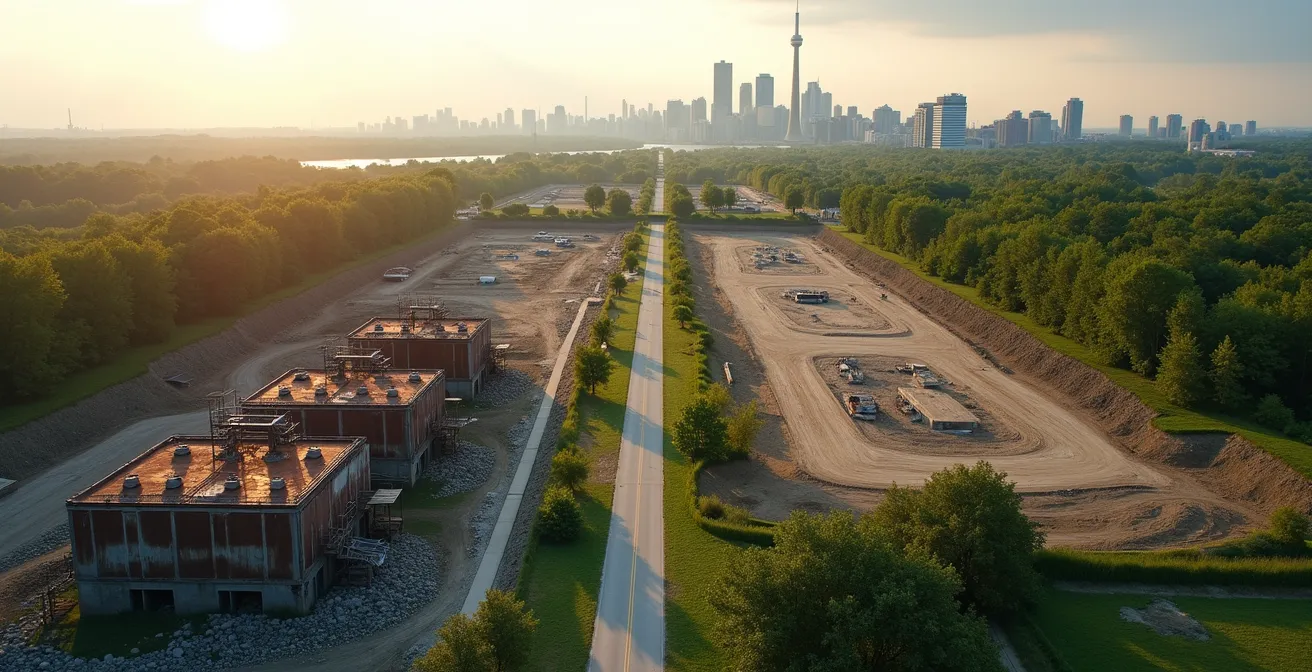
Successfully redeveloping a Montreal brownfield site hinges on treating environmental due diligence not as a regulatory cost, but as a strategic tool to de-risk your investment and optimize project timelines.
- Front-loading a comprehensive Phase I/II Environmental Site Assessment (ESA) is critical to accurately price subsurface uncertainty into your acquisition offer.
- Choosing the right remediation method—like on-site treatment over dig-and-dump for mild contamination—directly impacts your budget and schedule, especially with Montreal’s seasonal constraints.
Recommendation: Prioritize engaging a MELCC-accredited environmental engineer before acquisition to build a robust remediation plan that aligns with provincial grant requirements and minimizes authorization delays.
For a real estate developer in Montreal, the allure of a strategically located but underutilized industrial site is undeniable. These brownfields represent a significant opportunity for urban revitalization, but they also carry a substantial, often hidden, financial risk buried within the soil. The default approach often involves viewing environmental compliance as a series of bureaucratic hurdles—a costly and time-consuming process mandated by Quebec’s Ministry of the Environment, a.k.a. the Ministère de l’Environnement, de la Lutte contre les changements climatiques, de la Faune et des Parcs (MELCC).
Many developers focus on the most obvious steps: conduct a basic assessment, get a quote for cleanup, and hope for the best. This reactive stance, however, frequently leads to budget overruns, crippling timeline delays, and unforeseen liabilities. The conventional wisdom suggests simply following the rules, but this overlooks the profound strategic implications of each technical decision. The true challenge isn’t just about decontamination; it’s about navigating a complex matrix of regulatory, logistical, and financial variables unique to the Montreal landscape.
But what if the key to a profitable brownfield project wasn’t merely compliance, but a proactive strategy of risk quantification? This guide reframes the process from an environmental engineer’s investment-focused perspective. We will move beyond the basics of regulatory adherence to explore how front-loading risk assessment and making informed choices on remediation pathways can directly optimize your capital stack and project schedule. It’s about turning a potential liability into a calculated, manageable, and ultimately profitable venture.
This article provides a developer-centric breakdown of the critical environmental milestones. We will dissect the strategic choices you face at each stage, from initial site assessment to securing final authorizations, ensuring your next Montreal redevelopment project is built on a foundation of financial certainty, not subsurface uncertainty.
Summary: A Developer’s Strategic Guide to Montreal Brownfield Redevelopment
- Phase 1 vs Phase 2 Assessment: What Do You Really Need Before Buying?
- Dig-and-Dump vs On-Site Treatment: Which Is Cheaper for Mild Contamination?
- How to Access Provincial Grants for Decontaminating Urban Lands?
- The Soil Gas Risk That Can Make Your New Condo Tower Uninhabitable
- When to Expect the Certificate of Authorization: Managing Timeline Expectations?
- Private Hauler vs Municipal Collection: Which Offers Better Traceability?
- How to Install Deep-Mount Bollards Without Hitting Downtown Utility Lines?
- Reducing the Urban Environmental Footprint of Large Montreal Venues
Phase 1 vs Phase 2 Assessment: What Do You Really Need Before Buying?
In the context of a Montreal property acquisition, the Phase I Environmental Site Assessment (ESA) is not a mere formality; it is your primary tool for risk quantification. Its purpose is to identify potential or existing environmental contamination liabilities through historical record reviews and site reconnaissance, without intrusive sampling. For a developer, this is the first and most crucial step in pricing risk into your offer. Given Montreal’s extensive industrial past, from tanneries in Saint-Henri to rail yards in Rosemont, the potential for legacy contamination is high. A thorough Phase I, compliant with CSA Z768-01 standards, provides the liability shield necessary to make a sound investment decision.
The critical question is when to escalate to a Phase II ESA, which involves physical soil and groundwater sampling. A Phase I ESA that flags Recognized Environmental Conditions (RECs)—such as evidence of former underground storage tanks or proximity to a dry cleaner—mandates a Phase II. Proceeding with a purchase without a Phase II in such cases is equivalent to acquiring a property with an unquantified liability. The costs can vary significantly, with market analysis showing a Phase 1 ranging from $3,000 to $5,000, while a Phase 2 can span from $7,000 to over $60,000 depending on the scope of drilling and lab analysis required.
For a developer, the Phase II ESA is not a cost center but an investment in certainty. It provides the data needed to estimate remediation costs, which directly informs your financial model and negotiation strategy. Skipping a recommended Phase II means you are inheriting the full, unknown cost of cleanup, a risk that no sound development pro forma can absorb. In Montreal’s unique geological context, with its complex glacial and fluvial soil history, contaminants can migrate in unpredictable ways, making a robust Phase II assessment indispensable before closing a deal.
Dig-and-Dump vs On-Site Treatment: Which Is Cheaper for Mild Contamination?
Once contamination is confirmed by a Phase II ESA, the next major financial decision is the remediation method. The traditional approach, “dig-and-dump,” involves excavating contaminated soil and transporting it to a licensed landfill. While seemingly straightforward, this method’s costs are subject to significant volatility, including landfill tipping fees, transportation logistics, and the expense of clean backfill. In a city like Montreal, these logistics can be further complicated by traffic congestion and seasonal restrictions, such as during festival season or winter weight limits on roads.
For large sites with mild to moderate contamination—particularly petroleum hydrocarbons or organic compounds—on-site treatment presents a compelling, and often more cost-effective, alternative. Methods like bioremediation (using microorganisms to break down contaminants) or soil washing (separating contaminants from soil particles) eliminate transportation costs and the need for clean backfill. Though the timeline for on-site treatment is typically longer and can be affected by factors like Montreal’s winter freezes, the potential for significant long-term savings makes it a strategic option for developers with flexible project schedules.
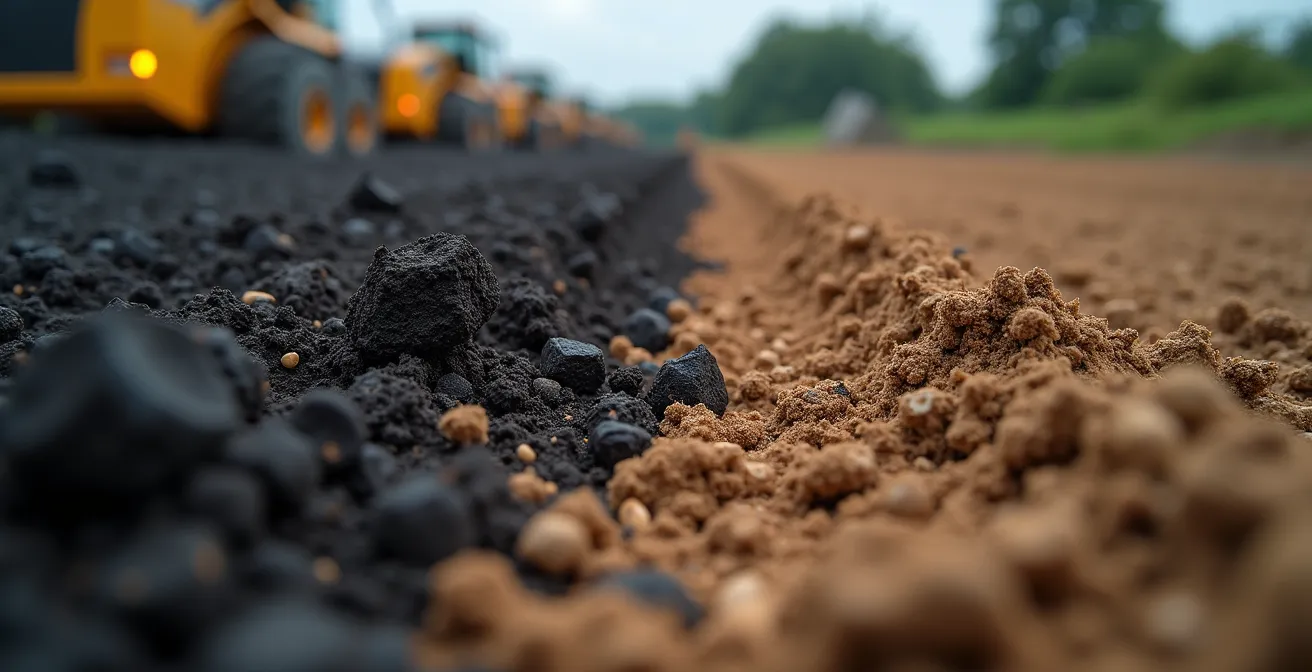
The choice is not purely financial but also impacts your project’s environmental, social, and governance (ESG) profile. On-site treatment is viewed more favorably from a sustainability perspective, which can be an asset when seeking public funding or marketing the final development. A detailed comparative analysis is essential for making the right call.
The following table, based on guidance for sustainable remediation, outlines the key decision factors for a developer. A recent analysis from the Green Municipal Fund provides a framework for evaluating these sustainable remediation options.
| Method | Cost Factors | Timeline Considerations | Best For |
|---|---|---|---|
| Dig-and-Dump | Landfill tipping fees + Transportation + Clean backfill costs | Faster completion but logistics complex during Montreal festival season | Small sites with severe contamination |
| On-Site Treatment | Equipment rental + Treatment chemicals/organisms + Monitoring | Slower, affected by Montreal winter freezes | Large sites with mild-moderate contamination |
| Bioremediation | Lower operational costs but longer duration | 6-24 months depending on contaminants | Petroleum hydrocarbons, organic compounds |
| Soil Washing | Higher equipment costs but reusable soil | 3-6 months typical | Heavy metals, mixed contamination |
How to Access Provincial Grants for Decontaminating Urban Lands?
For developers undertaking brownfield projects in Quebec, environmental remediation costs can be partially offset by robust provincial funding programs. The most significant of these is ClimatSol-Plus, a program specifically designed to encourage the rehabilitation and revitalization of contaminated lands. Integrating this grant application into your project’s capital stack from the outset is a critical strategic move. The program provides financial assistance to cover a portion of the costs related to site characterization and remediation work, turning a potential financial burden into a more manageable expense.
Accessing these funds requires meticulous planning and adherence to strict eligibility criteria. The program prioritizes projects that promote sustainable development, such as those incorporating on-site treatment methods over dig-and-dump, or those leading to residential or community-focused use. The Quebec government’s recent ClimatSol-Plus investment of over $9.7 million in May 2024 for five projects underscores its commitment to urban brownfield redevelopment. This signals a clear opportunity for well-prepared developers.
The application process is rigorous. Developers must work with a MELCC-authorized expert with at least 10 years of experience who can vouch for the proposed remediation plan. All work must comply with Quebec’s Environment Quality Act and utilize the government-mandated TRACES Québec system for any soil that is moved. Proving that your project aligns with the program’s goals—and submitting flawless documentation—is key to a successful application. Missing a deadline or submitting an incomplete file can delay funding and jeopardize your project’s financial viability.
Your Checklist for Montreal’s Contaminated Land Subsidy Application
- Compliance Verification: Confirm your project adheres to Quebec’s Environment Quality Act and all associated MELCC regulations.
- Rehabilitation Plan: Complete a full rehabilitation plan for the contaminated lot, ensuring use of the MELCC-approved TRACES tracing system for any excavated soil.
- Treatment Priority: Demonstrate the promotion of in-situ treatment or the recovery-focused treatment of excavated soil whenever technically and economically feasible.
- Expert Credentials: Submit resumes of MELCC-authorized experts involved, proving a minimum of 10 years of relevant experience.
- Residential Project Criteria: For residential developments, provide implementation plans and detailed proof that the project meets the specific criteria outlined in Article 6 of the subsidy program.
The Soil Gas Risk That Can Make Your New Condo Tower Uninhabitable
Beyond soil and groundwater contamination, a more insidious and often overlooked risk in Montreal’s brownfield sites is soil gas intrusion. This occurs when volatile organic compounds (VOCs) from historical contamination—or naturally occurring gases like radon—migrate from the subsurface into a building’s interior. This poses a direct health and safety threat to future occupants and can render a newly constructed building uninhabitable, creating a catastrophic liability for the developer. This is not a theoretical risk; it is a critical factor in site viability.
In Montreal, with its legacy of industrial workshops, former dry cleaners (using tetrachloroethylene, or PCE), and gas stations, the potential for VOCs is significant. As one environmental assessment professional from Partner ESI’s Montreal guidelines notes, “Volatile organic compounds like TCE and PCE, common in Montreal’s industrial legacy sites, pose significant health and safety risks beyond just radon.” These invisible gases can accumulate in indoor air to levels that exceed health standards, leading to regulatory enforcement action, lawsuits, and irreversible reputational damage.
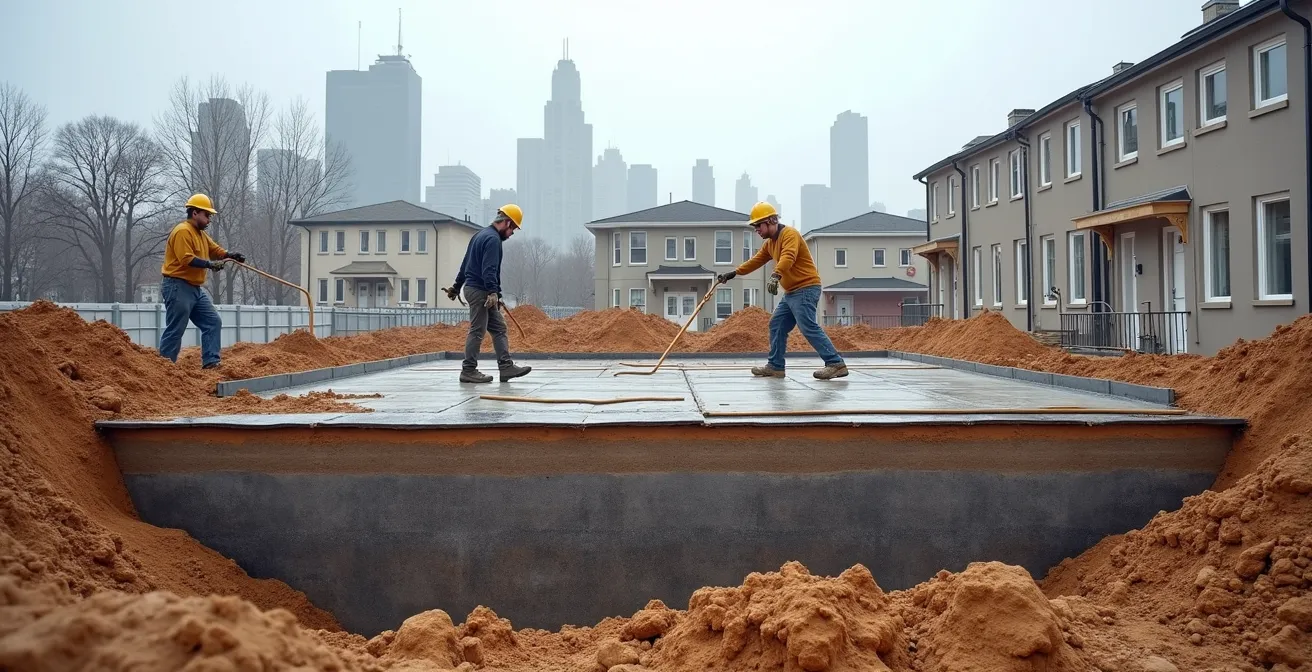
Mitigating this risk starts during the Phase II ESA with a soil vapor assessment. If a risk is identified, the building design must incorporate a vapor mitigation system. This typically involves installing an impermeable vapor barrier beneath the foundation slab, coupled with a sub-slab depressurization system (similar to a radon mitigation system) that actively vents gases to the exterior. While adding to construction costs, this system is a non-negotiable insurance policy against future liability. Ignoring the potential for soil gas intrusion is a gamble that no prudent developer should take, as the cost of post-construction retrofitting is exponentially higher than proactive installation.
When to Expect the Certificate of Authorization: Managing Timeline Expectations?
For a developer, time is money. One of the most significant sources of delay in a Montreal brownfield project is the process of obtaining a Certificate of Authorization (C of A) from the MELCC. This certificate is the official green light for your remediation and construction plan, and no major work can begin without it. Mismanaging expectations around this timeline can have a devastating impact on your project’s critical path, affecting financing draws, contractor scheduling, and a.m. sales velocity.
It is crucial to understand that the C of A review is not a quick administrative check. It is a detailed technical review of your site characterization studies and proposed remediation action plan. The MELCC analyst assigned to your file will scrutinize every detail to ensure compliance with the Environment Quality Act. Based on current government information for related subsidies, current MELCC processing estimates indicate that timelines can vary widely, from 3 to 12 months or even longer for highly complex sites. This variance represents a major financial risk that must be factored into your project schedule.
However, developers are not powerless. Proactive strategies can help streamline the review process. The most effective approach is to schedule a pre-submission meeting with the assigned MELCC analyst. This allows your environmental consultant to walk them through the project, understand their specific concerns upfront, and tailor the submission accordingly. Submitting a comprehensive, well-organized package that anticipates potential questions—complete with detailed site characterization from the Phase II ESA and a clear chain of custody for all samples—can significantly reduce back-and-forth communication and accelerate approval. Structuring your construction financing with a buffer for potential authorization delays is simply prudent risk management.
Private Hauler vs Municipal Collection: Which Offers Better Traceability?
When your remediation strategy involves “dig-and-dump,” the choice of a soil hauler is not a simple procurement decision—it is a critical link in your chain of liability. In Quebec, the disposal of contaminated soil is heavily regulated. The mandatory TRACES Québec system provides a digital, real-time tracking mechanism for every truckload of contaminated soil, from the moment it leaves your site to its arrival at an authorized treatment facility or landfill. This system is designed to prevent illegal dumping and ensure full accountability.
For a developer, the key question is whether to use a private hauler or rely on municipal collection services, where available. While municipal services generally offer built-in compliance and standardized liability coverage, they often lack flexibility in scheduling and may come at a fixed, non-negotiable rate. Private haulers, on the other hand, can offer competitive pricing and highly flexible scheduling, which is a major advantage for a fast-moving construction project. However, the onus is entirely on you, the developer, to perform rigorous due diligence.
You must verify that the private hauler is fully compliant with TRACES Québec, holds all necessary MELCC permits, and carries adequate liability insurance. As Quebec legal precedents show, a developer can remain legally responsible if their chosen hauler disposes of soil illegally, even if the developer was unaware. Your liability does not end when the truck leaves the gate. Therefore, demanding and reviewing meticulous chain of custody documentation is non-negotiable. The slight cost savings from a cheaper hauler are insignificant compared to the potential fines and legal costs of a compliance failure.
| Criteria | Private Haulers | Municipal Collection |
|---|---|---|
| TRACES Quebec Compliance | Must verify individual compliance | Generally compliant by default |
| MELCC Permits | Requires verification of current permits | Maintained by municipality |
| Liability Insurance | Variable coverage levels | Standardized municipal coverage |
| Chain of Custody Documentation | Company-specific protocols | Standardized municipal procedures |
| Cost | Competitive pricing possible | Fixed municipal rates |
| Flexibility | High – customizable schedules | Limited – fixed schedules |
How to Install Deep-Mount Bollards Without Hitting Downtown Utility Lines?
While environmental contamination is a primary concern, the physical risks of working in a dense urban environment like downtown Montreal present another layer of complexity. A seemingly simple task like installing deep-mount security bollards or starting excavation for a foundation can become a high-stakes operation due to the city’s congested subsurface. Hitting an undocumented utility line—be it a high-voltage conduit from Hydro-Québec, a high-pressure gas line from Énergir, or a critical fiber optic cable from Bell Canada—can lead to catastrophic project delays, costly repairs, and significant safety hazards.
The “Call Before You Dig” service provided by Info-Excavation is the mandatory first step, but it is not foolproof. The provided markings indicate the approximate location of known, registered utilities. However, in older parts of Montreal, historical records can be incomplete or inaccurate, and many private or abandoned lines may not be documented at all. This is a classic example of “subsurface uncertainty,” where the risk of the unknown is high.
To mitigate this risk, a multi-pronged approach to subsurface investigation is required before any excavation. This involves deploying advanced locating technologies as part of your site preparation. Ground Penetrating Radar (GPR) is essential for identifying non-metallic pipes and undocumented anomalies, while electromagnetic locators can precisely trace metal pipes and electrical cables. This technical due diligence must be integrated directly into your site’s Health and Safety Plan (HSAP) and communicated clearly to all excavation contractors.
Action Plan: Safe Subsurface Work in Downtown Montreal
- Initial Marking: Place a formal request with Info-Excavation at least 72 hours before any planned digging for official marking of known public utilities.
- Advanced Scanning: Deploy Ground Penetrating Radar (GPR) across the entire excavation footprint to detect undocumented objects and verify the accuracy of initial markings.
- Electromagnetic Locating: Use electromagnetic (EM) locators to trace the precise path and depth of metallic pipes and active electrical conduits.
- Utility Coordination: Directly consult with key utility owners like Hydro-Québec (electrical), Énergir (gas), and Bell Canada (telecom) to obtain any available detailed maps or as-built drawings for the immediate area.
- Integration and Briefing: Consolidate all findings into a comprehensive subsurface utility map and make it a mandatory review item in the site Health and Safety Plan (HSAP) briefing for all excavation crews.
Key Takeaways
- Brownfield liability in Montreal is manageable if environmental due diligence is treated as a strategic investment, not just a regulatory cost.
- The choice between remediation methods (e.g., dig-and-dump vs. on-site) must be analyzed based on cost, timeline, and site-specific constraints, including Montreal’s seasons.
- Provincial grants like ClimatSol-Plus are accessible with meticulous planning and can significantly improve your project’s financial model.
Reducing the Urban Environmental Footprint of Large Montreal Venues
The challenge of brownfield redevelopment in Montreal is immense. As Mayor Valerie Plante once stated, “the entire island of Montreal is contaminated” outside of its existing parks and green spaces. This reality, however, also presents a profound opportunity to not only clean up legacy sites but also to integrate forward-thinking environmental design into new large-scale developments. For a developer, reducing the project’s long-term environmental footprint is no longer just a “nice-to-have”; it is becoming a key factor in securing public support, attracting tenants, and enhancing brand value.
Successful projects, like the rehabilitation of the Pointe-Saint-Charles industrial park, demonstrate a viable path forward. The strategy extends beyond simple decontamination. It involves implementing green infrastructure that provides ongoing environmental benefits. This can include installing bioswales for natural stormwater filtration, using permeable pavements to aid groundwater recharge, and designing green roofs to mitigate the urban heat island effect. These features transform a remediated site from a neutral space into an active contributor to the city’s ecological health.
These strategies also serve a practical risk-management function. For instance, a permanent capping system with integrated integrity monitoring ensures that any residual, low-level contamination remains safely sequestered, providing long-term public safety and regulatory peace of mind. By establishing institutional controls and using natural elements like windbreaks to manage dust, a developer can create a venue that is not only profitable but also a positive landmark in the community. This holistic approach aligns with the city’s broader sustainability goals and positions the development as a model for future urban revitalization.
To successfully navigate this complex but rewarding landscape, the first step is always the most critical: begin your due diligence by engaging a qualified, MELCC-accredited environmental professional to assess your target property’s specific risk profile and build a strategic remediation plan.