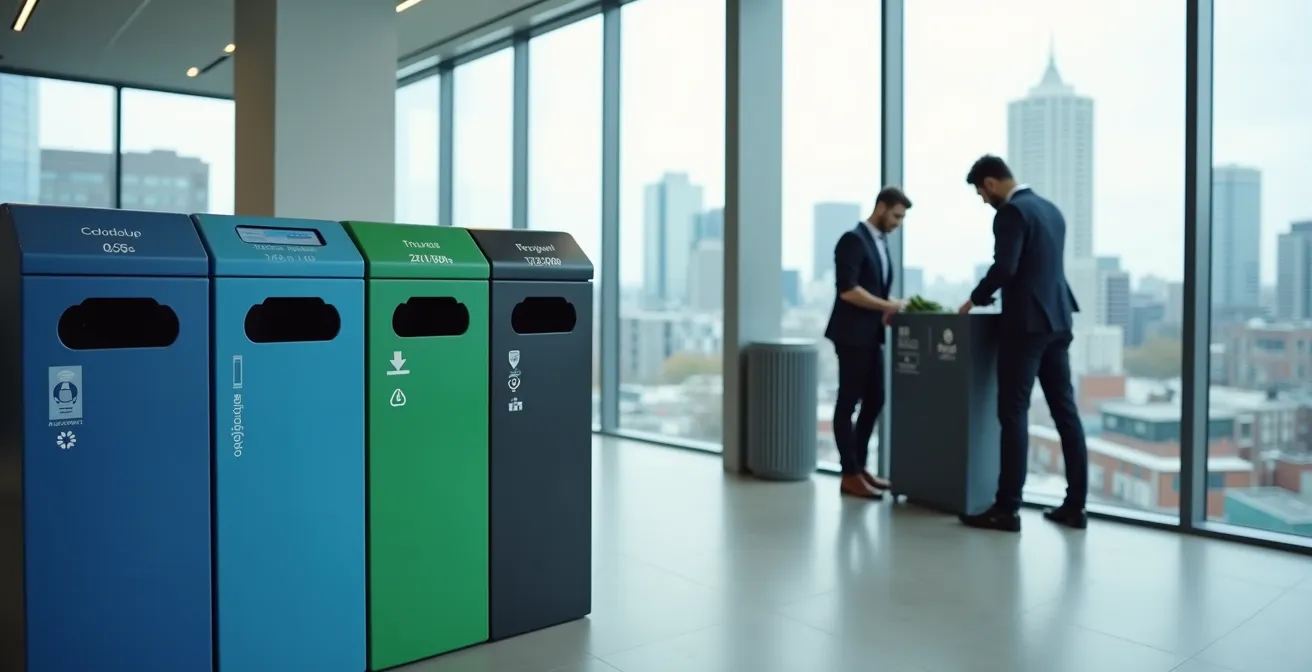
Meeting Montreal’s 2025 waste targets isn’t about adding more bins; it’s about redesigning your waste system to eliminate costly operational inefficiencies and compliance risks.
- Contamination is the primary driver of cost, turning recyclable assets into landfill liabilities.
- Data-driven waste audits and behavioural design are more effective than simple employee awareness campaigns.
Recommendation: Prioritize waste stream traceability and implement robust contamination control protocols to transform your recycling program from a cost center into a strategic advantage.
As a sustainability director for a major Montreal firm, the 2025 deadline for Quebec’s waste reduction strategy isn’t just a date on a calendar; it’s a looming operational and financial reckoning. With escalating disposal costs and tightening regulations, the pressure to demonstrate tangible progress is immense. For years, the standard corporate response has been a predictable mix of awareness posters in the breakroom and the deployment of more blue bins, hoping for the best. This approach, however, treats recycling as a matter of employee goodwill rather than what it has become: a critical component of operational efficiency.
The common wisdom suggests that employee education is the key. But what if the posters are ignored and well-intentioned sorting efforts are still leading to contaminated loads? The truth is, many corporate recycling programs fail not because of a lack of will, but a lack of strategy. They leak value at every stage, from confusing signage to opaque disposal chains, turning potentially valuable materials into expensive landfill-bound waste. This is where we must shift our perspective. The fundamental challenge isn’t just about diverting waste; it’s about treating your waste stream as a system to be engineered, measured, and optimized, transforming it from a financial and regulatory liability into a well-managed asset.
This guide moves beyond the platitudes. We will dissect the structural failures of typical office recycling programs and provide a strategic framework for Montreal businesses. We will explore how to design systems that inherently guide correct behaviour, evaluate the critical choice between private and municipal haulers, and implement data-driven methods to optimize collection. The goal is to equip you with a plan that not only ensures compliance with the 2025 targets but also delivers significant cost savings and enhances your company’s sustainability credentials.
This article provides a detailed roadmap for transforming your approach to corporate waste management. The following sections break down the essential strategies and tactical shifts necessary to build a truly effective and compliant recycling program in the Montreal context.
Summary: A Strategic Framework for Corporate Waste in Montreal
- Why Your “Recyclable” Office Waste Is Likely Going Straight to the Landfill?
- How to Design Bin Signage That Prevents Sorting Errors by Employees?
- Private Hauler vs Municipal Collection: Which Offers Better Traceability?
- The Composting Oversight That Will Trigger Fines for Large Producers
- How to Reduce Single-Use Cups in the Office by 50% in 3 Months?
- How to Calculate Waste Generation Rates to Optimize Pick-Up Frequency?
- The “Broken Window” Theory: Why Cleaning Graffiti Within 24 Hours Matters?
- Meeting Provincial Environmental Standards for Brownfield Redevelopment in Montreal
Why Your “Recyclable” Office Waste Is Likely Going Straight to the Landfill?
The most inconvenient truth in corporate recycling is that a significant portion of what your employees place in the blue bin never actually gets recycled. The single greatest culprit is contamination. In a commercial setting, a single non-compliant item—like a greasy pizza box in the paper bin or a black plastic takeout container mixed with clear plastics—can compromise an entire batch. When a sorting facility (or “centre de tri”) deems a load too contaminated, the most economically viable decision is often to divert the whole lot to a landfill. For your company, this means you are paying to have a potential asset collected, only to then pay again for its disposal as garbage.
In Montreal, specific items are notorious for causing these costly diversions. Black plastic, commonly used for microwaveable meals, is optically invisible to many automated sorting machines. Coffee cups with polyethylene (plastic) linings are another major offender; while the paper fibre is recyclable, it must be separated from the lining, a process most facilities are not equipped for. This transforms a seemingly “paper” cup into a contaminant. These small, repeated errors, multiplied across hundreds of employees, create a systemic and expensive problem.
The solution is not to simply tell employees to “be better.” The solution is to strategically eliminate common contaminants from your procurement process and waste streams entirely. A proactive audit of your office’s most common waste items is the first step toward stopping contamination at the source. By identifying and addressing these “culprits,” you shift from a reactive, hope-based strategy to a proactive, systems-based one that directly impacts your bottom line and environmental footprint. This is the first principle of treating waste as a liability that needs to be managed and engineered out of the system.
Action Plan: Eliminating Common Office Contamination
- Identify and phase out procurement of black plastic food containers for catering and kitchen supplies.
- Work with your coffee supplier to switch to fully compostable or plastic-free cups, or implement a robust reusable mug program.
- Install a dedicated rinsing station near kitchen bins with clear signage to ensure all containers are clean before disposal.
- Ensure cleaning staff are trained to remove plastic bin liners from paper and cardboard recycling bins before collection.
- Create a simple, visual guide specifically for “mixed plastics” (numbers 3-7), directing them to the appropriate disposal stream as they present challenges for Montreal’s facilities.
How to Design Bin Signage That Prevents Sorting Errors by Employees?
Traditional recycling signage often fails because it relies on people reading and correctly interpreting text in a split second. A more effective approach is rooted in behavioural science: behavioural architecture. This means designing the physical environment to make the right choice the easiest and most intuitive choice. Instead of just telling employees what to do, you build a system that guides their actions subconsciously. This moves beyond simple awareness and into the realm of strategic design, a far more powerful tool for reducing contamination.
The design of the bins themselves is your most powerful piece of signage. For instance, creating an aperture (opening) that matches the shape of the desired item—a thin slot for paper, a small circle for cans and bottles—creates a “forcing function.” An employee is physically prevented from putting a bulky plastic container in the paper slot. Similarly, as detailed by a guideline from the municipality of Westmount, using consistent colour-coding that aligns with Montreal’s municipal standards (blue for recycling, green for organics, black for landfill) creates an instant visual cue that requires zero cognitive load. The goal is to reduce the decision-making burden on the employee to near zero.
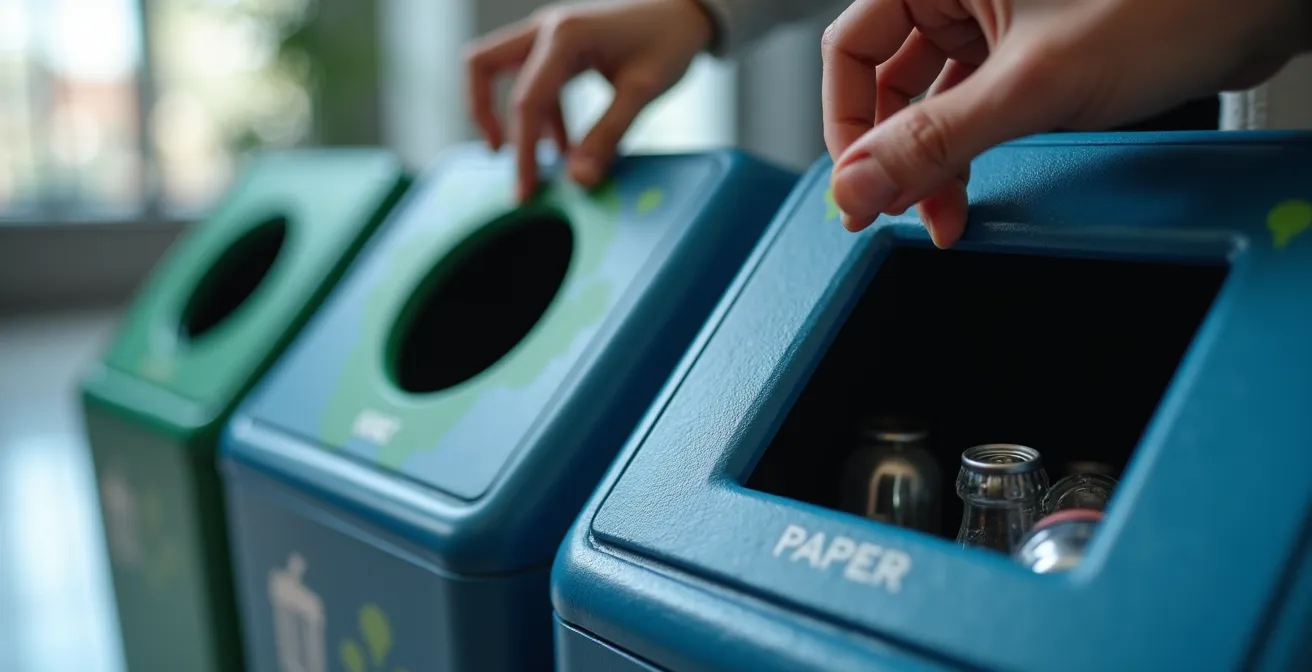
Furthermore, the placement and physical characteristics of bins can nudge behaviour. Positioning recycling and compost bins in more prominent, well-lit, high-traffic locations than landfill bins subtly signals their importance. Some facilities have even experimented with making the landfill bin lid slightly heavier or more difficult to open, adding a tiny point of friction that makes the recycling bin the path of least resistance. These are not elaborate or expensive changes; they are small, strategic modifications that, collectively, architect a workplace environment where correct sorting becomes second nature.
Your Bin Design and Placement Checklist
- Contact Points: Are bin apertures shaped to match the desired waste (e.g., a slot for paper)? Does the color scheme match Montreal’s standard (blue, green, black)?
- Collection Audit: Inventory all current bins. Are recycling and organics bins more conveniently located and numerous than landfill bins in high-traffic areas like kitchens and copy rooms?
- Coherence Check: Does your visual signage use clear, high-contrast images instead of text? Is it consistent across all floors and departments?
- Emotional Cue: Is the waste area clean, well-lit, and organized? A tidy space encourages conscientious behaviour, whereas an overflowing one signals that sorting doesn’t matter.
- Integration Plan: Develop a phased plan to replace non-compliant bins and strategically relocate stations to create “nudge-friendly” pathways for employees.
Private Hauler vs Municipal Collection: Which Offers Better Traceability?
For a large Montreal enterprise, the choice of a waste hauler is a strategic decision with significant implications for cost, compliance, and data. While municipal collection offers simplicity and fixed rates, its primary drawback is a near-total lack of granular data and traceability. You receive a bill, but you have no insight into your contamination rates, diversion success, or the final destination of your materials. This black-box approach makes it impossible to manage your recycling program effectively or prove your sustainability performance to stakeholders. It completely undermines any effort at data-driven optimization.
Private haulers, in contrast, operate in a competitive market where data and traceability are key differentiators. They can provide detailed monthly reports on tonnage, contamination levels, and diversion rates for each waste stream. This feedback loop is invaluable. If your contamination rate for mixed paper suddenly spikes, a private hauler can alert you, allowing you to identify and correct the problem (e.g., a new packaging type being disposed of incorrectly) before it becomes a chronic and costly issue. As confirmed in a comparison on the City of Montreal’s website, this level of individual feedback is simply not available through municipal services.
Furthermore, leading private sector partners offer a robust chain of custody for sensitive materials. For example, specialized electronics recyclers provide services critical for corporate data security and environmental liability. An electronics recycling specialist like Quantum Lifecycle can offer secure transport with GPS tracking and verified destruction, ensuring that decommissioned IT assets don’t become a data breach liability or an environmental hazard. The ability to conduct site visits at your hauler’s sorting facility to see their process firsthand also provides a level of transparency and partnership that is crucial for building a truly circular waste strategy.
The following table outlines the key differences a sustainability director must consider when evaluating their hauling options in Montreal.
| Criteria | Private Haulers | Municipal Collection |
|---|---|---|
| Traceability Reports | Monthly detailed reports available | Limited to annual summaries |
| Certification Options | B Corp, Ecocert available | Government standard only |
| Site Visit Possibility | Yes, can arrange facility tours | Restricted access |
| Contamination Feedback | Real-time alerts possible | No individual feedback |
| Cost | Higher but negotiable | Fixed municipal rates |
The Composting Oversight That Will Trigger Fines for Large Producers
While much focus is placed on recycling, Montreal’s regulations around organic waste represent a more immediate and punitive compliance risk for large businesses. Under bylaw RCG 19-026, any institution generating a significant volume of organic matter is required to have a contract with a certified collection service. The threshold is lower than many realize, and with the city’s aggressive push toward diverting organics from landfill, enforcement is becoming stricter. For a large corporate office with a cafeteria, this is not an optional program; it’s a legal obligation. Ignoring this can lead to substantial and repeated fines, turning a manageable operational cost into an unnecessary financial penalty.
The primary oversight companies make is underestimating their organic waste volume or failing to secure a compliant collection contract. The logistical challenges, especially in dense urban areas with space constraints for brown bins, are often cited as a reason for non-compliance. However, these are not valid excuses in the eyes of municipal inspectors. As outlined in the City of Montreal’s guidelines, businesses exceeding the threshold must register and maintain documentation of their collection services for verification. Failure to produce this documentation during an inspection is a direct route to a fine.
Beyond simple compliance, there are also strategic opportunities. Instead of viewing organic waste as simply another stream for disposal, innovative Montreal organizations are finding ways to create value. A prime example is partnering with local groups like La Transformerie. This model allows businesses to divert unsold or surplus food from their cafeterias to be repurposed into new products. This not only fulfills the spirit of the bylaw by diverting waste from landfills but also creates a positive social impact and a compelling sustainability story. It reframes the compliance burden as a chance to participate in the local circular economy, moving up the waste hierarchy from disposal to reduction and reuse.
Case Study: The La Transformerie Partnership Model
Instead of just composting, Montreal businesses can partner with local organizations like La Transformerie to repurpose unsold food. This approach avoids potential fines under bylaw RCG 19-026 by creating value from would-be waste, directly addressing regulatory compliance while building community engagement. It’s a strategic move from simple disposal to value creation.
How to Reduce Single-Use Cups in the Office by 50% in 3 Months?
Single-use coffee cups are one of the most visible—and voluminous—sources of waste in a corporate office. While seemingly recyclable, most are lined with plastic, making them a major contaminant in paper streams. Tackling this problem offers a high-impact, visible win for any sustainability program. Achieving a 50% reduction in three months is an ambitious but achievable goal that requires a multi-pronged approach combining incentives, disincentives, and high-quality alternatives.
The first month should focus on laying the groundwork. The most effective strategy is a combination of a “push” and a “pull.” The “push” is a small but noticeable surcharge—for example, 25 cents—on every disposable cup used. This financial disincentive makes employees consciously consider their choice. The “pull” is the introduction of a desirable alternative. This can be a mug-sharing program, perhaps launched in partnership with a local Montreal coffee shop to strengthen community ties, or the distribution of high-quality, branded reusable mugs to every employee. The key is that the reusable option must be convenient and appealing.

The second month is about engagement and reinforcement. A powerful tool is gamification. Installing a digital dashboard in a common area that tracks the reduction in disposable cup usage by department can spark friendly competition. This visual feedback makes the collective progress tangible and celebrated. This is the moment to ensure every employee has received their high-quality reusable mug, removing any excuse for not participating. It’s about making the sustainable choice the path of least resistance and the socially celebrated norm within the office culture.
Finally, the third month is about consolidating the habit and celebrating the success. By now, the new behaviour should be well-established. Reaching the 50% reduction milestone should be acknowledged and rewarded. Hosting a catered lunch from a local, sustainable Montreal restaurant reinforces the company’s commitment to its environmental values and thanks employees for their participation. This completes the cycle from initial push to cultural shift, embedding the reduction of single-use items into the company’s daily operations.
How to Calculate Waste Generation Rates to Optimize Pick-Up Frequency?
Optimizing your waste hauling contract is one of the fastest ways to reduce operational expenses. Most companies operate on a fixed pick-up schedule, regardless of whether their bins are full or not. You could be paying for the collection of half-empty bins, or conversely, suffering from overflows that create health and safety issues. The solution is to move to a data-driven collection schedule based on your actual waste generation rates. This requires a simple but systematic process of waste auditing.
The first step is to conduct a baseline audit over a period of two to four weeks. This involves measuring the volume and weight of each waste stream—landfill, recycling, and organics—before each scheduled pick-up. You don’t need sophisticated equipment; this can be done by recording how full each container is (e.g., 50%, 75%, 100%) and estimating weight. The goal is to identify patterns. Is your paper recycling bin always overflowing by Thursday while the landfill bin is only half-full at the end of the week? This data is pure gold for contract renegotiation.
With this data in hand, you can work with your hauler to adjust pick-up frequencies. The analysis may show you can reduce landfill collections from weekly to bi-weekly, while needing to increase organics collections during peak periods. For specialized streams like e-waste, which can accumulate unpredictably, the data justifies shifting to an on-demand collection model rather than a fixed monthly schedule. As a case in point, Montreal’s businesses generate over 40 million pounds of e-waste annually, a stream that is particularly ill-suited to fixed schedules. Optimizing its collection can yield significant savings.
This optimization exercise directly translates to your bottom line, as different waste streams carry vastly different costs. Landfill is the most expensive, while organics and well-sorted recycling are significantly cheaper. A data-driven approach allows you to precisely match service levels to your actual needs, eliminating over-servicing and its associated costs.
| Waste Stream | Collection Frequency | Relative Cost | Optimization Potential |
|---|---|---|---|
| Landfill | Weekly | Highest | Reduce by 40% |
| Recycling | Bi-weekly | Medium | Maintain current |
| Organics | 2x weekly | Low | Increase if needed |
| E-waste | Monthly | Variable | Schedule as needed |
The “Broken Window” Theory: Why Cleaning Graffiti Within 24 Hours Matters?
The “Broken Window” theory is a criminological concept which posits that visible signs of disorder, like a broken window or graffiti, create an environment that encourages further crime and anti-social behaviour. This theory has a powerful and direct application to corporate waste management. An overflowing, messy, and poorly maintained bin area acts as a “broken window.” It sends a clear, albeit implicit, signal to employees and service staff: no one cares. When faced with a chaotic waste station, even the most diligent employee is less likely to take the extra moment to sort their items correctly.
This psychological effect directly undermines all other recycling efforts. You can have the world’s best signage and bin design, but if the area is consistently dirty, contamination rates will rise. As a Montreal waste management expert noted in a corporate sustainability guide, “A messy, overflowing bin area signals lack of care and implicitly encourages incorrect sorting behaviors.” The state of your waste infrastructure is a physical manifestation of your company’s commitment to its sustainability policies. A clean, organized system inspires confidence and encourages compliance; a disorderly one breeds apathy and carelessness.
Therefore, establishing a rapid-response cleanliness protocol is not a janitorial task—it’s a core component of your waste reduction strategy. This means daily inspections of all waste areas and a system to immediately address overflows or significant messes. For external areas, this includes coordinating with Montreal’s borough-level programs for rapid graffiti removal. By maintaining a pristine environment, you are not just cleaning; you are constantly reinforcing the message that sorting matters and that the company is serious about its program. This high standard of maintenance is a crucial element of behavioural architecture, creating an environment where compliance is the natural and expected behaviour.
Key Takeaways
- Waste contamination is a primary financial drain, turning recyclable materials into costly landfill liabilities that must be proactively managed.
- System design, including bin shape, placement, and color, is more effective at guiding employee behavior and reducing sorting errors than awareness posters alone.
- Traceability is non-negotiable for compliance and cost control; private haulers provide essential data and feedback loops that municipal services lack.
Meeting Provincial Environmental Standards for Brownfield Redevelopment in Montreal
The connection between your office’s recycling bins and the redevelopment of industrial land in Montreal might not seem obvious, but it is direct. Every tonne of waste that is improperly managed and sent to a landfill contributes to a larger environmental liability. Landfills are a primary source of soil and groundwater contamination. In a land-constrained city like Montreal, the long-term goal is to minimize landfill use and reclaim post-industrial sites (“brownfields”) for new development. Failing to meet provincial environmental standards in your day-to-day operations makes this broader urban sustainability goal more difficult and expensive to achieve.

Improper disposal of specific waste streams, particularly e-waste, poses a severe threat. When discarded in landfills, electronics break down and release harmful chemicals like lead, mercury, and cadmium into the air, soil, and water. This pollution threatens Montreal’s ecosystems and public health, and creates complex and costly remediation challenges for future land use. As regulations tighten, with new rules imposing stricter penalties for improper waste disposal taking effect, the financial risk of non-compliance is escalating. Proper recycling ensures these hazardous materials are safely managed and kept out of the environment, directly contributing to the long-term health of the city’s land resources.
For a sustainability director, this macro perspective is crucial. Your corporate waste strategy is not an isolated function. It is an integral part of the city’s larger circular economy and land management strategy. By optimizing your internal processes to maximize diversion and ensure proper disposal, you are not only cutting costs and meeting the 2025 targets, but you are also playing a direct role in preventing the creation of future brownfields. You are reducing your company’s long-term environmental liability and contributing to a more sustainable urban future for Montreal. This is the ultimate expression of a successful, strategically-minded sustainability program.
Your journey toward 2025 compliance and operational excellence begins not with a massive investment, but with a strategic audit of your current waste streams. Begin today by implementing these data-driven frameworks to transform waste from a liability into a measurable asset.