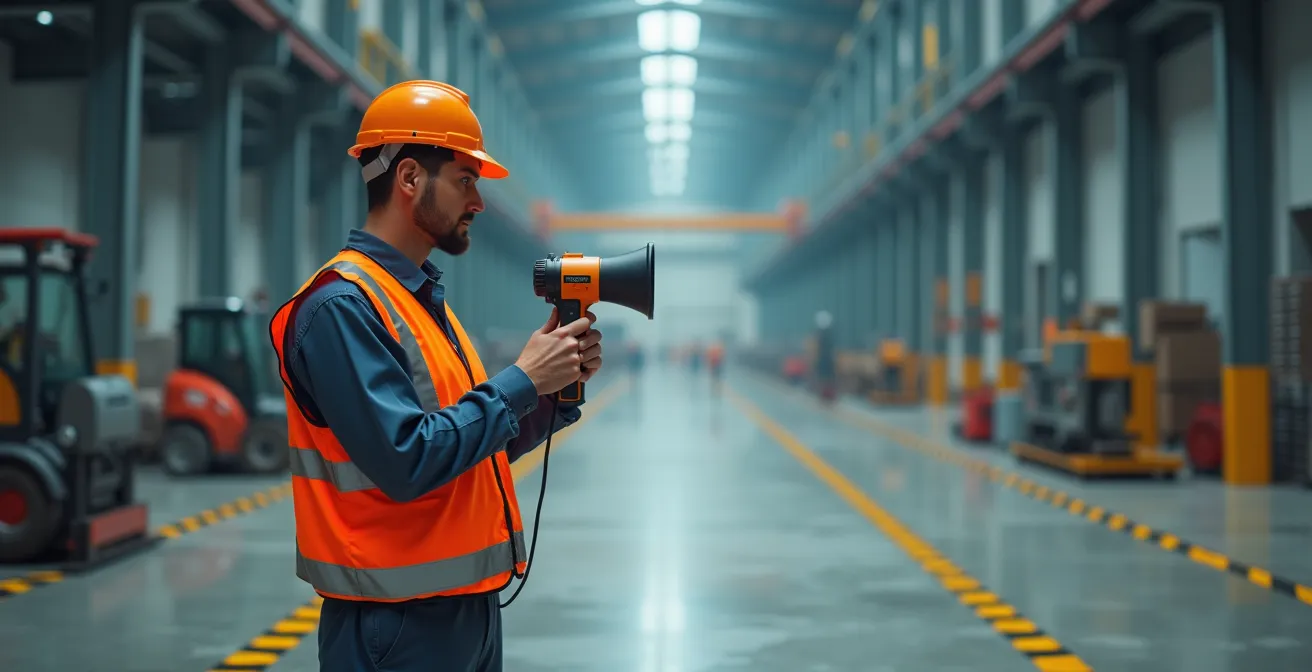
The key to managing industrial noise is shifting from a compliance-cost mindset to a strategic risk and performance framework.
- Effective noise control goes beyond PPE; it involves precise mapping, targeted engineering solutions, and understanding local Montreal bylaws.
- Choosing the right solution—from isolation pads to climate-resilient PPE—directly impacts both worker safety and operational continuity.
Recommendation: Begin by creating a detailed noise map of your facility to establish a data-driven baseline for all subsequent actions and investments.
As a factory manager in Montreal, the hum of machinery is the sound of productivity. But when that hum becomes a roar, it transforms into a significant liability. You’re caught between the non-negotiable mandate to protect your team from hearing loss and the constant pressure to maintain production targets. The challenge isn’t just about meeting regulatory standards; it’s about doing so without encumbering your workflow, adding prohibitive costs, or creating new, unforeseen safety hazards. Many managers default to handing out earplugs and hoping for the best, a strategy that often fails to address the root cause and can even lead to over-protection, isolating workers from critical auditory cues like alarms.
The conventional approach often presents a false dichotomy: safety or production. It focuses narrowly on personal protective equipment (PPE) as the primary solution, overlooking the more permanent and effective engineering controls that can design risk out of the system. This perspective fails to account for the holistic nature of your facility—what I call the ‘acoustic ecosystem’—where noise from one area impacts another, and where external factors like Montreal’s harsh winters can render standard equipment ineffective. The real question is not simply “how do we comply?”, but rather “how can we engineer a safer, quieter environment that enhances, rather than hinders, our operations?”
This guide moves beyond the platitudes. We will treat noise management not as a burdensome expense, but as a strategic pillar of operational excellence and long-term liability mitigation. By dissecting the problem through a scientific, problem-solving lens, you will learn to build a comprehensive program that is both compliant with CNESST regulations and tailored to the unique operational and climatic realities of your Montreal facility. We will explore how to diagnose your specific noise problems with precision, choose the most cost-effective controls, and select equipment that ensures both protection and productivity, season after season.
This article provides a structured path for tackling industrial noise head-on. The following sections break down the essential components of a robust noise management program, from initial assessment to the selection of specialized equipment.
Summary: A Manager’s Guide to Industrial Noise Control in Montreal
- How to Create a Noise Map to Identify Where Hearing Protection Is Mandatory?
- Isolation Pads vs Enclosures: Which Is More Cost-Effective for Noisy Compressors?
- Earplugs or Earmuffs: Which Provides Better Attenuation for High-Frequency Noise?
- The Safety Risk of Over-Protecting Hearing That Blocks Alarm Signals
- When to Schedule Hearing Tests: Baseline vs Periodic Monitoring?
- Why Your HVAC System Might Be Violating Montreal’s Noise Bylaws at Night?
- Fixed Guard or Interlock: Which Do You Need for Frequent Maintenance Access?
- Selecting Protective Equipment That Withstands Montreal’s Winter Extremes
How to Create a Noise Map to Identify Where Hearing Protection Is Mandatory?
The foundational step in any serious noise control program is to move from assumption to data. A noise map is a visual diagram of your facility that illustrates sound levels, allowing you to pinpoint high-risk zones and prioritize interventions. It is the single most critical tool for defending your compliance strategy. The process begins with a comprehensive noise assessment, using a calibrated sound level meter to measure ambient and peak noise levels at various locations and times. For mobile workers whose exposure fluctuates, personal dosimeters are essential to capture an accurate time-weighted average (TWA) throughout their shift. This data forms the basis of your acoustic ecosystem analysis.
In Quebec, the regulatory framework is clear. Your primary target is to stay below the limit set by the CNESST. Since June 2023, the standard has been reinforced, mandating that worker exposure must not exceed 85 dBA for an 8-hour maximum TWA. Any area where levels approach or surpass this threshold must be clearly identified on your map, typically using a color-coded system (e.g., green for safe, yellow for caution, red for mandatory PPE). This visual representation is not just for internal use; it becomes a crucial communication tool, making it immediately obvious to employees and inspectors where protection is required.
When exposure levels are found to exceed the limits, engaging a CNESST-recognized acoustician is not just a best practice; it’s a strategic necessity. Their involvement provides a legally defensible report and ensures that your measurement methodology is sound. This professional validation is invaluable for demonstrating due diligence and protecting your organization from potential claims and penalties. The resulting noise map becomes your blueprint for risk-based prioritization, guiding every decision from PPE policy to engineering control investments.
Your Action Plan: The 5-Step Industrial Noise Audit
- Source Identification: Systematically list all potential noise sources on the factory floor, from compressors and grinders to HVAC systems and conveyor lines.
- Data Collection: Inventory existing noise data, current PPE in use, and conduct new measurements with a sound level meter and personal dosimeters to quantify exposure levels.
- Compliance Check: Confront your collected data with CNESST’s 85 dBA TWA limit to identify all non-compliant areas and job roles.
- Qualitative Risk Assessment: Evaluate secondary risks, such as the audibility of fire alarms and forklift horns for workers wearing high-attenuation PPE.
- Prioritized Integration Plan: Develop a phased action plan that prioritizes the highest-risk areas for engineering controls and updates the PPE program accordingly.
This data-driven approach transforms noise control from a reactive chore into a proactive management system, laying the groundwork for more targeted and cost-effective solutions.
Isolation Pads vs Enclosures: Which Is More Cost-Effective for Noisy Compressors?
Once your noise map identifies a piece of equipment like a compressor as a primary noise source, the next decision is how to control it. The choice often comes down to two common engineering solutions: structural isolation with pads or airborne noise containment with an acoustic enclosure. Their effectiveness and cost-benefit profiles are fundamentally different, making the right choice dependent on the specific type of noise you are targeting. You must first diagnose whether the dominant noise is structure-borne vibration (a low-frequency hum transmitted through the floor) or airborne noise (a high-frequency sound radiating directly from the machine).
Isolation pads are designed to tackle vibration. By placing dense, flexible materials like rubber or cork composites between the machine and the floor, you decouple it from the building structure, significantly reducing the transmission of vibrational energy. This is a highly cost-effective solution for structure-borne noise, often seen with piston-style compressors. The key advantage is the low initial cost and the fact that they do not restrict maintenance access or airflow, thereby having no impact on the machine’s thermal performance. However, their ability to reduce airborne noise is minimal.

Acoustic enclosures, on the other hand, are designed to contain airborne noise. These are essentially soundproof boxes built around the equipment, often using modular panels with high-mass materials and absorptive liners. They are extremely effective for loud, high-frequency sources like screw compressors, offering significant decibel reductions. However, this performance comes at a higher initial cost and introduces new considerations: maintenance access must be designed in with doors and removable panels, and you must manage the heat buildup inside the enclosure, which may require a dedicated ventilation system and increase the load on your HVAC.
The choice is a matter of matching the solution to the problem. As this comparative analysis shows, a misdiagnosis can lead to spending significant funds on a solution that fails to address the dominant noise type. An enclosure will do little for a major vibration issue, while pads won’t quiet a loud screw compressor.
| Factor | Isolation Pads | Acoustic Enclosures |
|---|---|---|
| Initial Cost | Low ($100-500) | High ($5,000-20,000) |
| Noise Reduction | 10-20 dB for vibration noise | 20-30 dB for airborne noise |
| Maintenance Access | Unrestricted | Can be limited |
| Temperature Impact | None | May trap heat, increase HVAC load |
| Best For | Structural vibration (piston compressors) | Airborne noise (screw compressors) |
Ultimately, a precise diagnosis based on your initial noise assessment is paramount for achieving a cost-effective and successful engineering control.
Earplugs or Earmuffs: Which Provides Better Attenuation for High-Frequency Noise?
While engineering controls are the preferred first line of defense, Personal Protective Equipment (PPE) remains a critical component of any hearing conservation program. The most common choice is between earplugs and earmuffs, and a frequent question is which provides superior protection. The answer depends on the noise frequency, proper fit, and user compliance. Generally, for the high-frequency noise (above 2,000 Hz) typical of pneumatic tools, grinders, and saws, earplugs often provide better attenuation when inserted correctly. This is because they form a seal directly in the ear canal, blocking the sound path more effectively than earmuffs, which can be compromised by safety glasses, facial hair, or an improper seal against the head.
Earmuffs, however, tend to perform better against low-frequency noise, like the hum of large motors, engines, and compressors. Their larger mass and surface area are more effective at blocking these longer sound waves. Earmuffs also offer the benefit of being easier to put on and take off, making them suitable for intermittent noise exposure. User comfort and consistency are huge factors; the “best” hearing protector is the one an employee will wear correctly and consistently throughout their entire shift. A high-NRR (Noise Reduction Rating) earplug that is only partially inserted provides far less protection than a lower-NRR earmuff worn properly.
Therefore, a robust PPE program shouldn’t be an “either/or” proposition. It should offer choices and training. Providing both options and educating workers on when to use each—and how to achieve a proper fit—is essential. In extremely loud environments (above 100 dBA), using both earplugs and earmuffs simultaneously may be required. This dual protection does not simply add the NRR values together, but it can provide an additional 5-10 dB of attenuation, which can be critical in high-risk zones. The ultimate goal, as highlighted by workplace safety authorities, is prevention. According to the Workplace Safety and Insurance Board of Ontario (WSIB), “You can prevent noise-induced hearing loss by eliminating or reducing hazardous noise exposure in your workplace.” This reinforces that while PPE is necessary, it is the last line of defense after engineering and administrative controls have been implemented.
Ultimately, the effectiveness of your PPE strategy hinges not just on the equipment itself, but on the quality of your training and the buy-in from your workforce.
The Safety Risk of Over-Protecting Hearing That Blocks Alarm Signals
In the pursuit of CNESST compliance, it’s possible to create a new, equally dangerous problem: over-protection. When a worker’s hearing protection is so effective that it blocks out not only hazardous noise but also critical auditory warnings—such as fire alarms, reverse beepers on mobile equipment, or shouted warnings—their risk of injury from other hazards increases dramatically. This phenomenon, known as auditory masking, turns a safety device into a liability. A manager’s responsibility is to protect hearing without compromising a worker’s overall situational awareness. This is a delicate balancing act that requires a risk assessment beyond a simple decibel reading.
The key is to ensure that critical alarms are audible *above* the attenuated background noise. A formal alarm audibility test is a crucial step. This involves measuring the sound level of your alarms at various locations on the plant floor and then testing if employees wearing their standard-issue PPE can reliably detect and identify them against the backdrop of normal operational noise. This process must be documented as part of your overall risk assessment to satisfy CNESST requirements. If alarms are not sufficiently audible, you have a serious safety gap that must be addressed immediately.
Several mitigation strategies exist. The first is to increase the alarm’s volume or change its frequency to a range that is more easily heard through PPE. Another is to supplement auditory alarms with visual alarms, like flashing strobe lights. A more advanced solution is to invest in level-dependent hearing protection. These “smart” earmuffs use external microphones and internal electronics to compress or “clip” loud, hazardous noises while amplifying quieter ambient sounds, including speech and alarms. This technology allows workers to remain connected to their environment while still being protected from harmful noise levels. Rotating between different approved PPE types can also help combat ear fatigue, which may lead to improper use or temporary removal of the device.
Failing to consider the risk of masking critical signals means you are simply trading one hazard for another, undermining the very purpose of your safety program.
When to Schedule Hearing Tests: Baseline vs Periodic Monitoring?
A hearing conservation program is incomplete without audiometric testing. These tests provide the definitive measure of whether your noise control efforts are working and serve as crucial legal and medical documentation. The process is governed by a specific timeline and a set of requirements under Quebec’s regulations. The first and most important test is the baseline audiogram. For any worker regularly exposed to noise levels at or above the 85 dBA TWA action level, a baseline test must be conducted. Following the June 16, 2023 regulation update, this test was required within one year for all existing exposed workers, and for new hires, it should be done as soon as possible to establish their pre-exposure hearing status.
After the baseline is established, periodic monitoring is required. These follow-up tests are designed to detect any changes in hearing over time. The standard interval is typically every 5 years for reassessment, but this can be more frequent for workers in extremely high-risk areas or for those showing early signs of hearing loss. The goal of periodic testing is to identify a Standard Threshold Shift (STS), which is a measurable deterioration in hearing ability compared to the baseline. If an STS is detected, it is a significant event. It indicates that the worker’s current level of protection is insufficient and triggers an obligation to report the finding to the CNESST. It also necessitates a review of the worker’s job function, PPE, and the noise controls in their environment.
Managing the logistics of audiometric testing can be a challenge to production schedules. To minimize disruption, many companies opt for mobile testing services that bring an audiometric booth directly to the worksite. This significantly reduces the lost time associated with sending employees off-site. Over time, the aggregated, anonymized data from these tests becomes a powerful analytical tool. By tracking audiogram trends across different departments, you can identify which areas of your plant or which job roles present the highest risk, allowing you to focus your engineering control budget where it will have the greatest impact on preserving your workforce’s health. The scale of this issue is significant; it’s estimated that in North America, tens of millions of employees are exposed to hazardous noise, underscoring the importance of diligent monitoring.
This systematic testing closes the loop on your hearing conservation program, turning it from a set of static rules into a dynamic, data-driven system of continuous improvement.
Why Your HVAC System Might Be Violating Montreal’s Noise Bylaws at Night?
Your responsibility for noise management doesn’t stop at the factory walls. Industrial facilities are often a source of community noise complaints, and a frequent culprit is the HVAC system, particularly large rooftop units that run 24/7. In Montreal, noise regulations are not uniform; they are managed at the borough level, meaning the rules in one part of the city can be different from another. As a Zolo Blog post on Canadian noise regulations notes, ” The rules in Montreal differ from Canadian noise regulations elsewhere because they are based on the borough in which you live.” This complexity requires you to be aware of the specific bylaws governing your location, especially concerning nighttime noise limits, which are almost always stricter than daytime limits.
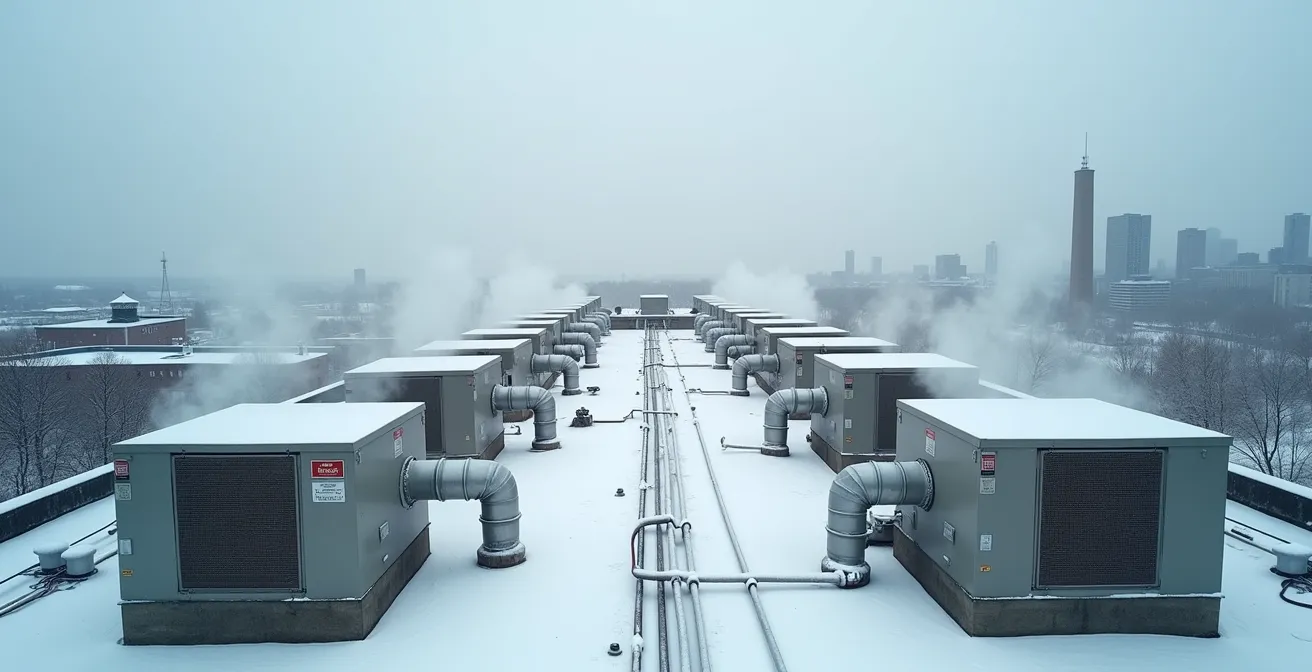
A perfectly compliant HVAC system during the day might become a source of illegal noise pollution after 10 p.m. The primary causes are often mechanical. Worn fan bearings can create excessive vibration and a low-frequency hum that travels far. The condenser units themselves generate significant airborne noise that can disturb nearby residential areas. A proactive audit of your HVAC system is a key part of being a good corporate neighbor and avoiding fines or legal action. This involves checking your borough’s specific decibel limits for both daytime and nighttime and measuring your system’s output at the property line.
If you find your system is non-compliant, several engineering controls can be implemented. For vibration issues, installing or upgrading vibration isolators under the units is a cost-effective first step. For airborne noise, strategically placed acoustic barriers or sound walls can block the direct path of sound to your neighbors. For a more permanent solution, retrofitting units with variable-speed fans that can operate more quietly at night, or installing specialized acoustic louvers on air intakes and exhausts, can provide significant, long-term noise reduction. Finally, an administrative control, such as scheduling non-critical HVAC operations to run only during daytime hours, can be a simple and effective measure.
Ignoring external noise emissions is a common blind spot that can lead to costly complaints and damage to your company’s public reputation.
Fixed Guard or Interlock: Which Do You Need for Frequent Maintenance Access?
While noise is a pervasive hazard, it exists within a broader context of machine safety. The guards and systems you use to protect workers from moving parts also play a role in the acoustic ecosystem. The choice between a fixed guard and an interlocked guard is a classic machine safety decision, but it’s one that should be considered alongside noise control. A fixed guard is a permanent barrier, typically a bolted-on panel or fence, that requires tools for removal. It is the preferred method when access for maintenance or cleaning is infrequent. From a noise perspective, a solid, well-sealed fixed guard can provide a degree of acoustic shielding as a secondary benefit.
However, when access is required frequently—daily or multiple times per shift—a fixed guard becomes a major impediment to production. Removing and replacing it is time-consuming and can lead to workers bypassing the guard altogether, creating a severe safety risk. This is where an interlocked guard is necessary. This type of guard, often a gate or door, is equipped with a sensor that is integrated into the machine’s control circuit. Opening the guard immediately stops the hazardous motion. This system provides a high level of safety while allowing for quick and easy access, thus maintaining operational continuity.
The decision should be driven by a formal risk assessment based on access frequency. If access is needed more than once a week, an interlock is generally the recommended solution. This principle of integrating safety without hindering productivity is vital. During large-scale projects, this same thinking applies. For instance, a case study on the Champlain Bridge Replacement Project in Montreal highlights how real-time noise monitoring allowed contractors to use sound barriers and schedule high-noise work to comply with local rules while maintaining project timelines. This demonstrates that safety and productivity are not mutually exclusive. With so many potential hazards in an industrial setting, a systematic approach to risk management is essential to prevent incidents. In 2020, the manufacturing industry was a significant contributor to workplace incidents, highlighting the ongoing need for robust safety systems.
Selecting the right guarding method is a prime example of how good safety engineering supports, rather than obstructs, efficient production.
Key Takeaways
- A noise map is the non-negotiable first step for CNESST compliance and data-driven decision making.
- Engineering controls (isolation, enclosures) are more effective than relying solely on PPE, but must be chosen based on the specific noise type (vibration vs. airborne).
- In Montreal, noise compliance extends beyond the factory walls to meet borough-specific bylaws, especially at night, and PPE must be selected for performance in extreme winter conditions.
Selecting Protective Equipment That Withstands Montreal’s Winter Extremes
For any facility operating in Montreal, a safety program that ignores the reality of winter is incomplete. Extreme cold has a significant impact on the performance and usability of Personal Protective Equipment, including hearing protection. Standard plastic earmuffs can become brittle at temperatures well below freezing, increasing the risk of the headband or cups cracking. This not only destroys the equipment but can also compromise the acoustic seal, rendering the protection ineffective when it’s needed most. Furthermore, moisture from snow or sleet can degrade the foam seals on standard earmuffs, further reducing their performance.
When selecting PPE for workers who operate outdoors or in unheated areas during winter, you must specify equipment rated for low temperatures. Winter-rated earmuffs are made with polymers that remain flexible down to -40°C and often feature water-resistant seals to maintain their integrity in wet conditions. While electronic hearing protection offers advanced features like level-dependency, their battery life can be reduced by 50% or more in extreme cold, a critical factor to plan for in your maintenance and replacement schedule. Custom-molded earplugs are an excellent option as their silicone or acrylic materials are largely unaffected by temperature and they maintain a consistent seal regardless of moisture.
All hearing protection used in Canada must meet the standards set by the Canadian Standards Association (CSA), specifically CSA Z94.2. When procuring winter gear, verify that it not only meets this base standard but is also explicitly rated by the manufacturer for the temperature ranges your workers will face. Building this ‘climatic resilience’ into your PPE program is a critical layer of due diligence.
As the following comparison shows, not all certified PPE performs equally when faced with the harsh conditions of a Montreal winter. Choosing equipment without considering its low-temperature performance is a foreseeable failure that can leave your workers exposed and your company liable.
Your duty of care requires you to provide equipment that is effective not just in theory, but in the actual environmental conditions your team faces every day.
| PPE Type | -30°C Performance | Wet Conditions Rating | CSA Standard |
|---|---|---|---|
| Standard Earmuffs | Plastic may become brittle | Poor seal when wet | CSA Z94.2 |
| Winter-rated Earmuffs | Flexible to -40°C | Water-resistant seals | CSA Z94.2-14 |
| Electronic Ear Protection | Battery life reduced 50% | Requires weatherproofing | CSA Z94.2 |
| Custom Molded Earplugs | Maintains flexibility | Unaffected by moisture | CSA Z94.2 |