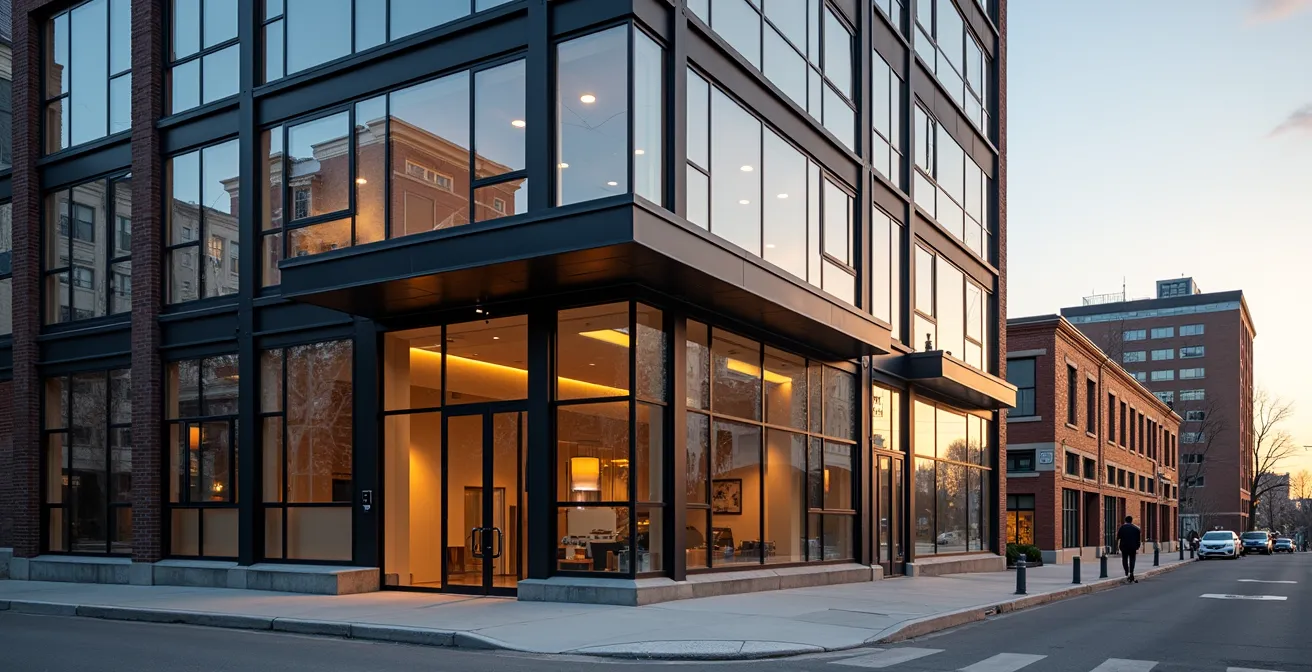
Standard security measures for commercial buildings often fail in Quebec because they ignore two critical local factors: the punishing freeze-thaw cycle and the specific tactics of smash-and-grab criminals.
- True compliance goes beyond the code’s surface, focusing on installation quality (e.g., 3-inch screws in door frames) and material suitability for the climate.
- For exit doors, fire safety (egress) is always the legal priority over security, requiring specialized compliant hardware to meet both needs.
Recommendation: Conduct a seasonal audit of all structural weak points—anchors, seals, and frames—to ensure their integrity against both forced entry and weather degradation.
For commercial building owners in Greater Montreal, securing a property is a two-front battle. On one side, there is the persistent threat of property crime, particularly smash-and-grab theft. On the other, the relentless Quebec climate, with its punishing freeze-thaw cycles, silently undermines the very structures designed to protect you. Many owners believe that standard locks, alarms, and basic double glazing are sufficient. This is a costly misconception. While these elements have their place, they often fail to address the specific methods of criminals and the unique environmental stresses of our region.
The key to effective structural security in Quebec is not simply adding more layers, but understanding the precise points of failure. Why does a reinforced door give way to a crowbar? How can a historic facade be secured without violating heritage bylaws? What is the real-world performance of a security shutter when it’s -25°C and coated in ice? The answers lie beyond generic advice and deep within the specifics of material science, proper installation, and a proactive understanding of the Quebec Construction Code (RBQ) priorities.
This guide moves past the platitudes. We will dissect the mandatory and recommended structural safeguards through the lens of a Montreal reality. By focusing on a point-of-failure analysis, from the vulnerability of standard glass to the critical importance of anchor maintenance, you will gain an authoritative understanding of what it truly takes to fortify your commercial asset. This is not just about compliance; it’s about building a resilient defense against the specific risks your property faces every day.
To provide a clear and actionable framework, this guide breaks down the essential structural safeguards your commercial building requires. We will examine each critical component, from windows and doors to internal structures and exit protocols, ensuring you have the knowledge to make informed decisions that align with Quebec’s unique regulatory and environmental landscape.
Summary: Mandatory Structural Safeguards for Quebec Commercial Buildings
- Why Standard Double Glazing Offers Zero Protection Against Smash-and-Grab Theft?
- How to Retrofit Historic Old Montreal Facades with Modern Security Frames?
- Roll-Down Shutters or Laminated Glass: What Best Secures a High-Street Storefront?
- The Installation Flaw That Renders Reinforced Doors Useless Against Crowbars
- When to Inspect Security Anchors: A Seasonal Maintenance Timeline
- Fire-Retardant Wood or Steel Studs: Which Is Mandatory for Multi-Story Offices?
- Fire Rating vs Security Rating: Which Priority Wins for Exit Doors?
- Glass Protection for Montreal Retailers: Safety Film or Polycarbonate Shields?
Why Standard Double Glazing Offers Zero Protection Against Smash-and-Grab Theft?
The most common point of forced entry for retail and ground-floor commercial properties is the front glass. Many property owners assume their standard double-pane insulated glass units (IGUs) offer a degree of security. This is fundamentally incorrect. These windows are designed for thermal insulation, not impact resistance. A smash-and-grab attack is defined by its speed; criminals use a heavy object to shatter the glass, grab high-value goods, and flee in under a minute. Standard annealed or heat-strengthened glass disintegrates on impact, offering virtually no delay. The prevalence of this crime is significant, with over 33,800 incidents of theft under $5,000 recorded in Montreal in 2022 alone, many of which involve this method.
The financial impact extends far beyond the stolen merchandise. A typical smash-and-grab robbery results in thousands of dollars in losses per incident, factoring in property damage, business interruption, and increased insurance premiums. The core vulnerability is the brittle nature of standard glass. It provides a psychological deterrent at best, but against a motivated attacker, it is a negligible physical barrier. The loud crash may trigger an alarm, but the theft is often complete before any response team can arrive. Therefore, relying on double glazing for security is a critical strategic error; it addresses the wrong problem (thermal efficiency) while completely ignoring the real threat (forced entry and impact).
To counter this, a building owner must upgrade from a thermal solution to a security solution. This involves materials specifically engineered to withstand and delay forceful impacts, such as laminated security glass or polycarbonate shields. These products work by absorbing and dissipating the energy of an attack, keeping the window intact even after multiple strikes. This delay is the crucial factor that foils smash-and-grab attempts, as it removes the element of speed that criminals rely on. The objective is not to make the glass unbreakable, but to make it too time-consuming to breach quickly.
How to Retrofit Historic Old Montreal Facades with Modern Security Frames?
Securing a property in historic districts like Old Montreal presents a unique challenge: how to implement modern security measures without compromising the architectural integrity protected by heritage bylaws. Standard, bulky security frames or shutters are often prohibited. The key to a successful retrofit lies in selecting discreet, low-profile solutions that are approved by municipal bodies like the Conseil du patrimoine de Montréal. The process must prioritize aesthetics and preservation while still achieving a meaningful increase in security. This is not a standard construction job; it requires specialized installers familiar with heritage building constraints and materials.
The primary solutions for heritage properties are interior-mounted systems. These include high-tensile security films applied to the inside of existing glass, or ultra-low-profile steel frames installed on the interior side of the window casement. These methods are often permissible because they are either invisible from the street or minimally impact the building’s external appearance. The goal is to reinforce the existing structure from within, making it resistant to forced entry without altering the historic greystone or brick facade that defines the area’s character.
This image showcases the careful integration of a modern security element with a traditional building material, a common challenge in heritage districts.
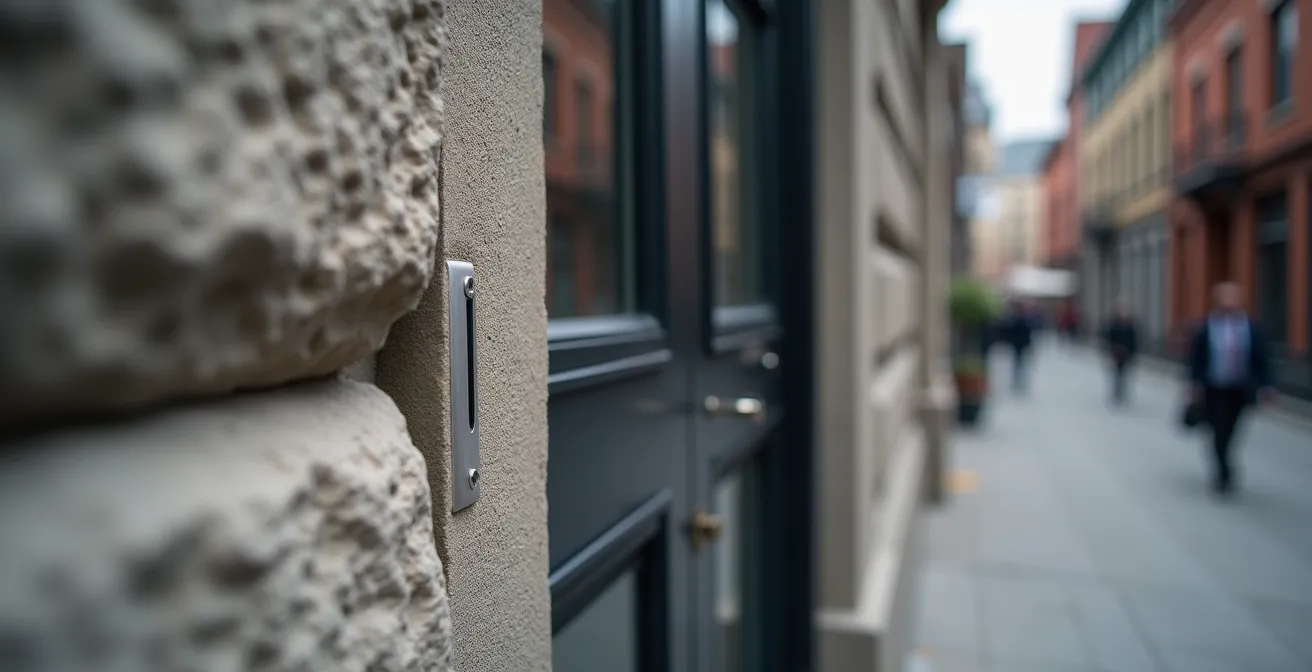
As you can see, the junction between the weathered stone and the clean line of the new frame is precise. Achieving this requires collaboration with both heritage consultants and certified security installers. Before any work begins, a detailed permit application with material specifications must be submitted to the Ville de Montréal for approval. This ensures that the chosen solution respects the district’s stringent architectural guidelines.
Action Plan: Upgrading Security on a Heritage Building
- Consult with the Conseil du patrimoine de Montréal to understand the specific architectural guidelines and restrictions for your property in Vieux-Montréal.
- Select interior-mounted security solutions, such as high-grade security films or ultra-low-profile steel frames, that meet heritage requirements for minimal visual impact.
- Engage certified Montreal installers who have documented experience working with heritage properties and understand the local restrictions and material sensitivities.
- Prepare and submit a detailed permit application to the Ville de Montréal, including all material specifications and installation plans, for formal approval.
- Document all approved solutions and permits for future compliance verification and as a reference for any subsequent work on the property.
Roll-Down Shutters or Laminated Glass: What Best Secures a High-Street Storefront?
When securing a high-street storefront on an artery like Sainte-Catherine Street, owners are often faced with a choice between two highly effective solutions: roll-down shutters and laminated security glass. Both offer a significant upgrade over standard windows, but they serve different business models and come with distinct operational trade-offs, especially in the Montreal context. The decision is not just about security; it’s about balancing visibility, aesthetics, climate performance, and local regulations. As Blackbird Security notes in their Commercial Building Security Report 2024, the stakes are high:
Each year, commercial theft and vandalism cost Canadian businesses billions of dollars in losses, property damage, and lost productivity.
– Blackbird Security, Commercial Building Security Report 2024
Roll-down shutters provide an imposing, overt physical barrier. When closed, they offer maximum protection against brute-force attacks and vandalism. However, they completely eliminate 24/7 product visibility, a critical factor for retailers who rely on window shopping to attract customers after hours. Furthermore, their mechanisms can be vulnerable to Montreal’s climate, with a risk of freezing and jamming during harsh winter conditions. Some boroughs, like the Plateau-Mont-Royal, may also have restrictions on their external appearance.
Laminated glass, on the other hand, offers a covert layer of security. It maintains full product visibility, allowing for continuous marketing while providing robust protection. Composed of a tough polymer interlayer (PVB) sandwiched between two panes of glass, it holds together when shattered, resisting repeated blows. While its initial cost can be higher, it performs consistently year-round without mechanical parts susceptible to freezing. This makes it an ideal choice for luxury boutiques, jewelry stores, and any retailer where aesthetics and constant visibility are paramount.
The following table breaks down the key decision-making factors for a Montreal business owner.
| Feature | Roll-Down Shutters | Laminated Glass |
|---|---|---|
| Initial Cost | $5,000-$15,000 per storefront | $8,000-$20,000 per storefront |
| Montreal Climate Performance | Risk of freezing/jamming in winter | Consistent year-round performance |
| 24/7 Product Visibility | No visibility when closed | Full visibility maintained |
| Borough Restrictions | May be restricted in Plateau-Mont-Royal | Generally permitted citywide |
| Insurance Premium Discount | 15-25% reduction typical | 10-20% reduction typical |
| Best For | Pharmacies, cannabis stores (SQDC) | Luxury boutiques, jewelry stores |
The Installation Flaw That Renders Reinforced Doors Useless Against Crowbars
Investing in a heavy-duty, reinforced commercial door can create a false sense of security if its installation is flawed. The unfortunate reality is that most forced entries through doors don’t happen by breaking the door itself, but by exploiting weaknesses in the frame and locking hardware. A crowbar or pry bar applies immense leverage to the door’s weakest points, and a few common installation mistakes can render a thousand-dollar door useless in seconds. The low probability of perpetrators being caught, as Toronto police data shows that only a 15.7% resolution rate for commercial burglaries was achieved in 2021, underscores the need for preventative, robust installation.
The single most critical installation flaw is the use of short screws in the strike plate. A standard installation often uses 1-inch screws that only anchor into the soft wood of the door jamb. These offer minimal resistance. For a door to withstand a prying attack, the strike plate and hinges must be secured with 3-inch screws that penetrate the jamb and anchor firmly into the solid wood of the building’s structural frame (the king and jack studs). This simple change dramatically increases the force required to compromise the door.
Other common points of failure identified by Montreal locksmiths include improperly set deadbolts and weak frame reinforcement. A misaligned deadbolt may only engage partially, reducing its resistance from over 1,500 lbs of force to less than 300 lbs. In Montreal’s older buildings with greystone or brick exteriors, failing to reinforce the door frame with appropriate masonry anchors creates a critical vulnerability. The solution is to insist on certified installers, such as those recognized by the Bureau de la sécurité privée, who understand these failure points and use the correct hardware for local construction materials. The security of your door is not in the door itself, but in how well it is integrated into the building’s structure.
- Fail 1: Short screws in strike plates. Using standard 1-inch screws that only grip the door jamb instead of 3-inch screws that anchor deep into the building’s frame structure.
- Fail 2: Improperly set deadbolts. Misalignment that causes the bolt to only partially engage, drastically reducing its resistance to applied force.
- Fail 3: Weak frame reinforcement. Neglecting to use proper masonry anchors to secure the door frame in Montreal’s characteristic older greystone and brick buildings.
When to Inspect Security Anchors: A Seasonal Maintenance Timeline
In Quebec, installing robust security hardware is only half the battle; ensuring its continued integrity against our severe climate is the other. The relentless freeze-thaw cycle is the primary enemy of any structural anchor. As water seeps into microscopic cracks in masonry and concrete, it freezes, expands, and exerts immense pressure. Over time, this “frost heave” can loosen fixings, compromise seals, and create vulnerabilities where none existed. A security system that was perfectly solid upon installation can be significantly weakened after just a few winters. Therefore, a generic annual check-up is insufficient. A proactive, seasonal maintenance timeline is mandatory for any serious commercial security plan in Montreal.
This professional is performing a crucial post-winter inspection, checking for any loosening or damage caused by frost heave—a critical task in Montreal.
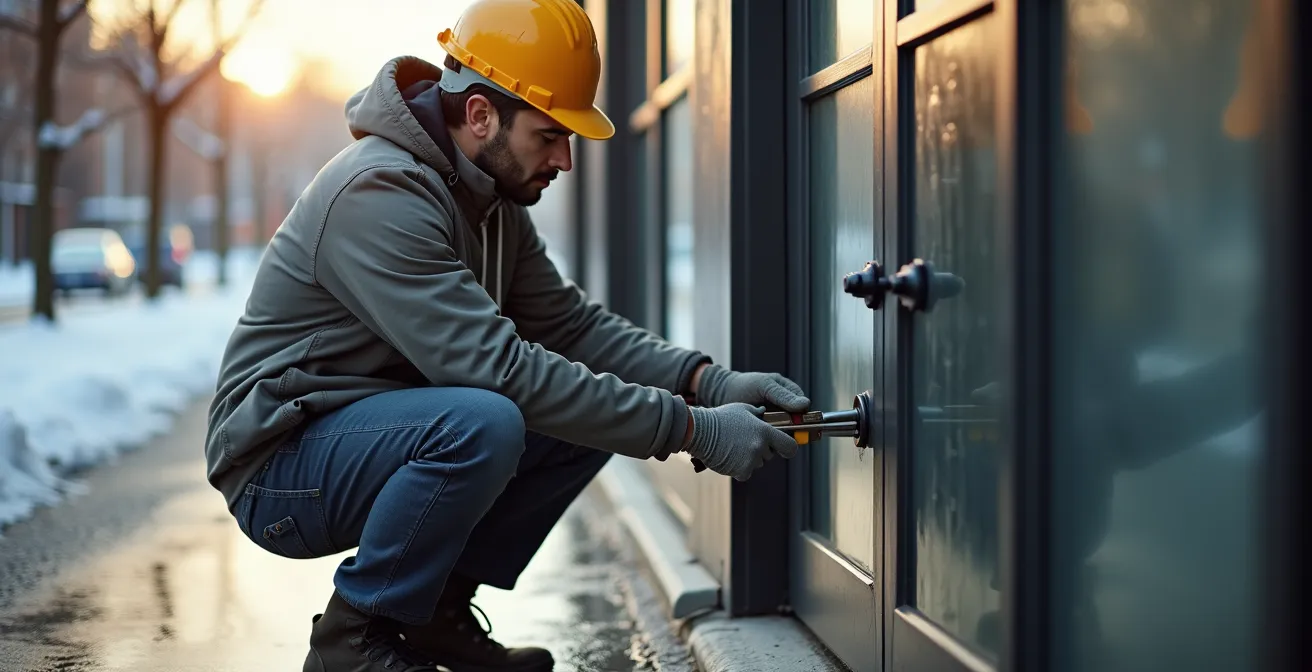
As shown, the inspection is a hands-on process. A seasonal schedule allows you to address specific threats as they arise. The post-thaw inspection in April is the most critical, focusing on damage from the winter. The summer check should assess UV degradation on polycarbonate or film surfaces, which can become brittle. The pre-freeze check in autumn is preventative, ensuring seals are intact and protective coatings are applied before the damaging cycle begins again. A quick visual check in mid-winter ensures ice buildup is not obstructing emergency exits or jamming mechanisms. This approach transforms maintenance from a reactive chore into a proactive security strategy.
Montreal Seasonal Security Inspection Schedule
- April – Post-Thaw Inspection: This is the most crucial inspection. Check all exterior anchor points for loosening caused by frost heave. Look for signs of water infiltration around window and door frames and verify that all fixings are tight.
- July – Summer UV Check: Intense summer sun can degrade plastic-based security components. Inspect polycarbonate shields and security films for any signs of yellowing, cloudiness, or brittleness, which indicate UV damage and reduced strength.
- October – Pre-Freeze Check: Prepare for winter by cleaning any salt or chemical residue from metal frames and anchors to prevent corrosion. Apply protective coatings where necessary and verify the integrity of all weather seals to prevent water ingress.
- January – Mid-Winter Assessment: Perform a quick visual inspection to ensure that ice and snow buildup are not obstructing the function of roll-down shutters, emergency exit panic bars, or other moving security mechanisms.
Fire-Retardant Wood or Steel Studs: Which Is Mandatory for Multi-Story Offices?
When constructing or retrofitting a multi-story office building in Quebec, the choice of framing material for interior walls is dictated primarily by the Quebec Construction Code, which prioritizes fire safety. For many commercial buildings, particularly those classified as Group D (Business and personal services) occupancies, the code mandates the use of non-combustible construction materials for specific structural elements once a certain height or area is exceeded. This often means steel studs are not just an option, but a requirement. While fire-retardant treated wood (FRTW) exists, its applications are more limited in larger commercial structures compared to steel.
Steel studs offer superior fire resistance and structural stability, which is why they are the standard for modern commercial construction in areas like Griffintown. Unlike wood, steel does not burn and will not contribute fuel to a fire, helping to contain its spread and maintain structural integrity longer, allowing for safe egress. While steel framing can add to upfront costs, it provides significant long-term value in the Montreal climate. It is impervious to rot and termites, and its dimensional stability is unaffected by the humidity swings and extreme temperatures that can cause wood to warp or shrink over time.
Case Study: Framing Decision for a Griffintown Office Building
In a market analysis for a typical 3-6 story office project in Montreal’s Griffintown, steel studs were found to add approximately 15-20% to the initial framing costs compared to fire-retardant wood. However, due to their superior durability in the city’s freeze-thaw climate and their straightforward compliance with Quebec’s stringent fire codes for Group D occupancies, steel framing was determined to provide better long-term value and reduced compliance risk. The higher upfront cost was offset by enhanced durability, lower insurance premiums, and guaranteed code adherence for a multi-story commercial structure.
Therefore, while FRTW may be suitable for certain smaller-scale or specific applications, steel studs are generally the mandatory and strategically superior choice for the core structure of multi-story office buildings in Quebec. The decision is less about preference and more about adhering to the life safety principles embedded in the building code.
Fire Rating vs Security Rating: Which Priority Wins for Exit Doors?
A common point of confusion for building owners is how to secure emergency exit doors. These doors must be fortified against intruders, but they must also allow for immediate, unimpeded egress in the event of a fire. So, when fire safety and security seem to be in conflict, which one takes priority? The answer, under the law, is unequivocal. As the experts at Accès Secure Inc. state clearly:
Life safety egress is non-negotiable – the Quebec Construction Code and Service de sécurité incendie de Montréal requirements always take legal precedence over security concerns.
– Accès Secure Inc., Commercial Fire Safety Compliance Guide
This means that any security measure that delays or prevents free exit from the inside—such as a standard deadbolt, chain, or unapproved bar—is illegal and creates significant liability. An exit door must always be openable from the inside with a single motion, without requiring a key, special knowledge, or excessive force. The door’s fire-resistance rating (e.g., 90-minute) and its function as a means of egress are its primary legal characteristics.
However, this does not mean exit doors must be left vulnerable. A range of code-compliant hardware solutions exist to provide security without violating life safety rules. These include:
- Panic bars with integrated alarms: These devices secure the door from the outside but will sound a loud local alarm if opened from the inside, deterring unauthorized use for theft while allowing emergency egress.
- Delayed egress magnetic locks: In certain building types and with fire department approval, these locks can be used. When the panic bar is pushed, an alarm sounds and the door remains locked for a 15-30 second delay before automatically releasing. This allows staff time to respond to a potential theft while still guaranteeing egress. This often requires integration with the building’s sprinkler system.
All such installations must include proper signage in both French and English, as required in Quebec, explaining the door’s operation. The key is to choose certified hardware that is explicitly designed to meet both security needs and the non-negotiable requirements of the fire code.
Key takeaways
- Focus on installation details: The failure point is often not the device itself (door, lock) but its installation (screws, frame reinforcement).
- Prioritize code compliance correctly: Fire safety regulations for egress always supersede security measures on exit doors.
- Adapt to the climate: A security plan for Montreal must include a seasonal maintenance schedule to counter the effects of freeze-thaw cycles on anchors and seals.
Glass Protection for Montreal Retailers: Safety Film or Polycarbonate Shields?
For Montreal retailers seeking to upgrade their glass beyond standard panes, the two leading options are adhesive security films and externally mounted polycarbonate shields. Both aim to prevent smash-and-grab attacks, but they do so at different price points and with different levels of durability, particularly in the local climate. This is a critical decision, as retail crime cost Canadian businesses an estimated $9.1 billion in 2024, making glass protection a vital investment. Security film, typically 8 to 12 mil thick, is a polyester membrane applied to the interior of the glass. It works by holding the glass shards together upon impact, significantly delaying entry.
Polycarbonate shields, on the other hand, are essentially a sheet of “bullet-resistant” plastic (though typically not rated for firearms at this thickness) mounted over the existing glass. At 6mm thick, polycarbonate is vastly stronger than glass or film and can withstand repeated, heavy-duty attacks with tools like hammers or bats. It is the superior solution for high-risk businesses like jewelry stores or electronics retailers. However, its cost is significantly higher, and it requires a UV-resistant coating to prevent yellowing and degradation from sun exposure, a key consideration for long-term durability.
The choice often comes down to a cost-benefit analysis based on the value of the merchandise and the perceived level of risk. An additional layer to consider is anti-graffiti film, a thinner, sacrificial film applied to the exterior that can be easily replaced if vandalized, protecting the more expensive security layer underneath. This is especially useful in high-traffic urban areas like Ville-Marie.
This table outlines the cost and performance characteristics to help Montreal retailers make an informed decision.
| Protection Type | Material Cost/sq ft | Installation Cost | Montreal Climate Durability | Best Application |
|---|---|---|---|---|
| Security Film (8mil) | $8-12 | $5-8/sq ft | 5-7 years (temperature cycling may cause edge lift) | Budget-conscious small retailers |
| Security Film (12mil) | $12-18 | $8-12/sq ft | 7-10 years | Mid-range protection, Plateau boutiques |
| Polycarbonate (6mm) | $25-35 | $15-20/sq ft | 10-15 years (UV coating essential) | High-risk jewelry, electronics stores |
| Anti-graffiti Film | $6-10 | $4-6/sq ft | 1-2 years (sacrificial) | High-traffic areas like Ville-Marie |
Ultimately, securing your commercial building in Quebec is an exercise in context-specific engineering. It requires moving beyond a generic checklist and adopting a holistic strategy that accounts for criminal tactics, code priorities, and relentless climate pressures. To ensure your property meets these specific Quebec standards, the next logical step is to commission a professional security audit that evaluates these structural vulnerabilities in detail.