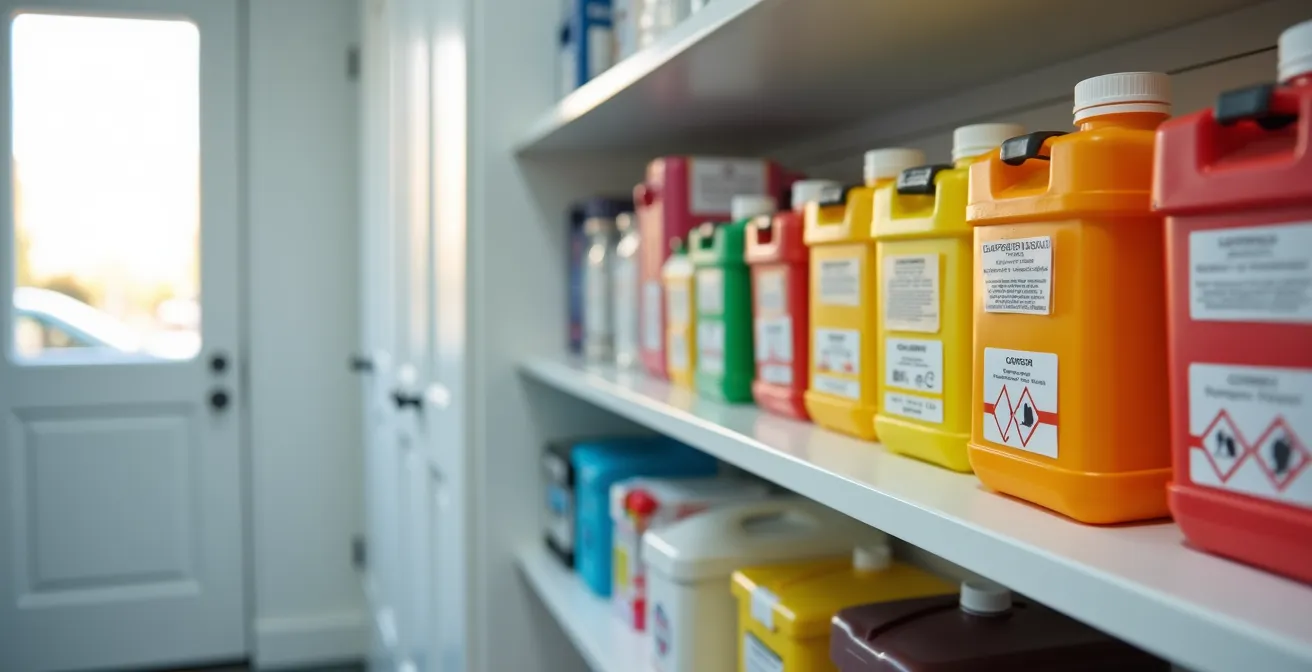
Contrary to popular belief, SIMDUT (WHMIS) compliance is not just a concern for industrial sites; it is a strict legal requirement for any Montreal office that uses, stores, or handles products classified as hazardous—including common cleaning supplies and printer toner.
- Everyday items like bleach, disinfectants, and even some window cleaners are considered “hazardous products” under Quebec law, requiring full SIMDUT compliance.
- The CNESST mandates not just training, but a complete, documented prevention program that identifies risks, establishes procedures, and ensures worker competency.
Recommendation: Immediately audit all chemical products in your workplace, verify you have up-to-date French Safety Data Sheets (SDS), and begin structuring a formal prevention program to avoid significant fines.
As an office manager in Montreal, your list of responsibilities is endless. Between managing supplies, coordinating staff, and ensuring the workplace runs smoothly, “hazardous material management” probably seems like a problem for factories and construction sites. You might look at your janitor’s closet—with its bottles of all-purpose cleaner, bleach, and window spray—and think it’s hardly an industrial chemical depot. This is a common and costly misconception.
The reality is that under Quebec’s Commission des normes, de l’équité, de la santé et de la sécurité du travail (CNESST), the rules for SIMDUT 2015 (Système d’information sur les matières dangereuses utilisées au travail) apply to any workplace where hazardous products are present. That bottle of concentrated disinfectant or that toner cartridge for the printer falls squarely under this regulation. Ignoring these obligations creates significant compliance blind spots, exposing your business to hefty fines and, more importantly, jeopardizing the health of your employees.
This guide moves beyond the generic platitudes about safety. Instead of just showing you pictograms, we will demonstrate how everyday office tasks—from refilling a spray bottle to storing bleach—are regulated activities. We will explore the specific, often-overlooked CNESST requirements for Montreal offices, shifting the focus from a simple training certificate to achieving genuine, demonstrable operational competency. By understanding the hidden risks in your own supply closet, you can build a compliant and truly safe work environment.
This article will provide a clear roadmap for navigating your SIMDUT obligations. We will cover the essentials of managing safety data sheets, proper labelling, training best practices, safe storage, and how to build a prevention program that satisfies the CNESST.
Summary: Why SIMDUT 2015 Training Is Mandatory for Non-Industrial Montreal Workplaces Too?
- How to Ensure Your SDS Binder Is Current When Suppliers Change Formulations?
- The Labeling Mistake That Occurs When Transferring Cleaning Chemicals to Spray Bottles
- Online vs Classroom SIMDUT Training: Which Retains Knowledge Better?
- The Storage Compatibility Error That Can Cause Toxic Fumes in Your Janitor Closet
- When to Retrain Staff: Is Once a Year Enough for SIMDUT Compliance?
- Bleach vs Quaternary Ammonium: Which Is Safer for Daily Office Use?
- Why Losing a Waste Manifest Can Cost You Thousands in Fines?
- Creating a Prevention Program That Meets CNESST Requirements for Small Businesses
How to Ensure Your SDS Binder Is Current When Suppliers Change Formulations?
The foundation of any SIMDUT program is the Safety Data Sheet (SDS), or Fiche de Données de Sécurité (FDS) in French. This document is not a “set it and forget it” piece of paper. Suppliers frequently update product formulations, which can change a product’s hazards and required precautions. An outdated SDS binder is a direct violation of CNESST regulations. In Quebec, you have a dual obligation: the SDS must be current and it must be readily available in French. An English-only SDS from a supplier is not sufficient for compliance.
To maintain compliance, you must establish a proactive management system. This involves more than just filing the sheet that comes with a shipment. You need to verify the date on every SDS you receive; by law, it must have been issued within the last three years. If a supplier provides an English-only version, it is the employer’s responsibility to obtain a French translation. This isn’t just a suggestion; it is a legal requirement. Furthermore, with new WHMIS requirements being phased in, it’s crucial to stay ahead. According to provincial regulations, all Quebec workplaces must comply with new WHMIS requirements by December 14, 2025, which underscores the need for up-to-date documentation.
A robust system includes creating digital backups, setting calendar reminders for quarterly reviews with suppliers, and documenting all communications. This diligence creates a defensible record for a CNESST inspector, proving that you are actively managing your chemical safety information instead of passively collecting paper. This is a key part of demonstrating your operational competency beyond just having a binder on a shelf.
The Labeling Mistake That Occurs When Transferring Cleaning Chemicals to Spray Bottles
One of the most common compliance blind spots in an office setting occurs at the moment an employee transfers a cleaning chemical from its original, large container into a smaller, secondary container like a spray bottle. Simply writing “Cleaner” on the bottle with a marker is a significant compliance failure. SIMDUT requires that this new “workplace label” contains specific, critical information to ensure the safety of anyone who might use it.
A compliant workplace label in Quebec must be in French and include three key elements: the product identifier (what it is, including dilution ratios), information for the safe handling of the product (e.g., “Wear gloves,” “Use in a well-ventilated area”), and a clear reference to the Safety Data Sheet (SDS). Missing any of these elements renders the label non-compliant. The goal is to ensure that a diluted product in a spray bottle has the same level of hazard communication as the original concentrate. This is where many offices unknowingly violate the law.
Case Study: The Montreal Coffee Shop Labeling Error
A coffee shop in Montreal’s Mile End dilutes a concentrated sanitizer for use in spray bottles around the café. Initially, employees just wrote “Sanitizer” on the bottles. During a mock inspection, it was determined this was a violation. To become compliant, they were required to create new French workplace labels that included: the product identifier (‘Désinfectant concentré 1:10’), the hazard pictograms matching the original SDS, safe handling precautions (‘Porter des gants’), and a reference to the SDS location (‘Voir FDS dans le classeur de sécurité’). This example, detailed by resources from the CNESST, shows how a simple, everyday task can lead to non-compliance fines if not handled correctly.
To avoid these errors, it’s best to create standardized, printable labels for any chemical that is transferred or diluted. The following table illustrates the clear difference between a common mistake and a CNESST-compliant label.
| Label Element | Non-Compliant (Bad) | CNESST-Compliant (Good) |
|---|---|---|
| Product Identifier | ‘Cleaner’ (English only) | ‘Nettoyant tout usage – dilution 1:20’ |
| Hazard Pictogram | None or hand-drawn | Official GHS pictogram from SDS |
| Precautionary Statement | Missing | ‘Porter des gants et lunettes de protection’ |
| SDS Reference | None | ‘Voir FDS dans classeur sécurité’ |
Online vs Classroom SIMDUT Training: Which Retains Knowledge Better?
When it comes to SIMDUT training, managers often face a choice: a convenient online course or a traditional in-person classroom session. Online courses offer flexibility and are often more affordable, making them an attractive option for a busy office. They are excellent for establishing a baseline of knowledge, particularly for understanding pictograms and the structure of an SDS. However, their primary limitation is the lack of hands-on, site-specific application.
The CNESST’s focus is less on the certificate and more on worker competency. Can an employee, when asked, identify the hazards of the specific bleach you use? Do they know where to find the SDS for the floor stripper? Can they demonstrate how to properly label a decanted spray bottle? This is where a blended approach often yields the best results. An online course can cover the theoretical (“the what”), but it must be supplemented with on-site practical training that covers your specific products and procedures (“the how and where”).
This practical component is what truly builds knowledge retention and ensures compliance. The goal is for an employee to not just know what a corrosive pictogram means, but to know that the toilet bowl cleaner in *their* janitor’s closet is corrosive and requires gloves and eye protection. The image below represents this crucial final step: verifying that theoretical knowledge has translated into practical, workplace-specific competency.

Ultimately, the best training method is one that can be proven effective during an inspection. A manager should be able to demonstrate that employees are not just “trained” but are competent and knowledgeable about the specific hazards within their own work environment. This means documenting both the general training and any site-specific instruction provided.
The Storage Compatibility Error That Can Cause Toxic Fumes in Your Janitor Closet
The janitor’s closet in a typical office may seem harmless, but it can be a significant source of hidden risk if chemicals are stored improperly. Many cleaning products are perfectly safe on their own but can produce dangerous toxic gases when they mix. The most classic—and potentially deadly—example is mixing bleach (an oxidizer) with an ammonia-based cleaner, which can release chloramine gas, a severe respiratory irritant.
This is not just a theoretical danger. It’s a practical storage issue that SIMDUT regulations are designed to prevent. Proper chemical segregation is mandatory. This means storing incompatible chemicals in separate, clearly labeled containers and, ideally, in different locations. Acids (like descalers or some toilet bowl cleaners) should never be stored next to bases (like degreasers or oven cleaners). Oxidizers, such as bleach, require their own designated space away from everything else, especially flammable materials.
A simple and effective solution for an office environment is to use colour-coded plastic bins, which can be purchased from stores like Canadian Tire, and affixing clear, French-language safety signage. According to toxicology experts, the most critical storage rule is to never mix bleach and QAC-containing chemicals, a common mistake when multiple disinfectants are used. Implementing a clear segregation plan is a non-negotiable part of a compliant prevention program.
Action Plan: Chemical Segregation in Your Storage Closet
- Store acids (descalers, toilet bowl cleaners) in red bins labeled ‘ACIDES’
- Keep bases (degreasers, oven cleaners) in blue bins labeled ‘BASES’
- Separate oxidizers (bleach products) in yellow bins labeled ‘OXYDANTS’
- Never store ammonia-based cleaners near bleach products
- Post a ‘Ne Pas Mélanger’ (Do Not Mix) chart for reference
This systematic approach transforms your closet from a potential hazard zone into a compliant and safe storage area, demonstrating proactive risk management to any inspector.
When to Retrain Staff: Is Once a Year Enough for SIMDUT Compliance?
A common myth surrounding SIMDUT is the idea of mandatory annual retraining. While regular refreshers are a best practice, the CNESST’s requirement is not based on a calendar; it’s based on competency and change. An employer’s duty is to ensure that workers remain competent to handle the products they use. Therefore, retraining is triggered by specific events, not just the passage of time.
You must provide retraining under several key circumstances. The most obvious is when a new hazardous product is introduced to the workplace. If you switch from one brand of disinfectant to another with different hazards, all affected employees must be trained on the new product’s specific risks and handling procedures. Retraining is also required after any chemical-related incident or near-miss, as this indicates a clear gap in knowledge or procedure. Furthermore, if a worker demonstrates they do not understand the hazards or procedures—for instance, during an internal audit or observation—they must be retrained.
The case of a Montreal restaurant provides a clear, non-industrial example. The restaurant must retrain staff not just annually, but whenever new cleaning products are introduced, after any incident like a chemical splash, or if an employee cannot adequately explain the hazards of a product they use. While a general review every three years is a good baseline if no other triggers occur, the primary focus must always be on event-driven training. This competency-based approach is far more meaningful than a once-a-year check-the-box exercise and is what CNESST inspectors will look for.
Properly documenting these retraining events is just as important as conducting them. Your compliance log should note the date, the reason for the training (e.g., “new product introduced”), the topics covered, and the employees who attended. This creates a clear and defensible record of your ongoing commitment to worker safety and compliance.
Bleach vs Quaternary Ammonium: Which Is Safer for Daily Office Use?
Choosing the right disinfectant for an office is a decision with significant safety, compliance, and even financial implications. The two most common options are traditional bleach (sodium hypochlorite) and products based on Quaternary Ammonium Compounds (QACs). While bleach is inexpensive and widely recognized, it presents several challenges for an office environment, especially in Montreal’s older buildings which may have limited ventilation.
Bleach is highly corrosive and can damage metal surfaces, including stainless steel fixtures, over time. More importantly, it requires critical ventilation to prevent the buildup of fumes, which can be a serious respiratory irritant. Its use mandates personal protective equipment (PPE), including gloves and eye protection. From an environmental standpoint, it poses a chlorine gas risk if mixed improperly and is a concern for wastewater systems. It will also permanently damage carpets and fabrics upon contact.
QACs, on the other hand, are generally a safer and more practical choice for daily office use. They have low corrosivity, are safe for most surfaces, and require minimal ventilation as they do not produce toxic fumes. While gloves are still recommended, the overall PPE requirement is lower. They are also compatible with green building standards like BOMA BEST, a key consideration for many Montreal office buildings. The following table breaks down the key differences, sourced from a comparative analysis by government safety agencies.
| Criteria | Bleach (Sodium Hypochlorite) | Quaternary Ammonium (QACs) |
|---|---|---|
| Corrosivity | High – damages metal, stainless steel | Low – safe for most surfaces |
| Ventilation Needs | Critical in old Montreal buildings | Minimal – no toxic fumes |
| PPE Required | Gloves, eye protection essential | Gloves recommended |
| Environmental Impact | Chlorine gas risk, wastewater concern | Lower toxicity, BOMA BEST compatible |
| Cost | Lower initial cost | Higher cost, concentrated formulas |
| Fabric/Carpet Safety | Causes bleaching damage | Safe for textiles |
While QACs may have a higher initial cost, their safety profile, surface compatibility, and lower risk of misuse often make them a more prudent long-term investment for a non-industrial setting, reducing both health risks and potential property damage.
Why Losing a Waste Manifest Can Cost You Thousands in Fines?
SIMDUT compliance doesn’t end when a chemical container is empty. Your responsibility extends to the proper disposal of both the residual product and its container, as well as other regulated items in your office. In Quebec, hazardous waste management is co-regulated by the provincial Ministère de l’Environnement, de la Lutte contre les changements climatiques, de la Faune et des Parcs (MELCC) and municipal authorities like the Ville de Montréal. Failure to properly document the disposal of this waste can be extremely costly.
A “waste manifest” is a tracking document that proves you have disposed of hazardous materials through a certified vendor. Losing this document is like losing the title to your car; you have no proof of legal transfer. For an office, this applies to more than just leftover cleaners. It includes items like used fluorescent light bulbs (which contain mercury), old electronics (e-waste), and even expired hand sanitizer, which is often flammable. Simply tossing these items in the commercial dumpster is a violation that can result in fines from multiple agencies. According to Quebec regulations, serious CNESST violations can result in fines of thousands of dollars, and environmental infractions carry their own steep penalties.
Case Study: The Montreal Marketing Agency E-Waste Violation
A fictional Montreal marketing agency decided to discard old computers, monitors, and a box of used fluorescent tubes in their regular commercial dumpster during an office clean-out. This act constitutes illegal dumping of hazardous waste. To be compliant, they should have contracted a certified e-waste recycler. The agency would then receive a waste manifest or receipt, which they must keep on file as proof of proper disposal. This documentation is their only defence against potential fines from both the MELCC and the Ville de Montréal for improper handling of hazardous materials.
As an office manager, you must maintain a clear paper trail for the disposal of all regulated items. This includes keeping receipts and manifests from certified recyclers and waste handlers. This documentation proves you are exercising due diligence from the moment a product enters your workplace until it is safely and legally disposed of.
Key Takeaways
- SIMDUT/WHMIS is mandatory for any Montreal office with products like cleaners, disinfectants, or toner.
- Compliance is not about a certificate; it’s about demonstrable worker competency regarding site-specific hazards.
- Key compliance tasks include maintaining French SDS, proper workplace labeling, chemical segregation, and documented, trigger-based retraining.
Creating a Prevention Program That Meets CNESST Requirements for Small Businesses
Ultimately, all these individual tasks—managing SDS, labeling bottles, training staff—are not standalone activities. Under Quebec law, they must be integrated into a single, cohesive, and documented prevention program. This is the element most often missed by non-industrial workplaces, yet it is the cornerstone of what a CNESST inspector will want to see. A prevention program is your formal plan for identifying, controlling, and communicating the chemical hazards in your specific workplace.
As legal experts from DLA Piper Canada LLP highlight regarding recent changes in provincial health and safety, this is a formal obligation. They state that employers must maintain a register of contaminants and hazardous substances and submit updates to the CNESST. This elevates your responsibility from simple “safety awareness” to formal, documented risk management.
Your program must begin with a comprehensive identification of all hazardous products on site. For each product, you must identify the risks (e.g., “Floor stripper – skin irritation”) and establish control measures (e.g., “Mandatory gloves and apron”). The program must also name a designated liaison officer responsible for overseeing SIMDUT compliance and define their duties. Finally, it must include a schedule for annual review and a process for tracking which employees are exposed to which substances. This isn’t just a binder of papers; it’s your living strategy for ensuring a safe workplace.
Checklist: Building Your CNESST-Compliant Prevention Program
- Identify Hazards: Create a list of all chemical products and their specific risks (e.g., ‘Dishwasher detergent – eye splash risk’).
- Document Controls: For each risk, define the required control measure (e.g., ‘Require safety glasses’).
- Appoint a Liaison: Officially designate an employee to oversee SIMDUT compliance, verify SDS, and confirm training.
- Establish a Schedule: Set a date for an annual program review and mark the three-year CNESST submission requirement in your calendar.
- Create a Worker Registry: Maintain a log listing which employees are exposed to each hazardous substance as part of their regular duties.
Creating this program may seem daunting, but it is the most effective way to systematize your safety efforts, ensure long-term compliance, and prove to regulators that you take your health and safety obligations seriously.
Now that you understand the scope of SIMDUT obligations for your office, the next logical step is to move from awareness to action. Begin by conducting a thorough audit of your workplace, from the supply closet to the printer station, and start building the documented prevention program that the CNESST requires.