
That standard steel door on your warehouse isn’t the fortress you think it is. For a determined burglar with a crowbar and a bit of knowledge, it’s a puzzle with well-known solutions.
- The weak points are never the steel panel itself, but its hinges, frame, and a single-point lock that can be bypassed or broken with brute force.
- Common installation mistakes and a lack of specific winter maintenance in a city like Montreal can render even reinforced doors completely useless against physical attack.
Recommendation: Stop thinking about buying “a door” and start auditing your entire entry system for these specific, exploitable vulnerabilities.
You lock up your Montreal warehouse for the night, satisfied. The back entrance has a solid steel door, a heavy-duty deadbolt engaged. You assume you’re secure. You’re wrong. That feeling of security is based on a dangerous assumption: that the steel itself is the deterrent. To a physical fortification specialist, that door is a collection of potential failure points. Determined burglars don’t try to go through the steel; they go around it. They attack the hinges, spread the frame, or exploit the mechanics of the lock itself.
Most business owners focus on alarm systems or cameras, which only record a crime in progress. They neglect the fundamental principles of physical hardening. This isn’t about adding more steel, but about understanding the specific attack vectors used in industrial parks and systematically eliminating them. It’s a shift in mindset from basic security to active fortification. Your door is a system, and a system is only as strong as its weakest component. In the harsh reality of a Montreal winter and the isolation of an industrial park after hours, those weak components are an open invitation.
This guide breaks down the illusions. We will dissect the common vulnerabilities that make standard commercial steel doors fail under pressure. From the simple hinge pin to the integrity of the frame installation, you will learn to see your entry points through the eyes of an attacker. This is your first step toward building a truly hardened perimeter that doesn’t just deter, but physically stops a forced entry attempt.
This article dissects the critical failure points of typical commercial security setups. The following sections provide a detailed roadmap to identify and fortify the vulnerabilities that burglars actively exploit.
Summary: Why Standard Steel Doors Fail to Stop Determined Burglars in Industrial Parks?
- The Hinge Mistake That Lets Thieves Bypass Your Deadbolt in 10 Seconds
- How to Retrofit Multi-Point Locking Systems on Existing Commercial Doors?
- Fire Rating vs Security Rating: Which Priority Wins for Exit Doors?
- The “Frame Spreading” Technique Burglars Use and How to Block It
- When to Lubricate Security Hinges: A Maintenance Guide for Winter
- The Installation Flaw That Renders Reinforced Doors Useless Against Crowbars
- The Anti-Masking Feature You Need for High-Risk Inventory Zones
- Installing Anti-Ram Bollards in Montreal: Aesthetics vs Crash Ratings
The Hinge Mistake That Lets Thieves Bypass Your Deadbolt in 10 Seconds
Your deadbolt is irrelevant if an attacker can simply remove the door from its frame. The most common and catastrophically overlooked vulnerability on an outward-swinging commercial door is the exposed hinge pin. On a standard hinge, this pin can be hammered out from the bottom in seconds. Once the pins are removed, a burglar can lift the entire door off its hinges, regardless of how many locks you have installed. It’s a quiet, fast, and devastatingly effective brute-force attack.
The solution is not a bigger lock, but better hinges. Security hinges are designed to counter this specific attack vector. They feature non-removable pins (NRP), set screws that lock the pin in place, or interlocking hinge leaves (a stud on one leaf fits into a hole on the other) that keep the door secured even if the pin is somehow compromised. A continuous or “piano” hinge, which runs the full length of the door, is the ultimate upgrade as it distributes force evenly and eliminates the individual hinge weak points entirely.
Don’t assume your installer used the right hardware. While statistics often point to the front door as a common entry point, with some security statistics showing that 34% of burglars enter through the front door, industrial burglars are more methodical. They will check the often-neglected rear and side doors for exactly this kind of fundamental flaw. A quick visual inspection of your hinges can tell you everything you need to know about your real level of security.
How to Retrofit Multi-Point Locking Systems on Existing Commercial Doors?
A single deadbolt concentrates all of its resistance at one point in the door frame. A well-placed crowbar or hydraulic jack can apply enough force to splinter the frame or bend the door at that single point of failure. The professional solution is a multi-point locking system, which secures the door to the frame in at least three places: the top, the bottom, and the side. This distributes the force of an attack across the entire door panel and frame, making it exponentially more resistant to prying.
Retrofitting such a system onto an existing door is a specialized task but is entirely feasible. You have two main options: surface-mounted or integrated systems. Surface-mounted locks are installed on the interior face of the door. They are faster to install and require less modification to the door itself, making them a good option for quick upgrades on older doors. Integrated systems are mortised into the edge of the door for a cleaner look and potentially higher security, but they require extensive modification and are best suited for new installations or complete overhauls.
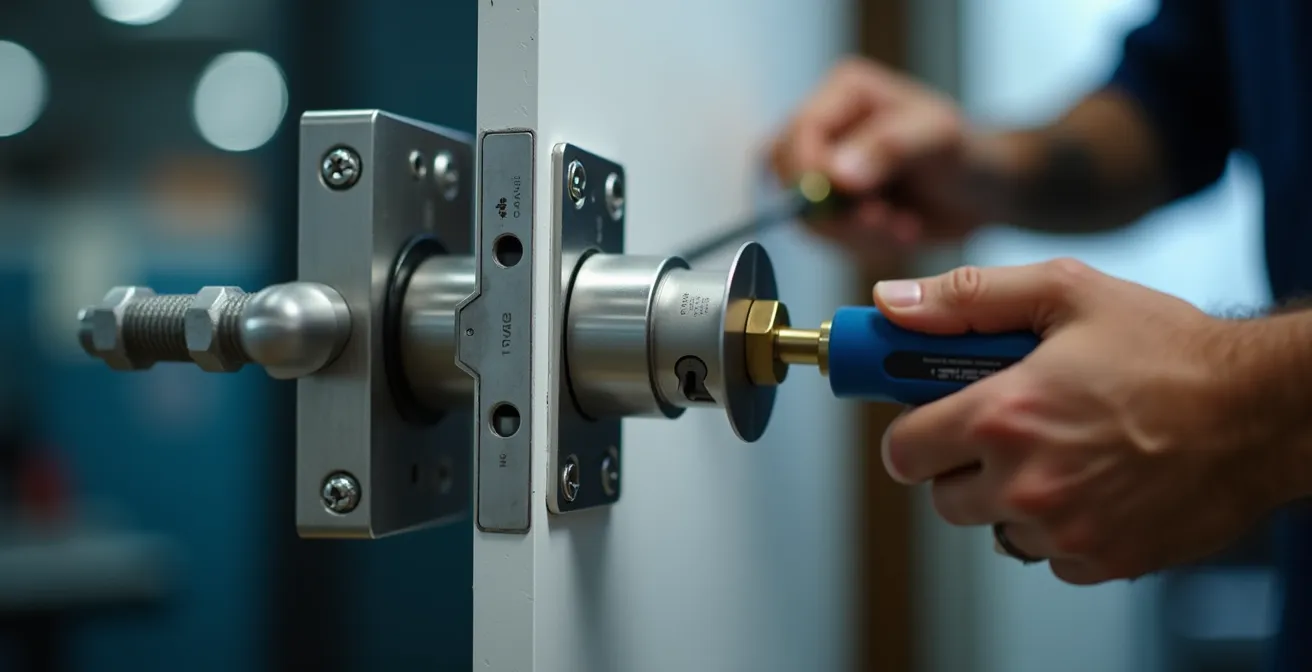
As you can see from the complexity of the mechanism, professional installation is non-negotiable. Local expertise is crucial. For instance, the Laval-based firm Robotec has a long history in the greater Montreal area, demonstrating successful retrofits of these complex systems while maintaining critical ULC (Underwriters Laboratories of Canada) certifications. This proves it’s possible to dramatically upgrade security without compromising other building code requirements, provided you work with a qualified integrator.
The choice between a surface-mounted or integrated system depends on your budget, timeline, and existing door’s condition. The following comparison breaks down the key decision factors.
| Feature | Surface-Mounted | Integrated |
|---|---|---|
| Installation Time | 2-4 hours | 6-8 hours |
| Cost Range | $800-$1,500 | $2,000-$4,000 |
| Door Modification | Minimal | Extensive |
| Fire Rating Impact | May void certification | Can maintain if properly installed |
| Best For | Older doors, quick upgrades | New installations, maximum security |
Fire Rating vs Security Rating: Which Priority Wins for Exit Doors?
Here lies a critical conflict for any warehouse owner: an emergency exit door must be easy to open from the inside for life safety, yet it must be difficult to open from the outside for security. This balancing act is governed by strict codes. In Quebec, the Service de sécurité incendie de Montréal and the provincial Construction Code dictate requirements for fire-rated doors and panic hardware. These doors are designed to contain a fire for a specific duration, with a standard fire-rated doors provide 90 minutes of typical protection for commercial steel security doors.
The problem is that a fire rating is not a security rating. The tests are completely different. A fire rating tests for heat resistance and integrity against fire, not resistance to a crowbar, a drill, or a sledgehammer. Many compliant fire doors offer shockingly poor resistance to forced entry. The panic bar, designed for quick egress, can become a vulnerability if it’s not properly secured or if the latch mechanism is weak. Attackers can and do attempt to manipulate these bars from the outside.
The solution is not to choose one over the other but to demand hardware that is dual-rated for both fire (ULC) and security (often a separate burglary-resistance grade). This means selecting alarm-integrated panic bars that meet fire codes for positive latching but also trigger an immediate alert if tampered with. It means ensuring any security modification, like adding an astragal or a new lock, is done by a certified professional who can guarantee the door’s ULC certification remains valid. Navigating this intersection of codes requires a focused approach.
Your 5-Point Quebec Code & Security Audit
- Verify panic hardware meets Quebec Construction Code requirements for positive latching to prevent manipulation.
- Ensure ULC certification remains valid after any security modifications by using a certified installer.
- Install alarm-integrated panic bars that comply with both security and fire egress codes.
- Document all modifications for potential Service de sécurité incendie de Montréal (SIM) inspections.
- Choose products with dual fire and security ratings, prioritizing suppliers who understand Canadian standards.
The “Frame Spreading” Technique Burglars Use and How to Block It
You can have the strongest door and the best lock, but if the frame it sits in is weak, it’s all for nothing. One of the most common brute-force attacks is “frame spreading” or “jamb peeling.” A burglar inserts a car jack or a high-leverage crowbar into the gap between the door and the frame and simply forces them apart. The goal is to create enough of a gap—often just a centimeter or two—for the lock’s bolt to slip free from the strike plate in the frame. The lock never breaks; it simply has nothing to hold onto anymore.
This attack is especially effective on standard hollow metal frames that are improperly installed, particularly if they are not filled with grout. The hollow space allows the metal to bend and deform under pressure. The weakest point is almost always the area around the lock’s strike plate. The force of the attack is concentrated there, and a standard, short-screwed strike plate can easily be ripped out of a weak frame.
Blocking this attack requires a fortification mindset focused on the entire door assembly, not just the door. The first line of defense is a heavy-duty, full-length reinforcement kit or a high-security astragal. An astragal is a vertical strip of metal that covers the gap between the door and the frame, preventing a pry bar from being inserted in the first place. For maximum resistance, door reinforcers strengthen the areas around locks, and the center post of the frame must be reinforced against spreading attacks. The goal is to make the door and frame act as a single, solid unit.
When to Lubricate Security Hinges: A Maintenance Guide for Winter
In Montreal, winter is not just a season; it’s a physical force that actively works against your security hardware. The extreme cold, constant freeze-thaw cycles, and corrosive road salt create a trifecta of problems for doors, hinges, and locks. Metal contracts in the cold, moisture freezes in mechanisms, and salt accelerates rust and corrosion. A perfectly aligned door in summer can become misaligned by winter, and a smooth lock can seize completely.
This isn’t just an inconvenience; it’s a security risk. A misaligned door puts immense stress on hinges and locking points, creating new weaknesses. A frozen lock bolt may not extend fully into the frame, leaving it vulnerable. Burglars know this. They know that a neglected door is often a frozen or binding door, and a binding door is a weak door.

Proactive winter maintenance is therefore a critical component of physical security. The key is to act before the first deep freeze. This means lubricating all moving parts—hinge pins, lock bolts, panic bar mechanisms—with a lubricant specifically rated for low temperatures, like a dry graphite lubricant rated for -40°C. Petroleum-based lubricants can gum up and freeze, making the problem worse. It’s also the time to inspect and replace worn weather stripping, which not only saves energy but also prevents ice from forming and forcing the door out of alignment. A simple maintenance schedule is your best defense against the season.
Here is a practical pre-winter maintenance schedule specifically for Montreal’s harsh conditions:
- October: Apply dry graphite lubricant rated for -40°C to all hinge pins and moving lock parts.
- November: Check and replace all weather stripping around the door frame to prevent drafts and moisture ingress that can lead to door misalignment from ice buildup.
- December-February: Perform a weekly visual inspection for ice buildup around the threshold and frame, clearing it before it can exert pressure on the door.
- Monthly: Test the lock bolt to ensure it extends and retracts smoothly in freezing conditions.
- Spring: Conduct a full inspection for any damage caused by winter, paying close attention to corrosion from road salt exposure.
The Installation Flaw That Renders Reinforced Doors Useless Against Crowbars
You can buy the most expensive, heavily reinforced steel door on the market, but if it is installed improperly, you have wasted your money. The most common and critical installation flaw is a poorly anchored frame. A steel door assembly is heavy; a properly installed steel doors weighing approximately 100 pounds or more needs to be anchored directly into the building’s structural studs, not just the drywall or superficial framing. An installer in a hurry might use short screws or insufficient anchors, creating a system that looks solid but will tear away from the wall under the focused force of a pry bar.
The gap between the door and the frame is another tell-tale sign of a poor installation. A properly installed door should have a uniform gap of no more than 1/8 inch all around. Larger, uneven gaps are an open invitation for a crowbar. They are often the result of the frame not being set plumb and square, or insufficient shimming behind the hinges and lock points to create a solid, flush fit. These gaps are not just an aesthetic issue; they are the primary vulnerability exploited in prying attacks.
In Quebec, the difference often comes down to who does the work. Using a general contractor without specific commercial door experience is a major risk. A licensed installer with an RBQ (Régie du bâtiment du Québec) certification specializing in commercial doors understands the critical importance of proper anchoring, shimming, and alignment. They know how to tie the frame into the structure so that an attacker would have to tear down the wall itself, not just the door. The difference between a secure installation and a vulnerable one is in these unseen details.
The following table highlights the critical differences between a professional job and a common, flawed installation.
| Installation Aspect | Proper Method | Common Errors |
|---|---|---|
| Frame Alignment | Plumb and square with uniform gaps | Uneven gaps creating pry points |
| Anchoring | Concrete anchors or 3″ screws into studs every 16 inches | Standard screws or missing anchors |
| Shim Placement | Solidly behind each hinge and lock point | Random or insufficient shimming |
| Gap Tolerance | Maximum 1/8 inch all around | Gaps up to 1/4 inch or more |
| RBQ Certification | Licensed commercial door installer | General contractor without specialty |
The Anti-Masking Feature You Need for High-Risk Inventory Zones
Physical hardening is your first and most important line of defense. But for areas protecting high-value inventory, you need an intelligent electronic layer that can’t be easily defeated. A common tactic for sophisticated burglars is “sensor masking.” Before a break-in, they may attempt to cover a motion sensor with tape or spray paint, or place an object in front of it to create a dead zone. A standard PIR (Passive Infrared) sensor won’t detect this and will fail to trigger an alarm when the actual entry occurs.
This is where anti-masking technology becomes essential. Anti-masking sensors, often required for high-grade ULC-S302 commercial installations, use a secondary technology to detect attempts to blind them. Dual-technology sensors combine a standard PIR sensor with a microwave sensor. The microwave field actively monitors the area directly in front of the sensor. If someone approaches to tamper with it, or if it is suddenly blocked, the sensor detects this change in its immediate environment and can trigger a “trouble” or “tamper” alert at the monitoring station, long before the break-in happens.
Integrating these advanced sensors is a key part of a modern security strategy in places like Montreal, where security systems are increasingly using AI and advanced detection to thwart criminals. These systems can include face recognition and human detection to prevent sensor masking. The goal is to create a layered system where the physical door delays the attacker, and the intelligent sensor detects the attempt and alerts authorities. This requires a professional integration to ensure the door sensors, motion detectors, and video analytics all work in concert.
Key Takeaways
- A standard steel door provides a false sense of security; its weak points are the hinges, frame, and single lock—not the steel itself.
- Brute-force attacks like frame spreading and hinge-pin removal are common and effective against improperly installed or maintained doors.
- True fortification requires a systemic approach: multi-point locks, reinforced frames, proper installation by certified professionals, and seasonal maintenance are non-negotiable in a climate like Montreal’s.
Installing Anti-Ram Bollards in Montreal: Aesthetics vs Crash Ratings
The final, most extreme threat to a warehouse is a ram-raid, where a vehicle is used as a battering ram to smash through a door or an entire wall. No standard door, no matter how reinforced, can withstand the kinetic energy of a multi-ton truck. For facilities facing a main road, with high-value inventory, or in isolated industrial parks like those in Anjou or Lachine, anti-ram bollards are the ultimate layer of physical fortification.
However, not all bollards are created equal. Their effectiveness is measured by standardized crash ratings, such as the ASTM F2656 standard. A bollard’s rating indicates what size vehicle it can stop at what speed. A K4/M30 rated bollard, for example, is certified to stop a 15,000 lb truck traveling at 30 mph (48 km/h), a common specification for industrial parks. A higher K12/M50 rating is for high-security government facilities. Choosing a non-rated, decorative bollard is a complete waste of money; it provides a visual deterrent but will fold like cardboard on impact.
In Montreal, installing bollards introduces another challenge: municipal permits and aesthetics. The city, originally founded as Ville-Marie, has specific requirements that vary by borough. Industrial areas may allow for purely utilitarian, high-visibility yellow steel posts. However, a facility in a more visible or heritage-zoned area might be required to use more aesthetically pleasing bollards that are integrated into the architectural design, such as stainless steel posts or bollards concealed within decorative concrete planters. This requires balancing the non-negotiable crash rating with local urban planning guidelines, a task best navigated with a local security contractor familiar with the specific borough’s requirements.
This table from an analysis of ASTM crash ratings provides a clear guide for Montreal applications.
| Rating | Vehicle Type | Impact Speed | Montreal Application |
|---|---|---|---|
| K4/M30 | 15,000 lb truck | 30 mph | Industrial parks in Anjou |
| K8/M40 | 15,000 lb truck | 40 mph | High-security facilities |
| K12/M50 | 15,000 lb truck | 50 mph | Government buildings downtown |
| L3 | 5,000 lb vehicle | 30 mph | Retail storefronts in Ville-Marie |
By now, the illusion of the “solid steel door” should be shattered. True security is a result of a comprehensive fortification strategy that accounts for every component: the hinges that hold the door, the lock that secures it, the frame that supports it, the installation that anchors it, and the external barriers that protect it. An uninspected system is an insecure system. The only way to know if you are protected is to actively search for these vulnerabilities before someone else does.